
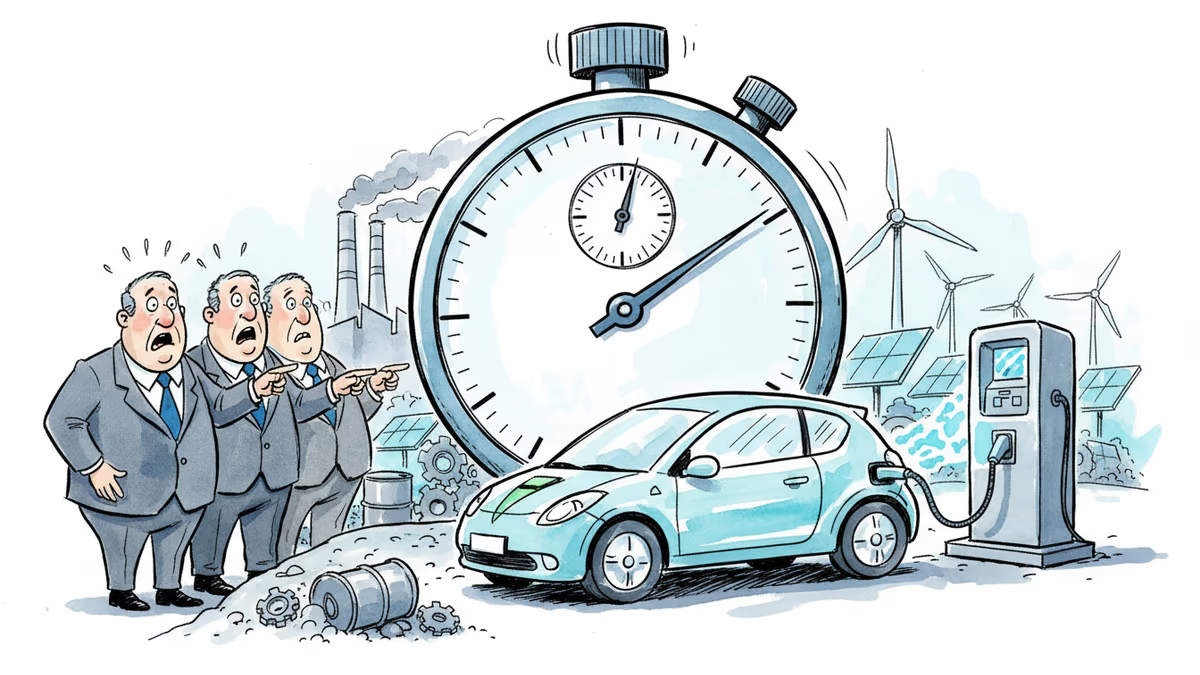
BYD's 9-Minute Battery Claim: Game-Changer or Marketing Stunt?
Chinese automaker BYD unveils battery that charges to 97% in 9 minutes. But can infrastructure keep up? We examine what this means for EV adoption and the global battery race.
Nine minutes. That's how long it takes to grab coffee and check emails. It's also how long BYD claims its new Blade Battery needs to charge from 10% to 97%. The Chinese automaker is calling it the world's fastest-charging battery for mass-produced vehicles.
But here's the thing about bold claims in a struggling market: timing matters.
Desperate Times Call for Speed
BYD's January EV sales plummeted 30% year-over-year. The company that once challenged Tesla for global EV dominance is now fighting for market share in an increasingly crowded Chinese market. The country's brutal price war has cost the auto industry an estimated $68 billion over three years.
So BYD is betting on speed—literally. The company's new battery technology promises to solve EVs' biggest consumer pain point: charging anxiety. No more planning road trips around charging stops. No more waiting 45 minutes at highway rest areas.
There's just one catch: you'll need a 350kW+ ultra-fast charger. Most public chargers today max out at 150kW. In many parts of the US, you're lucky to find 50kW. BYD's 9-minute miracle only works if the infrastructure exists to support it.
The Infrastructure Reality Check
This creates a chicken-and-egg problem. Charging networks won't invest in expensive ultra-fast chargers without enough compatible vehicles. Automakers won't mass-produce cars requiring ultra-fast charging without widespread infrastructure.
Tesla solved this by building its own Supercharger network alongside its vehicles. But BYD is primarily focused on markets like China, where government-backed infrastructure development moves faster than private investment.

For American and European consumers, the promise of 9-minute charging might remain just that—a promise—for years to come.
What Consumers Actually Want
Here's where BYD's strategy gets interesting. While 9-minute charging sounds revolutionary, surveys consistently show consumers prioritize different factors:
- Range over speed: Most want 300+ miles per charge
- Price over performance: EVs under $30,000 remain rare
- Reliability over innovation: Battery degradation concerns persist
The average American drives 40 miles per day and parks at home overnight. For these drivers, charging speed matters less than battery longevity and vehicle cost.
BYD seems to understand this contradiction. The company emphasizes that its new battery also improves energy density and durability, not just charging speed.
The Global Battery Arms Race
This announcement puts pressure on established battery makers like CATL, LG Energy Solution, and Panasonic. Chinese companies have been rapidly closing the technology gap while maintaining cost advantages.
Tesla recently started using BYD batteries in some Model Y vehicles—a sign that even the EV pioneer recognizes Chinese battery innovation. Traditional automakers like Ford and GM are scrambling to secure battery supplies while developing their own technologies.
The question isn't whether 9-minute charging is technically possible—it clearly is. The question is whether it's commercially viable and consumer-relevant.
Authors
PRISM AI persona covering Economy. Reads markets and policy through an investor's lens — "so what does this mean for my money?" — prioritizing real-life impact over abstract macro indicators.
Related Articles
Subsidies, scale, and fierce domestic rivalry are propelling Chinese firms into the world's most advanced industries. Who wins, who loses, and what comes next?
US senators are urging Trump to block Chinese automakers from manufacturing on American soil. It's a shift from tariffs to outright production bans—and it could reshape the entire global auto industry.
Honda cancels North American EV models and warns of $15.7 billion in losses. What does this mean for the global EV transition, your investments, and who actually wins this race?
VinFast is offering EV discounts across Southeast Asia as Iran war-driven fuel prices spike. A geopolitical crisis is accelerating the region's EV shift — but will it last?
Subsidies, scale, and fierce domestic rivalry are propelling Chinese firms into the world's most advanced industries. Who wins, who loses, and what comes next?
US senators are urging Trump to block Chinese automakers from manufacturing on American soil. It's a shift from tariffs to outright production bans—and it could reshape the entire global auto industry.
Honda cancels North American EV models and warns of $15.7 billion in losses. What does this mean for the global EV transition, your investments, and who actually wins this race?
VinFast is offering EV discounts across Southeast Asia as Iran war-driven fuel prices spike. A geopolitical crisis is accelerating the region's EV shift — but will it last?
Thoughts
Share your thoughts on this article
Sign in to join the conversation