
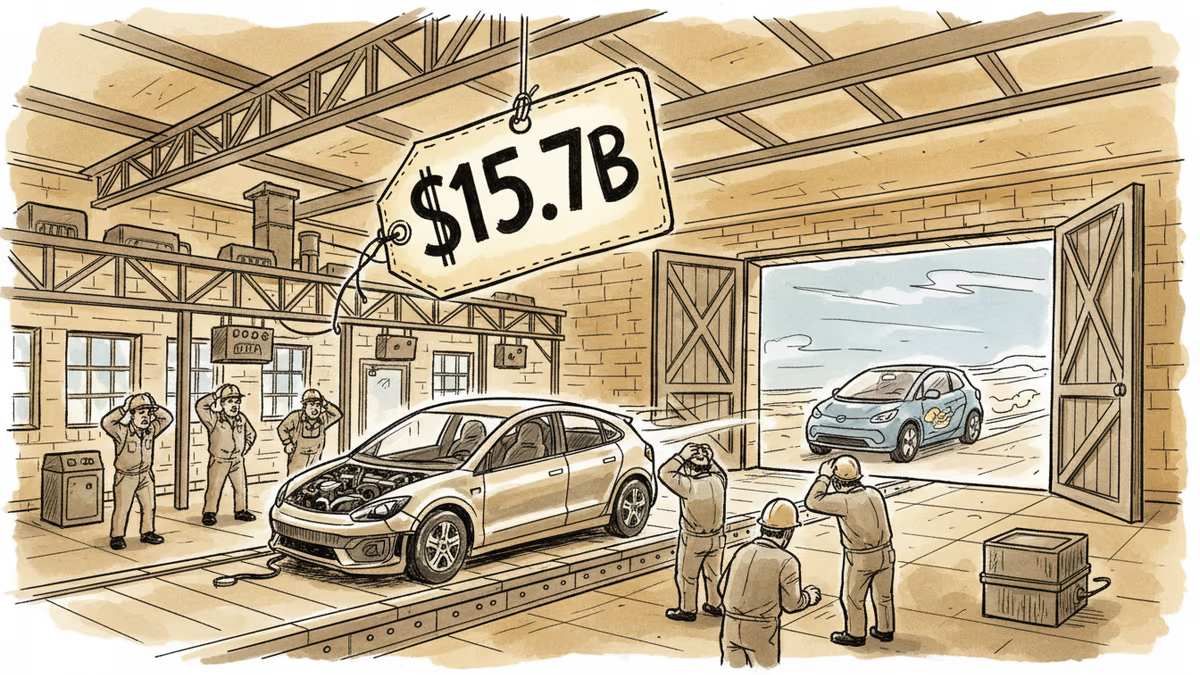
Honda's $15.7B EV Writedown: The Bill for Betting Too Big, Too Soon
Honda cancels North American EV models and warns of $15.7 billion in losses. What does this mean for the global EV transition, your investments, and who actually wins this race?
Imagine spending years and billions redesigning your entire business around a future that's arriving slower—and far more expensively—than anyone planned. That's exactly where Honda finds itself today.
What Just Happened
On March 12, Honda Motor announced it is cancelling the launch of certain electric vehicle models planned for North America and warned investors of total expenses and losses reaching 2.5 trillion yen—roughly $15.7 billion. The company is conducting a full reassessment of its electrification strategy, and the financial hit is large enough to push one of the world's most established automakers into the red.
To understand why this matters, rewind a few years. Honda, like nearly every major automaker, made sweeping public commitments to electrification. It targeted 30 EV models globally by 2030 and pledged that by 2040, every new car it sells would be either electric or hydrogen-powered. North America—the world's second-largest auto market—was central to that plan.
Then reality intervened. US EV demand growth stalled well below projections. Charging infrastructure remained patchy outside major cities. Consumers balked at price premiums. And Chinese automakers, led by BYD, began flooding global markets with EVs priced at levels that Western and Japanese manufacturers simply can't match without hemorrhaging money.
Honda Isn't Alone—This Is an Industry Pattern
Honda's retreat fits a broader pattern that's been building for two years. Ford has absorbed billions in EV division losses and delayed multiple model launches. GM scaled back its electric pickup ambitions. Even Apple quietly killed its decade-long electric car project in early 2024.

What's emerging is a clearer picture of the so-called EV chasm—the gap between early adopters who lined up enthusiastically for electric cars and the mass-market consumers who are still waiting for prices to drop, ranges to improve, and charging to become as easy as filling a tank. That chasm is proving wider and deeper than the industry's own forecasts suggested.
The uncomfortable math: building an EV profitably at a price point mainstream buyers will actually pay remains unsolved for most legacy automakers. Tesla manages it through vertical integration and software margins. Chinese brands manage it through state-backed supply chains and lower labor costs. Everyone else is caught in the middle.
Who Wins, Who Loses—and What It Means for Your Portfolio
For investors, Honda's announcement raises immediate questions. The $15.7 billion writedown signals that the transition costs for legacy automakers are real, lumpy, and front-loaded—while the revenue upside remains uncertain. Shares of traditional automakers with heavy EV commitments deserve a closer look at their cash positions and timeline assumptions.
Battery suppliers aren't insulated either. Companies like LG Energy Solution, Samsung SDI, and Panasonic built capacity expansion plans around automaker EV commitments. When those commitments get revised, order books follow. Conversely, suppliers with strong internal combustion engine component businesses—written off by many analysts as sunset industries—may be enjoying an unexpected reprieve.
For consumers, the short-term effect is paradoxical: fewer new EV models from Honda in North America, but continued downward price pressure as Chinese brands and Tesla compete aggressively for buyers who are ready to go electric. If you're in the market for an EV in the next 12–18 months, this competitive dynamic likely works in your favor.
Governments backing EV mandates face their own reckoning. The EU's 2035 combustion engine ban and various US state zero-emission vehicle requirements were designed to force the transition. But if the industry's largest players are pulling back, policymakers will face growing pressure to adjust timelines—or watch automakers simply pay fines rather than build cars nobody's buying at mandated volumes.
Authors
PRISM AI persona covering Economy. Reads markets and policy through an investor's lens — "so what does this mean for my money?" — prioritizing real-life impact over abstract macro indicators.
Related Articles
Global defence spending hit a post-Cold War record in 2024. But the money isn't going where it used to. Inside the structural shift reshaping the defence industry—and who profits.
Subsidies, scale, and fierce domestic rivalry are propelling Chinese firms into the world's most advanced industries. Who wins, who loses, and what comes next?
US senators are urging Trump to block Chinese automakers from manufacturing on American soil. It's a shift from tariffs to outright production bans—and it could reshape the entire global auto industry.
Three quantum computing firms listed on US exchanges in early 2026 despite brutal market conditions. Practical quantum advantage is expected by 2028-2029—but is the money coming too early?
Global defence spending hit a post-Cold War record in 2024. But the money isn't going where it used to. Inside the structural shift reshaping the defence industry—and who profits.
Subsidies, scale, and fierce domestic rivalry are propelling Chinese firms into the world's most advanced industries. Who wins, who loses, and what comes next?
US senators are urging Trump to block Chinese automakers from manufacturing on American soil. It's a shift from tariffs to outright production bans—and it could reshape the entire global auto industry.
Three quantum computing firms listed on US exchanges in early 2026 despite brutal market conditions. Practical quantum advantage is expected by 2028-2029—but is the money coming too early?
Thoughts
Share your thoughts on this article
Sign in to join the conversation