
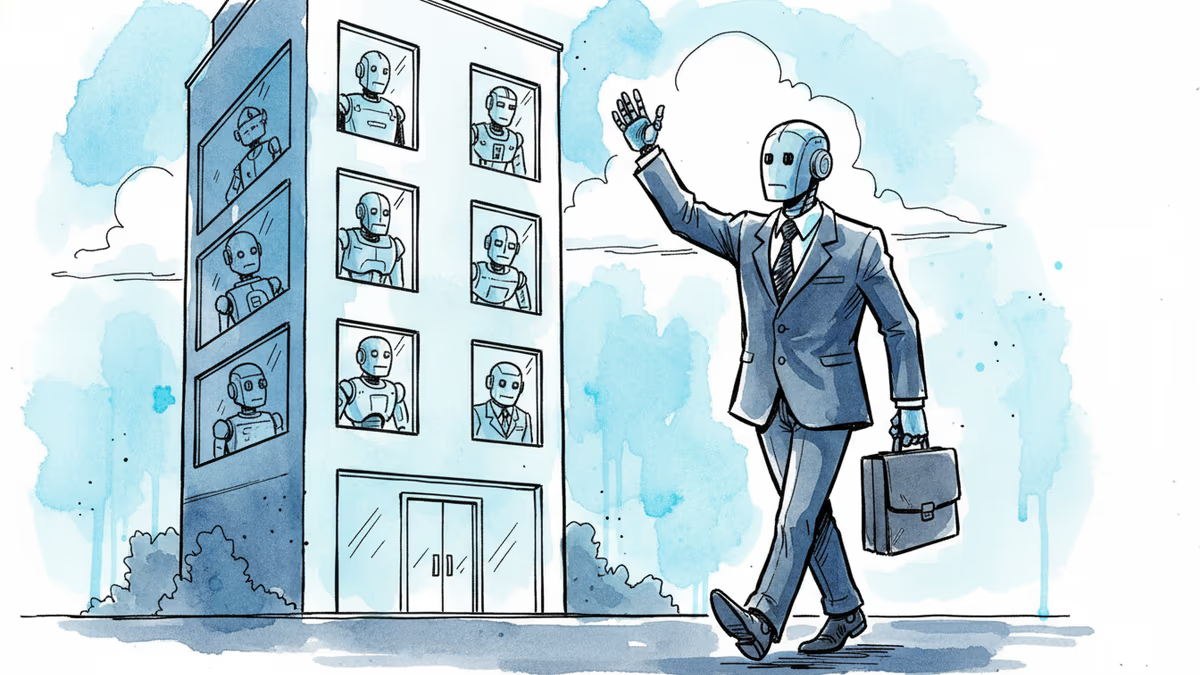
The Robot King Steps Down: What's Next for Boston Dynamics?
Robert Playter's sudden departure as CEO of Boston Dynamics raises questions about the company's future direction amid rapid humanoid robot development and enterprise expansion.
The world's most famous robot company just lost its captain. Robert Playter, CEO of Boston Dynamics, announced his immediate resignation Tuesday, ending a leadership tenure that transformed dancing robots into serious enterprise products.
The timing couldn't be more intriguing. Just days before Playter's announcement, the company released another viral video of its research Atlas robots performing tumbling passes and outdoor runs—the kind of content that's made Boston Dynamics a household name. Meanwhile, enterprise-ready versions of their humanoid robots are finally rolling out to customers.
From Softbank to Hyundai: A Turbulent Journey
Playter inherited a company in transition. When he took the helm, Boston Dynamics was navigating its acquisition from Softbank to Hyundai in 2021—a deal that valued the robotics pioneer at $1.1 billion. Under his watch, the company shifted from viral YouTube stunts to legitimate commercial applications.
The crown jewel of this transformation? The all-electric Atlas humanoid robot launched in 2024. Unlike its hydraulic predecessor that captivated millions with backflips and dance moves, the new Atlas was designed for real work environments. The robot represents a 40% improvement in energy efficiency and can operate for eight hours on a single charge.
At last month's CES, Boston Dynamics announced that Atlas robots would begin enterprise deployments this year, targeting warehouse automation and manufacturing applications. Early customers include major automotive manufacturers and logistics companies, though specific contracts remain under wraps.
The Succession Question

Playter's sudden departure—effective February 27th—leaves industry watchers scrambling for answers. The company hasn't named a successor, unusual for a planned transition. This timing coincides with increased competition in the humanoid robotics space, where companies like Tesla, Figure, and 1X are racing to commercialize their own bipedal workers.
From an investor perspective, leadership stability matters enormously in robotics. Unlike software companies that can pivot quickly, robotics requires years of R&D investment and careful manufacturing partnerships. Hyundai paid premium prices for Boston Dynamics' expertise—any disruption in leadership could slow the integration of robotics into their automotive and mobility ecosystem.
Enterprise customers, meanwhile, are watching closely. Manufacturing companies considering $150,000 Atlas robots for their facilities want assurance that support, updates, and spare parts will remain available. A CEO departure inevitably raises questions about strategic continuity.
The Broader Robotics Race
Playter's exit comes as the humanoid robotics market reaches an inflection point. Goldman Sachs projects the sector will reach $38 billion by 2035, driven by labor shortages and advancing AI capabilities. Boston Dynamics pioneered the technology, but competitors are catching up fast.
Tesla's Optimus robot, while less sophisticated than Atlas, benefits from the company's manufacturing scale and AI infrastructure. Chinese companies like Unitree are producing humanoid robots at a fraction of Boston Dynamics' costs. The question isn't whether humanoid robots will succeed—it's which company will dominate the market.
Cultural perspectives also matter. In Japan and South Korea, humanoid robots are viewed as companions and helpers. Western markets remain more skeptical, focusing on productivity and ROI. Boston Dynamics' new leadership will need to navigate these different expectations while scaling production.
Authors
Related Articles
Eclipse Ventures just raised $1.3B to build an ecosystem of physical AI startups across transportation, energy, robotics, and defense. Here's why the strategy matters more than the money.
A humanoid robot walked the White House red carpet with Melania Trump. It's a preview of an ed-tech vision that could reshape — or fracture — how children learn.
NASA's Swift Observatory is falling out of orbit. A $30M commercial robot mission may save it—and rewrite the rules for space infrastructure maintenance.
At Nvidia's GTC 2026, a rambling Olaf robot had its mic cut mid-demo. The real story isn't the glitch — it's the questions the industry keeps avoiding.
Eclipse Ventures just raised $1.3B to build an ecosystem of physical AI startups across transportation, energy, robotics, and defense. Here's why the strategy matters more than the money.
A humanoid robot walked the White House red carpet with Melania Trump. It's a preview of an ed-tech vision that could reshape — or fracture — how children learn.
NASA's Swift Observatory is falling out of orbit. A $30M commercial robot mission may save it—and rewrite the rules for space infrastructure maintenance.
At Nvidia's GTC 2026, a rambling Olaf robot had its mic cut mid-demo. The real story isn't the glitch — it's the questions the industry keeps avoiding.
Thoughts
Share your thoughts on this article
Sign in to join the conversation