
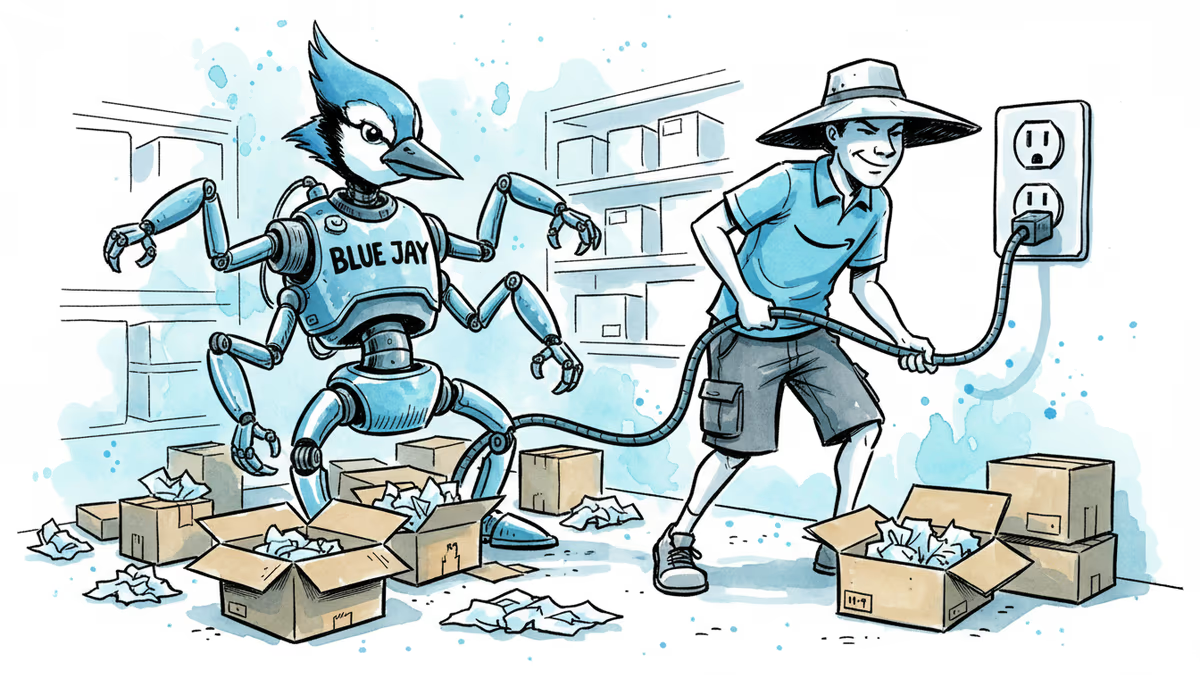
Why Amazon Just Killed Its Blue Jay Robot Project
Amazon operates hundreds of thousands of warehouse robots, but just scrapped Blue Jay months after unveiling it. What does this say about the robotics reality?
The Company with 1 Million Robots Just Gave Up on Its Newest One
Amazon operates more warehouse robots than anyone else on Earth—over 1 million at last count. Yet even the robotics giant isn't immune to failure. The company has quietly shuttered its Blue Jay warehouse robotics project just months after its October debut.
Blue Jay was supposed to be different. This multi-armed robot was designed to sort and move packages in same-day delivery facilities, and Amazon claimed it took only one year to develop—significantly faster than previous warehouse robots, thanks to AI breakthroughs.
But speed, it turns out, doesn't guarantee success.
The "Prototype" Defense That Came Too Late
Amazon spokesperson Terrence Clark now says Blue Jay was "launched as a prototype"—a detail conspicuously absent from the company's original press release. The company plans to salvage Blue Jay's core technology for other robotics "manipulation programs," with team members reassigned to different projects.
"We're always experimenting with new ways to improve the customer experience," Clark told TechCrunch. "In this case, we're actually accelerating the use of the underlying technology developed for Blue Jay."

It's corporate speak for "we're making the best of a bad situation."
What Vulcan Got Right That Blue Jay Got Wrong
Interestingly, Amazon's other recent robot—Vulcan—continues operating successfully. Vulcan is a two-armed robot that can "feel" objects it touches, trained on real-world interaction data. One arm rearranges items while the other, equipped with cameras and suction cups, grabs goods.
The difference? Vulcan appears to have solved specific, well-defined problems. Blue Jay seemed designed to do everything.
The Broader Robotics Reality Check
This isn't just an Amazon story—it's a robotics industry wake-up call. Despite $7.4 billion in robotics investments last year, many projects still fail to transition from lab to warehouse floor.
Amazon's robotics journey began in 2012 with its $775 million acquisition of Kiva Systems. That warehouse automation technology became the foundation of Amazon's fulfillment operations. But even with over a decade of experience and unlimited resources, not every bet pays off.
For competitors like Walmart, Target, and logistics startups, Amazon's stumble offers both warning and opportunity. The robotics race isn't just about having the most advanced technology—it's about having technology that actually works at scale.
Authors
Related Articles
Amazon has poured an additional $5 billion into Anthropic, bringing its total stake to $13 billion—with up to $20 billion more on the table. Here's what the deal really signals about the AI infrastructure race.
Amazon's fresh $5B investment in Anthropic brings its total to $13B. But the real story is a $100B AWS spending pledge and a bet on Amazon's own AI chips over Nvidia.

Eclipse Ventures just raised $1.3B to build an ecosystem of physical AI startups across transportation, energy, robotics, and defense. Here's why the strategy matters more than the money.
Amazon is in talks to acquire Globalstar, the satellite telecom firm that powers Apple's emergency SOS feature. A 20% Apple stake is complicating everything — and the stakes go beyond one deal.
Amazon has poured an additional $5 billion into Anthropic, bringing its total stake to $13 billion—with up to $20 billion more on the table. Here's what the deal really signals about the AI infrastructure race.
Amazon's fresh $5B investment in Anthropic brings its total to $13B. But the real story is a $100B AWS spending pledge and a bet on Amazon's own AI chips over Nvidia.
Eclipse Ventures just raised $1.3B to build an ecosystem of physical AI startups across transportation, energy, robotics, and defense. Here's why the strategy matters more than the money.
Amazon is in talks to acquire Globalstar, the satellite telecom firm that powers Apple's emergency SOS feature. A 20% Apple stake is complicating everything — and the stakes go beyond one deal.
Thoughts
Share your thoughts on this article
Sign in to join the conversation