
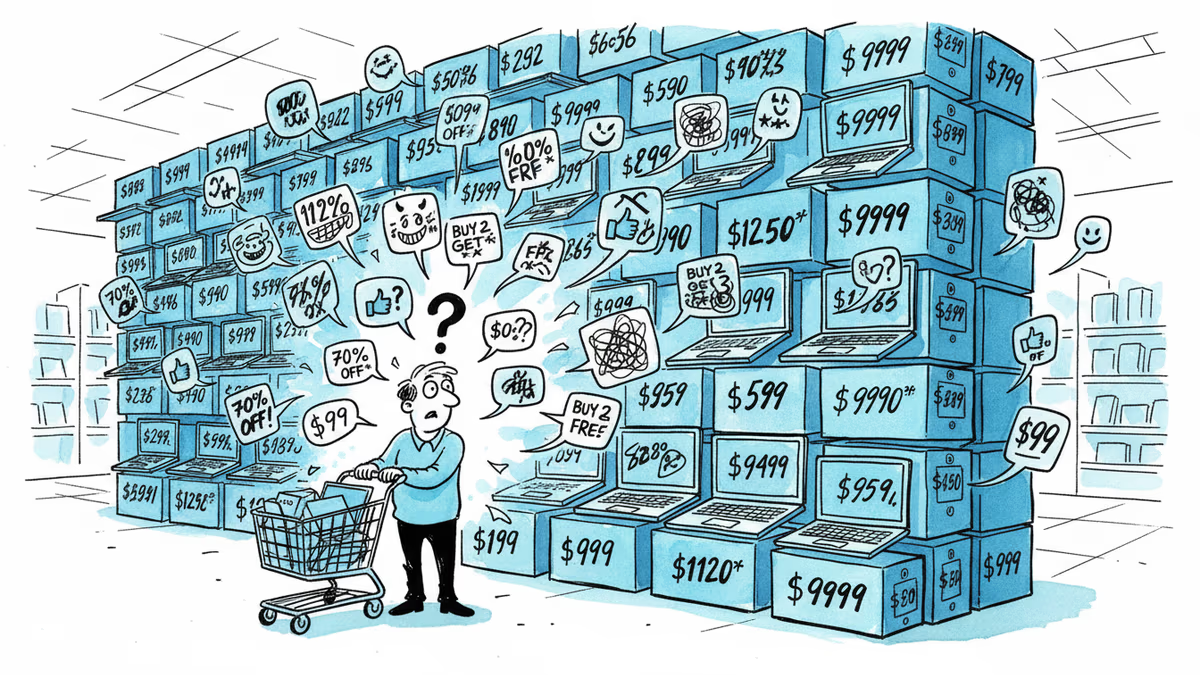
Why Amazon's Laptop Search Results Are Broken
Analysis of why Amazon's top laptop search results feature products experts would never recommend, and what consumers should buy instead.
24 Out of 40 Laptops Shouldn't Exist
Type "best laptop" into Google, and Amazon's results dominate the top spots. But here's the problem: most laptops on page one are machines no expert would recommend. We're talking about 4-year-old models with typos in their titles earning "Amazon's Choice" badges, and mystery brands masquerading as gaming powerhouses.
The real frustration isn't just poor quality—it's that better alternatives exist at identical price points, yet Amazon's algorithm buries them.
The Ultra-Cheap Windows Trap
Amazon's first page floods users with sub-$300 Windows laptops sporting seemingly decent specs like "Quad-Core processors" and "256GB storage." Don't be fooled.
Take this HP laptop: despite a glaring "Ultral Light" typo in the title, it's marked as "Amazon's Choice" with four stars. The 192GB storage claim? That's 64GB of actual storage plus a bundled 128GB SD card. Worse, it uses eMMC storage—significantly slower than proper SSDs.
The Intel Celeron processor can't handle Windows 11 smoothly, and the 1366 x 768 screen resolution is unacceptable in 2026. Period.
Better choice: The Asus Chromebook CX15 costs about the same but delivers a 1080p screen and proper 128GB SSD. Need Windows? The Acer Aspire Go 15 offers 1080p, 256GB SSD, and full Windows 11 Home.
Outdated Gaming Laptops at Premium Prices

The Acer Nitro V appears near the bottom at $950, boasting a 165Hz display, 16GB RAM, and 1TB storage. But the RTX 4050 graphics card is woefully underpowered for 2026 gaming.
Here's the kicker: you can get a newer Acer Nitro V with RTX 5050 for $750. Or better yet, the Lenovo LOQ 15 with RTX 5060 for $970. Storage can be upgraded later—graphics cards cannot.
Mystery Brands Masquerading as Legitimate Options
When the brand name isn't even in the product title, you know there's trouble. Ever heard of Jumper or Nimo? Neither have most consumers, yet Amazon promotes these unknown manufacturers alongside established brands.
Nimo particularly egregious, marketing $600 laptops as "gaming" devices despite lacking discrete graphics cards. They're exploiting the fact that you can't buy a worthwhile gaming laptop at that price point.
Platform Comparison: Best Buy Gets It Right
Walmart performs even worse than Amazon. Out of 40 first-page results, 24 come from mystery brands like "RNRUO" and "Coolby." It's a consumer nightmare.
Best Buy offers a stark contrast. Search results feature legitimate options: Dell 14 Plus, MacBook Pro, Zenbook S 14, and Lenovo Legion 7i. While some older HP models still appear, the overall quality is dramatically better.
The Economic Reality Behind the Chaos
As laptop prices rise in 2026 due to ongoing memory shortages and economic pressures, budget options become increasingly important. Yet major retailers are failing consumers when they need guidance most.
Consumer advocates argue that search algorithms prioritize short-term profits over long-term customer satisfaction. Tech reviewers express frustration that their recommendations get buried beneath sponsored listings. Budget-conscious shoppers find themselves trapped between overpriced flagships and unusable ultra-budget machines.
Authors
Related Articles

Amazon has poured an additional $5 billion into Anthropic, bringing its total stake to $13 billion—with up to $20 billion more on the table. Here's what the deal really signals about the AI infrastructure race.
Amazon's fresh $5B investment in Anthropic brings its total to $13B. But the real story is a $100B AWS spending pledge and a bet on Amazon's own AI chips over Nvidia.
Amazon is in talks to acquire Globalstar, the satellite telecom firm that powers Apple's emergency SOS feature. A 20% Apple stake is complicating everything — and the stakes go beyond one deal.
Amazon's Big Spring Sale runs through March 31st with record-low prices on robot vacuums, headphones, and smart home gear — but the real story is why it's happening now.
Amazon has poured an additional $5 billion into Anthropic, bringing its total stake to $13 billion—with up to $20 billion more on the table. Here's what the deal really signals about the AI infrastructure race.
Amazon's fresh $5B investment in Anthropic brings its total to $13B. But the real story is a $100B AWS spending pledge and a bet on Amazon's own AI chips over Nvidia.
Amazon is in talks to acquire Globalstar, the satellite telecom firm that powers Apple's emergency SOS feature. A 20% Apple stake is complicating everything — and the stakes go beyond one deal.
Amazon's Big Spring Sale runs through March 31st with record-low prices on robot vacuums, headphones, and smart home gear — but the real story is why it's happening now.
Thoughts
Share your thoughts on this article
Sign in to join the conversation