
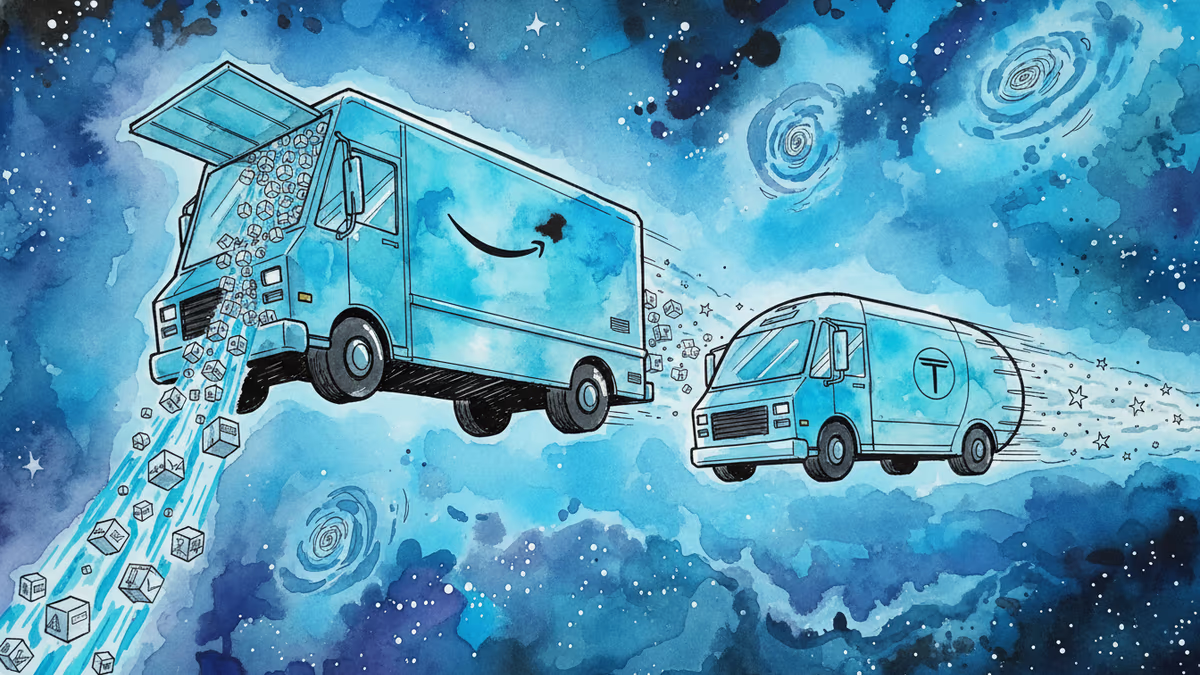
Amazon Just Put 32 Satellites in Orbit—Is This the End of Starlink's Dominance?
Europe's Ariane 6 rocket successfully launched Amazon's largest satellite batch yet. As Project Kuiper takes shape, the space internet market is about to get more competitive.
32 satellites in a single launch. That's what Amazon just achieved with Europe's Ariane 6 rocket, marking the largest deployment yet for Project Kuiper. But this isn't just another satellite launch—it's a declaration that the space internet monopoly is about to face serious competition.
The Starlink Stranglehold Loosens
Elon Musk's Starlink has dominated the satellite internet game with over 5,000 active satellites and 3 million subscribers worldwide. The service has become synonymous with space-based internet, especially in remote areas and conflict zones like Ukraine. But Amazon's aggressive push changes the equation entirely.
This launch represents a massive scale-up from Amazon's modest two-satellite test mission last year. With plans to deploy 3,236 satellites by 2029, and an FCC mandate to have half operational by 2027, Amazon is moving from prototype to production mode. The $10 billion investment suddenly looks less like a moonshot and more like a calculated assault on Musk's space empire.
Europe's Space Comeback Story
The choice of launch vehicle tells its own story. Ariane 6 represents Europe's attempt to reclaim relevance in the commercial launch market after years of watching SpaceX dominate. This "Ariane 64" configuration—using all four solid rocket boosters—generated over 3.4 million pounds of thrust, successfully delivering all 32 satellites to their target 289-mile orbit.
For the European Space Agency, landing Amazon as a customer is validation that their new rocket can compete with SpaceX's Falcon 9. It's also a geopolitical statement: Europe doesn't want to depend entirely on American launch capabilities for critical infrastructure.

What This Means for Consumers
More competition typically means better prices and service. Starlink currently charges around $120 per month in the US, with equipment costs of $599. Amazon hasn't announced Kuiper pricing yet, but the company's history suggests they'll undercut competitors to gain market share—just like they did with AWS cloud services.
The implications go beyond pricing. Amazon's integration across services could create powerful bundles: imagine Prime membership including satellite internet, or seamless connectivity between your home Wi-Fi and satellite backup. For rural Americans still struggling with broadband access, this could be transformative.
The Regulatory Wild Card
But there's a catch. As thousands more satellites crowd low-Earth orbit, regulators are getting nervous about space debris, light pollution, and orbital traffic management. The Federal Aviation Administration and FCC are already tightening oversight. Amazon's success might trigger stricter rules that could slow the entire industry.
Then there's the national security angle. Both Starlink and Kuiper will handle sensitive communications for government and military customers. Having multiple American-controlled networks might seem redundant, but it also provides strategic redundancy that defense planners value.
The Investment Angle
Wall Street is watching closely. Amazon's stock barely moved on the launch news—the market seems to view this as a long-term play rather than an immediate revenue driver. But if Kuiper can capture even 20% of the satellite internet market by 2030, it could generate billions in annual revenue.
For investors, the question isn't whether satellite internet will grow—it's whether Amazon can execute at scale while managing the massive capital requirements. SpaceX has the advantage of controlling both the satellites and the launch vehicles. Amazon relies on partners like Arianespace, which could create supply chain vulnerabilities.
Authors
Related Articles
American Airlines just signed Starlink for 500+ aircraft. It's not just about faster inflight internet — it's a calculated move in the run-up to what could be the largest IPO in history.

Amazon has poured an additional $5 billion into Anthropic, bringing its total stake to $13 billion—with up to $20 billion more on the table. Here's what the deal really signals about the AI infrastructure race.
Amazon's fresh $5B investment in Anthropic brings its total to $13B. But the real story is a $100B AWS spending pledge and a bet on Amazon's own AI chips over Nvidia.
Blue Origin's New Glenn is set to refly a used booster, directly challenging SpaceX's grip on orbital launch. If it works, a three-way satellite internet race begins—and your 'No Service' problem gets a lot more interesting.
American Airlines just signed Starlink for 500+ aircraft. It's not just about faster inflight internet — it's a calculated move in the run-up to what could be the largest IPO in history.
Amazon has poured an additional $5 billion into Anthropic, bringing its total stake to $13 billion—with up to $20 billion more on the table. Here's what the deal really signals about the AI infrastructure race.
Amazon's fresh $5B investment in Anthropic brings its total to $13B. But the real story is a $100B AWS spending pledge and a bet on Amazon's own AI chips over Nvidia.
Blue Origin's New Glenn is set to refly a used booster, directly challenging SpaceX's grip on orbital launch. If it works, a three-way satellite internet race begins—and your 'No Service' problem gets a lot more interesting.
Thoughts
Share your thoughts on this article
Sign in to join the conversation