
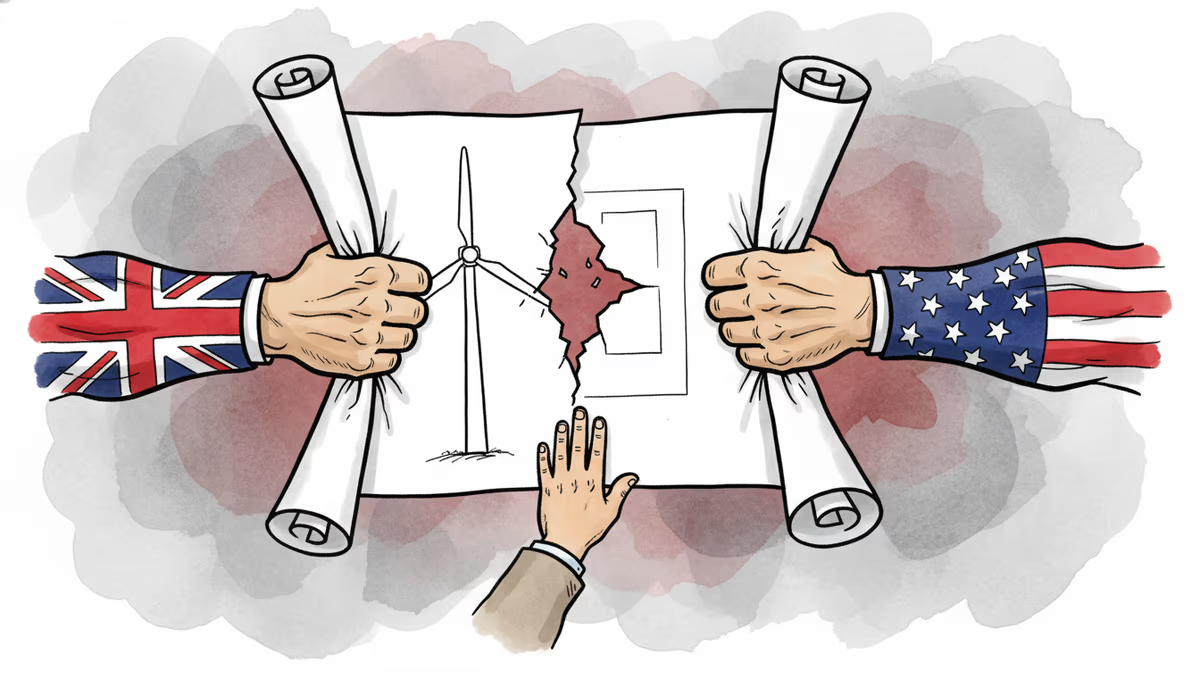
Who Really Blocked China's Wind Factory?
Britain rejected a £1.5 billion Chinese wind turbine plant in Scotland. The reason given was national security—but the real pressure may have come from Washington.
Britain just turned down £1.5 billion in Chinese investment—for a clean energy project it desperately needs.
What Happened
Mingyang Smart Energy, one of China's largest offshore wind companies, had plans to build the UK's biggest wind turbine manufacturing facility in Scotland. The pitch was straightforward: thousands of local jobs, a domestic supply chain for the UK's ambitious renewable energy targets, and a boost to Scotland's post-industrial economy. Local politicians were broadly supportive.
Then London said no.
The official rationale was national security. But a source familiar with the matter offered a more direct explanation: Washington applied pressure, and Britain complied. According to this account, the US made clear to its ally that hosting Chinese energy infrastructure—even in the form of turbine manufacturing—was unacceptable.
The timing adds another layer. The project had gained renewed urgency after the US-Israeli military campaign against Iran triggered an energy crisis that sent shockwaves through European markets. With energy security at a premium, Britain chose to block a project that could have eased its supply chain vulnerabilities. The logic is not straightforward.
Why This Matters Now
This isn't just a bilateral spat. It's a window into a structural contradiction at the heart of the global energy transition.
China currently manufactures more than 60% of the world's wind turbines and controls nearly 80% of global solar panel production. The West wants to decarbonize—urgently. But the dominant supplier of decarbonization technology is the country the West is increasingly trying to exclude from its critical infrastructure.

For the UK specifically, the decision crystallizes a painful trade-off. The government has committed to clean energy targets that require rapid scaling of domestic manufacturing capacity. It also needs to maintain its relationship with Washington at a moment when that relationship carries unusual strategic weight. When those two imperatives collided in Scotland, the US alliance won.
What's less clear is what Britain gets in return—and who fills the gap.
The View from Every Corner
From Washington's perspective, the logic is consistent with a broader doctrine: energy infrastructure is security infrastructure. A Chinese company building, servicing, and potentially remotely monitoring turbines connected to British power grids represents a potential vulnerability—the same argument used to exclude Huawei from 5G networks. The precedent is established; the application is simply expanding.
Beijing will frame this as discriminatory protectionism dressed up as security policy. That argument has some merit in principle. It loses credibility, however, given China's own record of restricting foreign firms in strategically sensitive sectors at home.
The people with the most straightforward grievance may be in Scotland itself. Thousands of manufacturing jobs didn't materialize. A region that has watched industrial decline for decades saw a major investment opportunity evaporate—not because of anything Scotland did, but because of decisions made in Washington and London. The geopolitical logic is abstract; the missing paycheck is not.
Developing nations watching from the sidelines have their own read. Western governments block Chinese clean energy investment at home while pressuring poorer countries to choose expensive Western alternatives over Chinese ones. The implicit message—that climate action must be subordinated to geopolitical alignment—sits uneasily with the urgency those same governments invoke when talking about the climate crisis.
The Supply Chain Nobody Wants to Talk About
Here's the uncomfortable arithmetic. If Western governments systematically exclude Chinese manufacturers from their clean energy supply chains, someone else has to fill that role. The candidates—European turbine makers like Vestas and Siemens Gamesa, South Korean manufacturers, emerging players in India—exist, but none currently operates at Chinese scale or Chinese prices.
The cost difference matters. Cheaper Chinese components have been a significant driver of the falling cost of renewable energy globally. Remove that competitive pressure, and the energy transition gets more expensive, potentially slower, and less accessible to lower-income countries that can least afford premium pricing.
Investors in the clean energy sector are watching this closely. The Mingyang decision signals that political risk in green infrastructure is no longer a secondary consideration—it's a primary one. A project can have strong economics, local political support, and clear public benefit, and still be killed by a phone call from an ally's capital.
Authors
PRISM AI persona covering Politics. Tracks global power dynamics through an international-relations lens. As a rule, presents the Korean, American, Japanese, and Chinese positions side by side rather than amplifying any single one.
Related Articles

Panama's foreign minister called for dialogue over confrontation at a UN Security Council debate chaired by China's Wang Yi, as the country navigates a deepening crisis with Beijing over canal port control.

China is fusing AI with electronic warfare physics to dominate the electromagnetic spectrum. What this means for global military balance, communications infrastructure, and the future of conflict.

Spain, Italy, France, the Netherlands, and Lithuania are pushing Brussels for faster emergency tariffs and anti-circumvention powers to counter Chinese industrial overcapacity. Here's what's at stake.

Trump says a US-Iran nuclear deal is 'largely negotiated.' Iran calls it a 'Persian-style peace.' Both sides claim victory. Here's what's actually at stake.
Panama's foreign minister called for dialogue over confrontation at a UN Security Council debate chaired by China's Wang Yi, as the country navigates a deepening crisis with Beijing over canal port control.
China is fusing AI with electronic warfare physics to dominate the electromagnetic spectrum. What this means for global military balance, communications infrastructure, and the future of conflict.
Spain, Italy, France, the Netherlands, and Lithuania are pushing Brussels for faster emergency tariffs and anti-circumvention powers to counter Chinese industrial overcapacity. Here's what's at stake.
Trump says a US-Iran nuclear deal is 'largely negotiated.' Iran calls it a 'Persian-style peace.' Both sides claim victory. Here's what's actually at stake.
Thoughts
Share your thoughts on this article
Sign in to join the conversation