

Dead Black Hole Suddenly Wakes Up, Gets 50 Times Brighter
A black hole discovered in 2018 has defied expectations by reactivating after three years and continuing to brighten. Scientists predict it won't peak until 2027, raising new questions about cosmic physics.
What happens when something you thought was dead in space suddenly comes back to life 50 times brighter? That's exactly what black hole AT2018hyz, first spotted in 2018, is doing right now.
The Zombie Black Hole That Won't Stay Dead
Back in 2022, astronomers witnessed something bizarre. A tidal disruption event (TDE) that had faded three years earlier suddenly reanimated, burping out extremely bright radio waves. University of Oregon astrophysicist Yvette Cendes, who dubbed it "Jetty McJetface," probably didn't expect it to become this famous.
But instead of fading again, this black hole has grown 50 times brighter—and it's still getting brighter. According to new research published in the Astrophysical Journal, the energy emission might not peak until 2027. That's like a firework that keeps exploding for years.
Black Holes Aren't Cosmic Vacuum Cleaners
Contrary to popular belief, black holes don't behave like cosmic vacuum cleaners, ravenously sucking up everything around them. Only matter that crosses the event horizon—that point of no return—gets permanently swallowed. Even light can't escape once it's past that boundary.

Here's the twist: black holes are messy eaters. During the feeding process, they actually eject part of the matter in powerful jets. Think of it like a cosmic food fight where some of the meal gets thrown back out into space.
When Science Gets Surprised
The AT2018hyz phenomenon is challenging everything astronomers thought they knew about tidal disruption events. These were supposed to be one-time shows—a star gets too close to a black hole, gets ripped apart, creates a brief light display, and that's it. Case closed.
But this "zombie" black hole decided to write its own script. After three years of apparent dormancy, it's back with a vengeance and shows no signs of stopping. This suggests that the physics around black holes might be far more complex and unpredictable than current models suggest.
The Bigger Picture: Cosmic Humility
This isn't just about one unusual black hole. It's about how much we still don't understand about the universe. Every time we think we've figured out a cosmic phenomenon, nature throws us a curveball. The fact that we can monitor this black hole in real-time, watching it defy our expectations, represents both the power and limitations of modern astronomy.
The discovery also highlights how space-based observations and improved monitoring techniques are revealing behaviors that previous generations of astronomers never could have detected. We're not just seeing more of the universe—we're seeing it behave in ways we never imagined.
Authors
Related Articles
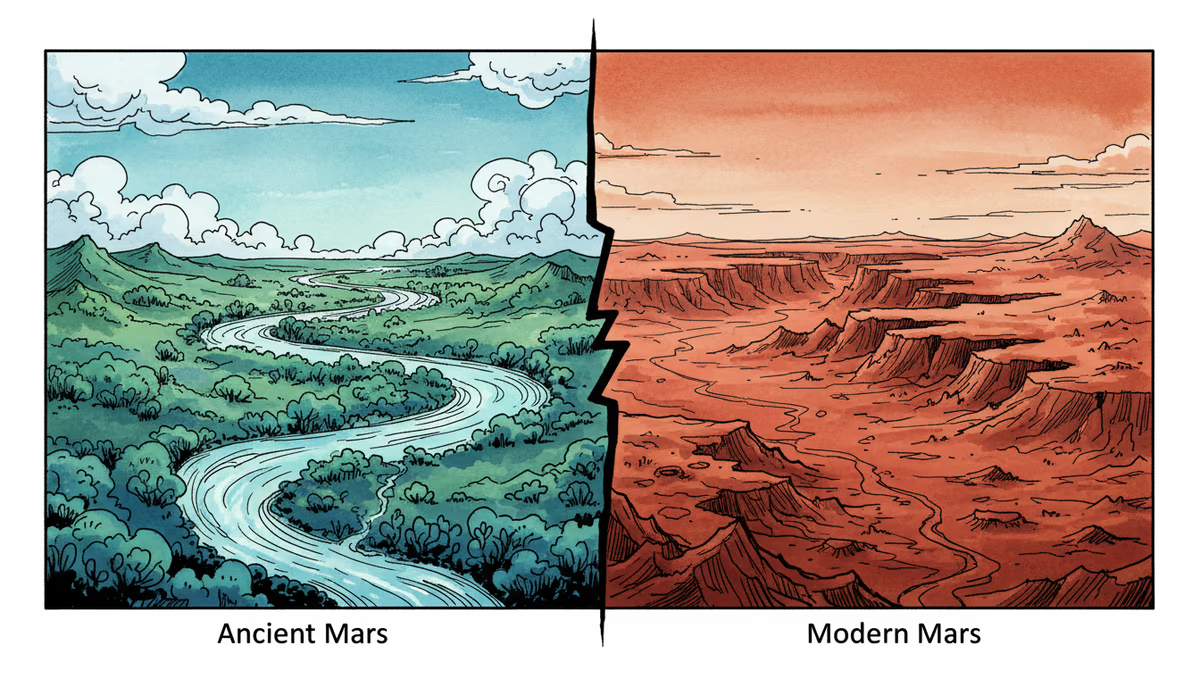
New research reveals Mars was warm and wet during the Noachian epoch, challenging cold-and-icy theories and reigniting debates about ancient Martian life possibilities.

NASA's 2026 fiscal year budget faced a 50% cut proposal from the White House, but Congress intervened to save key science missions from being shut down.

Five stories from late September, traced to where the paper trail stops: Korea's export record, Nvidia's Hugging Face 8-K, a US-China AI channel, the UN on AI, and rising births.

Huawei's CANN is open source under a license barring software for non-Ascend chips. Inside China's second CUDA, and the two links still outside it: pre-training compute and 5nm capacity.
New research reveals Mars was warm and wet during the Noachian epoch, challenging cold-and-icy theories and reigniting debates about ancient Martian life possibilities.
NASA's 2026 fiscal year budget faced a 50% cut proposal from the White House, but Congress intervened to save key science missions from being shut down.
Five stories from late September, traced to where the paper trail stops: Korea's export record, Nvidia's Hugging Face 8-K, a US-China AI channel, the UN on AI, and rising births.
Huawei's CANN is open source under a license barring software for non-Ascend chips. Inside China's second CUDA, and the two links still outside it: pre-training compute and 5nm capacity.
Thoughts
Share your thoughts on this article
Sign in to join the conversation