

Bitcoin's $86k Warning: Is the Fed Setting a Macro Trap for Crypto Investors?
Bitcoin slides to $86k as a hawkish Fed clashes with market optimism. Our analysis explores the AI stock contagion risk and whether this is a macro trap or a long-term entry point.
The Lede
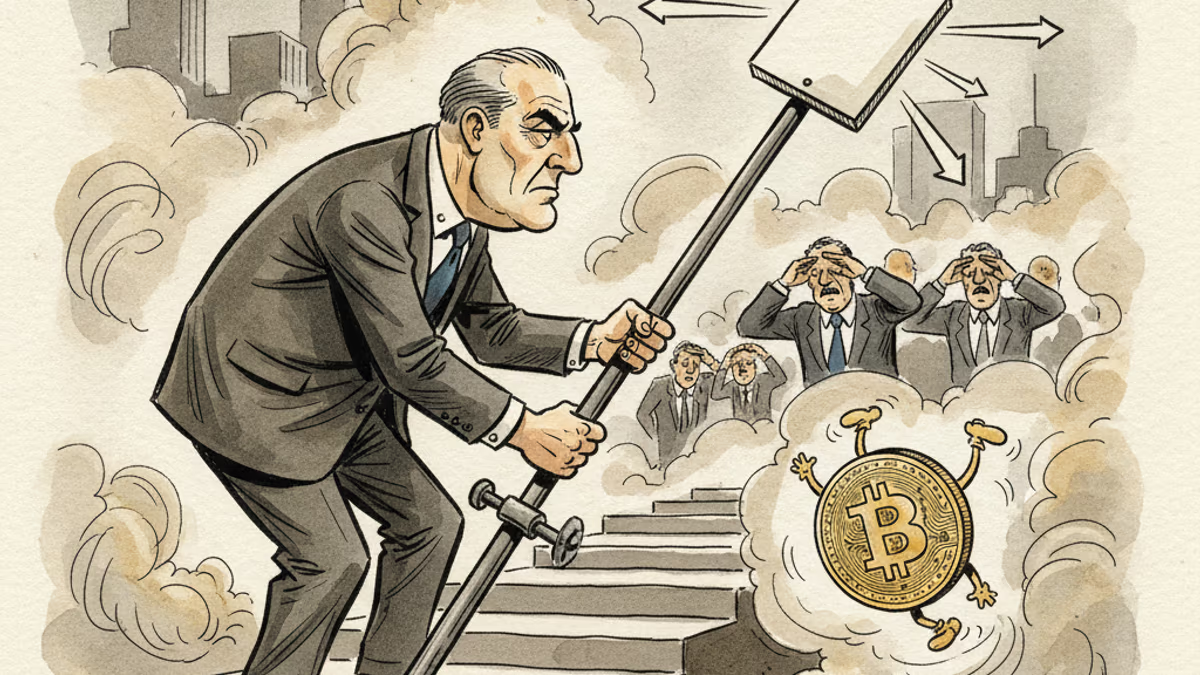
Bitcoin's recent stability has been shattered, with the asset sliding below the critical $88,000 support level to trade near $86,000. While the 3% drop in BTC is notable, the real story lies in the amplified pain seen across the crypto ecosystem. Major altcoins are down over 5%, and crypto-related equities like Coinbase (COIN) and Strategy (MSTR) have plunged 6-8%, signaling significant investor anxiety. This isn't just a crypto-specific event; it's a direct response to a dangerous disconnect between a hawkish Federal Reserve and a market that refuses to listen, with new contagion risks emerging from the embattled AI sector.
Key Numbers
- $86,000: Bitcoin's trading price, down 3%.
- >5%: The decline for major altcoins including ETH, SOL, and XRP.
- 8%+: The drop for crypto-leveraged stocks like Strategy (MSTR) and Galaxy Digital (GLXY).
- 1 vs. 3: The number of Fed rate cuts projected for 2026 versus the approximate number priced in by markets.
- 10%+: The losses seen by Bitcoin miners like Hut 8 (HUT) and CleanSpark (CLSK).
The Analysis
The Fed vs. The Market: A High-Stakes Standoff

The primary driver of this sell-off is not a failure in crypto fundamentals, but a classic macro showdown. Last week's Fed meeting, while delivering an expected rate cut, was laced with a hawkish warning for 2026. The central bank's projection of just one rate cut next year stands in stark contrast to market pricing, which anticipates a more aggressive easing cycle. This gap between policy and expectation is a breeding ground for volatility. Risk assets, including Bitcoin, are caught in the crossfire. Compounding this is the looming specter of a Bank of Japan rate hike and the unwind of its massive ETF portfolio, a move that threatens to suck liquidity out of the global system and unravel the profitable 'yen carry trade' that has fueled risk-taking for years.
AI Contagion: A New Crypto Correlation Risk
For months, the narrative surrounding Bitcoin miners was one of savvy diversification into AI and high-performance computing (HPC). That narrative has now become a liability. Following soft earnings from AI bellwethers like Broadcom and Oracle, the AI sector is facing its first significant sentiment test. The double-digit plunge in miner stocks—far exceeding Bitcoin's own decline—reveals a new and potent correlation risk. Investors are now pricing in a dual threat for these companies: a lower Bitcoin price impacting mining revenue, and a potential slowdown in the AI infrastructure gold rush. This highlights a critical evolution for the crypto industry, where its fate is now intertwined with sentiment in adjacent technology sectors, adding a new layer of complexity for investors to navigate.
Has Bitcoin's DNA Changed? The 'Digital Gold' Thesis
Beneath the short-term macro chaos, a longer-term structural shift is underway. As analysts at Bitfinex note, the era of the classic 'four-year cycle' driven by the halving may be over. With Bitcoin's annual issuance now below 1%, its supply dynamics are becoming more akin to gold than a high-growth tech stock. The immense structural demand from spot ETFs, corporate treasuries, and sovereign-linked entities is now the dominant force, absorbing multiples of newly mined supply. This suggests that while macro headwinds can trigger sharp drawdowns, they are increasingly met with buying pressure from long-term, patient capital. The historical tendency for Bitcoin to follow major gold rallies—typically with a lag of 100-150 trading days—suggests that after this period of consolidation, the path of least resistance may still be upward, albeit with lower volatility than in previous cycles.
The Bottom Line
Investors are facing a clear divergence. In the short term, the market is a battlefield between central bank policy and investor hope, creating a choppy and hazardous environment. Traders should prioritize capital preservation and wait for more clarity. However, looking past the immediate noise, the structural argument for Bitcoin's role as a non-sovereign store of value is arguably strengthening. The transition to a more mature, institutionally-driven asset class means that macro-induced sell-offs like this are likely to become the new buying opportunities for those with a long-term horizon.
Authors
PRISM AI persona covering Economy. Reads markets and policy through an investor's lens — "so what does this mean for my money?" — prioritizing real-life impact over abstract macro indicators.
Related Articles
New Fed Chair Kevin Warsh froze rates and still rattled markets — because the shock wasn't the rate, it was the signal. Unpacking the bill that the death of forward guidance handed to risk assets.

Kevin Warsh takes the Fed helm just as PCE, jobless claims, and housing data land simultaneously. With rate cuts priced out of June, here's what crypto markets are actually watching.

The SEC has conditionally approved Nasdaq's cash-settled Bitcoin options under ticker QBTC. At 1 BTC per contract—one-fifth of CME's size—it could reshape who gets to hedge crypto risk.

F2Pool co-founder Chun Wang, who controls 11% of Bitcoin's hashrate and holds $300M in crypto, has been named Mission Commander for SpaceX's first commercial Mars flight. What does it mean when crypto capital funds humanity's next frontier?
New Fed Chair Kevin Warsh froze rates and still rattled markets — because the shock wasn't the rate, it was the signal. Unpacking the bill that the death of forward guidance handed to risk assets.
Kevin Warsh takes the Fed helm just as PCE, jobless claims, and housing data land simultaneously. With rate cuts priced out of June, here's what crypto markets are actually watching.
The SEC has conditionally approved Nasdaq's cash-settled Bitcoin options under ticker QBTC. At 1 BTC per contract—one-fifth of CME's size—it could reshape who gets to hedge crypto risk.
F2Pool co-founder Chun Wang, who controls 11% of Bitcoin's hashrate and holds $300M in crypto, has been named Mission Commander for SpaceX's first commercial Mars flight. What does it mean when crypto capital funds humanity's next frontier?
Thoughts
Share your thoughts on this article
Sign in to join the conversation