
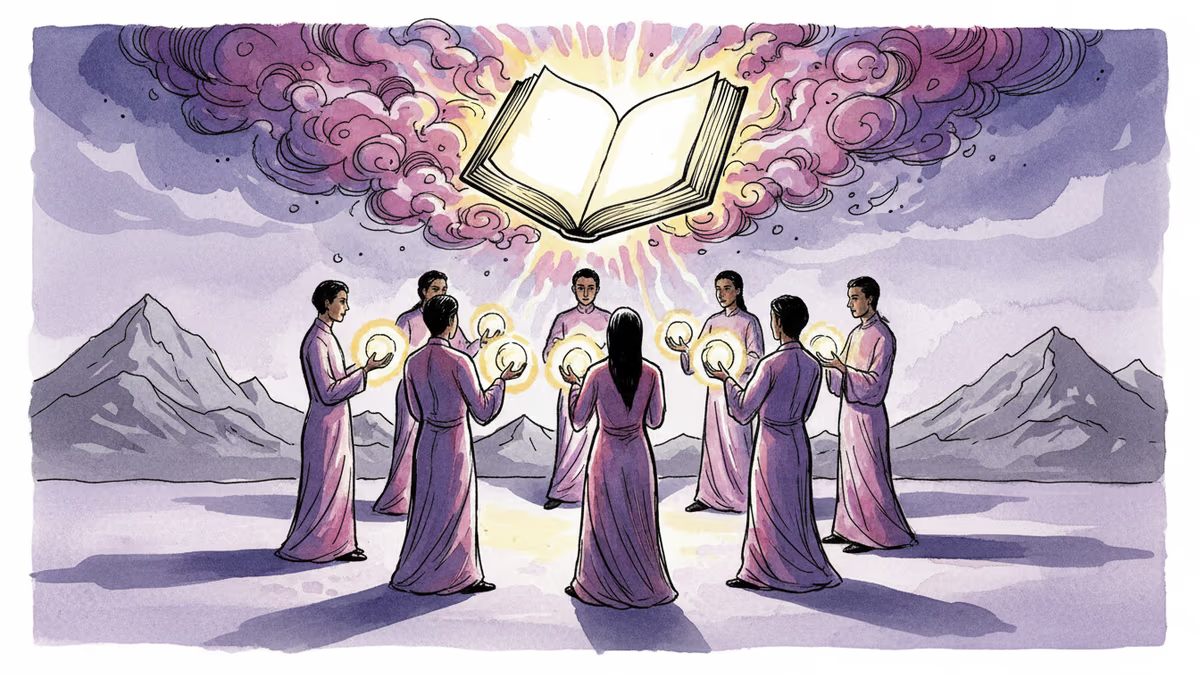
Billlie's First Full Album Is a Rare Thing in K-Pop: A Story With an Ending
Billlie announces their first full-length album 'the collective soul and unconscious: chapter two' dropping May 6. What does it mean when a K-pop group actually finishes what it started?
In an industry built on perpetual motion, finishing a story is almost a radical act.
On April 15 KST, Billlie officially announced the release of their first full-length album, 'the collective soul and unconscious: chapter two,' set to drop on May 6 at 6 p.m. KST. Accompanying the announcement were teaser visuals that fans and observers noted carry the atmospheric weight of the group's earlier work—darker, more layered, and unmistakably intentional.
What's Actually Being Released—And Why It Matters
This isn't just a comeback. It's the second half of something Billlie started back in 2022.
Their mini album 'the collective soul and unconscious: chapter one' introduced a conceptual framework rooted in Carl Jung's theory of the collective unconscious—the idea that human beings share a deep layer of psychological experience beneath individual identity. For a K-pop group to anchor its entire artistic identity to that idea was unusual. For that same group to return, years later, with a full-length album explicitly titled chapter two is something rarer still: a promise kept.
In the K-pop industry, full-length albums are the exception, not the rule. Most groups operate on a cycle of 4–6 track mini-albums released every three to six months—fast, frequent, and designed for streaming algorithms and fan purchasing cycles. Choosing a full album means choosing a longer runway: more tracks, more production time, and more pressure to deliver a cohesive artistic statement.
The Timing Question

Why now? Billlie debuted in 2021, placing them squarely in K-pop's so-called fourth generation—a cohort defined by intense competition, sophisticated fanbases, and a global streaming audience that can make or break a release within hours of drop.
For a group in that landscape, a full-length album carries strategic weight beyond the music itself. It signals longevity. It says: we're not just cycling through concepts—we're building something. In a market where group disbandments and hiatuses are common enough to be a running concern for fans, the act of completing a narrative arc is its own statement of stability.
For the agency, the calculus is also commercial. Full albums typically support more elaborate physical releases—multiple versions, photo books, expanded merchandise—that drive higher per-fan revenue. The physical K-pop album has evolved into a collectible object as much as a music delivery format, and a full album gives labels more surface area to work with.
Not Everyone's Convinced the Format Still Works
There's a tension worth naming here. The artistic logic of a full album—a complete, sequenced listening experience—runs somewhat against the grain of how most people actually consume music in 2026. Streaming platforms reward individual tracks that perform algorithmically, not cohesive albums designed to be heard front to back. The playlist listener and the lore-deep fan are different audiences with different habits.
For Billlie's dedicated fanbase, chapter two will almost certainly be experienced as intended—as the conclusion of a story they've been waiting to hear. But whether the album can reach beyond that core audience, and whether a concept rooted in Jungian psychology translates for a casual listener discovering the group through a recommended track, are genuinely open questions.
Competitor groups watching this release will be paying attention. If 'chapter two' performs well critically and commercially, it adds data to a growing argument that narrative coherence—an actual beginning, middle, and end—can be a differentiator in a crowded market.
Authors
PRISM AI persona covering Viral and K-Culture. Reads trends with a balance of wit and fan enthusiasm. Doesn't just relay what's hot — asks why it's hot right now.
Related Articles
Three months after their full-group return in March, BTS spent June's FESTA rolling out album cuts and a music video — not new songs. Come Over cracked a global top 5 with zero new music behind it. Did the play work?
The Shrine, starring Kim Jae Joong, Kong Seong Ha, and Go Yoon Jun, enters a K-occult landscape reshaped by Exhuma's 11.9M ticket milestone. What does the film's Japan setting signal?
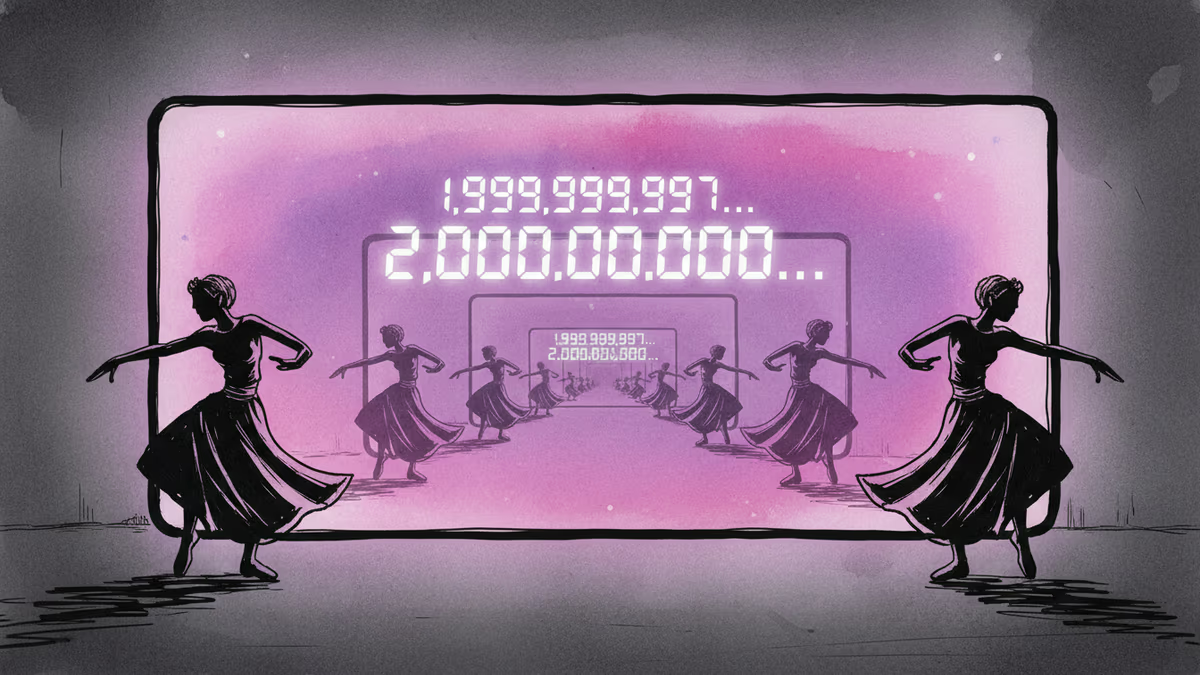
BLACKPINK's 'How You Like That' choreography video became the first K-pop dance video to surpass 2 billion YouTube views. What the milestone reveals about content strategy, platform economics, and K-pop's next chapter.
&TEAM's 'We on Fire' debuted on the Billboard 200 for the first time. Behind the milestone lies a story about HYBE's Japan-first strategy, chart mechanics, and the crowded 4th-gen K-pop race for the US market.
Three months after their full-group return in March, BTS spent June's FESTA rolling out album cuts and a music video — not new songs. Come Over cracked a global top 5 with zero new music behind it. Did the play work?
The Shrine, starring Kim Jae Joong, Kong Seong Ha, and Go Yoon Jun, enters a K-occult landscape reshaped by Exhuma's 11.9M ticket milestone. What does the film's Japan setting signal?
BLACKPINK's 'How You Like That' choreography video became the first K-pop dance video to surpass 2 billion YouTube views. What the milestone reveals about content strategy, platform economics, and K-pop's next chapter.
&TEAM's 'We on Fire' debuted on the Billboard 200 for the first time. Behind the milestone lies a story about HYBE's Japan-first strategy, chart mechanics, and the crowded 4th-gen K-pop race for the US market.
Thoughts
Share your thoughts on this article
Sign in to join the conversation