

Big Tech's New Trojan Horse? Inside the 'U.S. Tech Force' and its Real Mission
The 'U.S. Tech Force' isn't just a jobs program. It's a strategic move in the US-China AI war, conscripting Big Tech as national infrastructure. Here's what it really means.
The Lede: More Than a Modernization Effort
The Trump administration's newly unveiled "U.S. Tech Force" is being presented as a straightforward initiative to bring top tech talent into government. But make no mistake: this is not just another IT upgrade. It represents a fundamental, and potentially fraught, escalation in the US-China tech war, formally conscripting Silicon Valley's elite—from Google and Microsoft to OpenAI and Palantir—as a direct extension of national strategic infrastructure. For investors and industry leaders, understanding this program isn't about government hiring; it's about seeing the new blueprint for American technological power.
Why It Matters
This initiative goes far beyond fixing government websites. It's a strategic move with profound second-order effects that most reports will miss. It formalizes the symbiotic relationship between Washington D.C. and Silicon Valley, turning ad-hoc partnerships into a structured talent pipeline aimed squarely at geopolitical competition. This program institutionalizes the idea that in the 21st century, the nation's most critical infrastructure isn't just roads and bridges, but AI models and cloud architecture.
- The Blurring Lines: For companies like Apple, Google, and Microsoft, this deepens their entanglement with the state, shifting their role from mere vendors to integral partners in national security. This presents both a massive opportunity in government contracts and a significant risk in terms of public perception and employee blowback.
- A New Talent Battlefield: The program, with its $150,00c0-$200,000 salaries and a direct path back to Big Tech, is a powerful recruiting tool. It also risks creating a two-tiered system within the federal workforce, potentially demoralizing long-serving civil servants and creating friction with established procurement processes.
- Geopolitical Signaling: The creation of the Tech Force is a direct response to China's state-driven AI 2030 plan. It signals to the world, and particularly to Beijing, that the U.S. is mobilizing its private sector might for a protracted technological cold war.
The Analysis: A Familiar Playbook with a New Edge
Echoes of the Past, Designed for the Future

Washington has tried to tap Silicon Valley talent before. The Obama administration launched the U.S. Digital Service (USDS) and 18F in the wake of the disastrous Healthcare.gov rollout. Those initiatives, however, were largely defensive—focused on improving citizen-facing digital services. The U.S. Tech Force is different. Its stated mission—focusing on "AI implementation, application development, data modernization"—and its roster of partners like Nvidia (chips), Palantir (data analysis), and OpenAI (foundational models) reveal a distinctly more offensive and strategic posture. This isn't about fixing what's broken; it's about building what's next for national competitive advantage.
The Revolving Door Becomes a Superhighway
The program's structure, where private companies can nominate their own employees for a tour of duty and then re-hire program alumni, institutionalizes the "revolving door" between industry and government. The upside is clear: fresh, cutting-edge expertise flowing into a notoriously slow-moving bureaucracy. The potential downside is a minefield of ethical conflicts. Our analysis suggests a critical question that remains unanswered: How will the government ensure an AWS-nominated engineer doesn't architect a new federal system that just so happens to be optimized exclusively for AWS cloud services? Without iron-clad guardrails, this initiative could be perceived as a way for Big Tech to embed its own salespeople and standards deep within the federal apparatus, shaping public policy and procurement from the inside.
For Investors: De-Risking the 'National Champions'
For investors, the list of private sector partners is a veritable who's who of companies the U.S. government considers strategically indispensable. Participation is a powerful signal that de-risks a company's government-facing business. Being a "Tech Force Partner" isn't just about a potential contract; it's a seal of approval that grants a seat at the table where the future of government technology is being architected. This implies a significant long-term moat, potentially leading to preferential treatment in future, multi-billion dollar cloud, AI, and data contracts. The stocks of these partners, particularly those deeply involved in AI and data infrastructure, now carry an implicit government backstop.
For the Industry: The Rise of 'Big Tech Defense'
This initiative solidifies a new paradigm: Big Tech as the new defense prime. For decades, companies like Lockheed Martin and Raytheon were the industrial base for national security. Now, the battlefield is digital, and the key suppliers are Microsoft, Google, and Amazon. This program is the clearest acknowledgment yet of that shift. It will force a cultural reckoning within these companies, which have often struggled with employee activism against military and intelligence-related work. The U.S. Tech Force effectively makes participation in the national security apparatus a core part of their identity, whether their employees like it or not.
PRISM's Take
The U.S. Tech Force is less a jobs program and more a declaration of strategy. It is Washington's formal admission that it cannot win the global AI race without fully integrating Silicon Valley into its operational core. While the practical challenges of merging fast-moving tech culture with rigid government bureaucracy are immense, the program's very existence is the headline. It signals the end of any pretense of tech sector neutrality in the great power competition. The long-term risks are significant—from conflicts of interest to mission creep—but in the administration's calculus, the risk of inaction and falling behind in the AI arms race is far greater. Silicon Valley has officially been drafted.
Authors
Related Articles
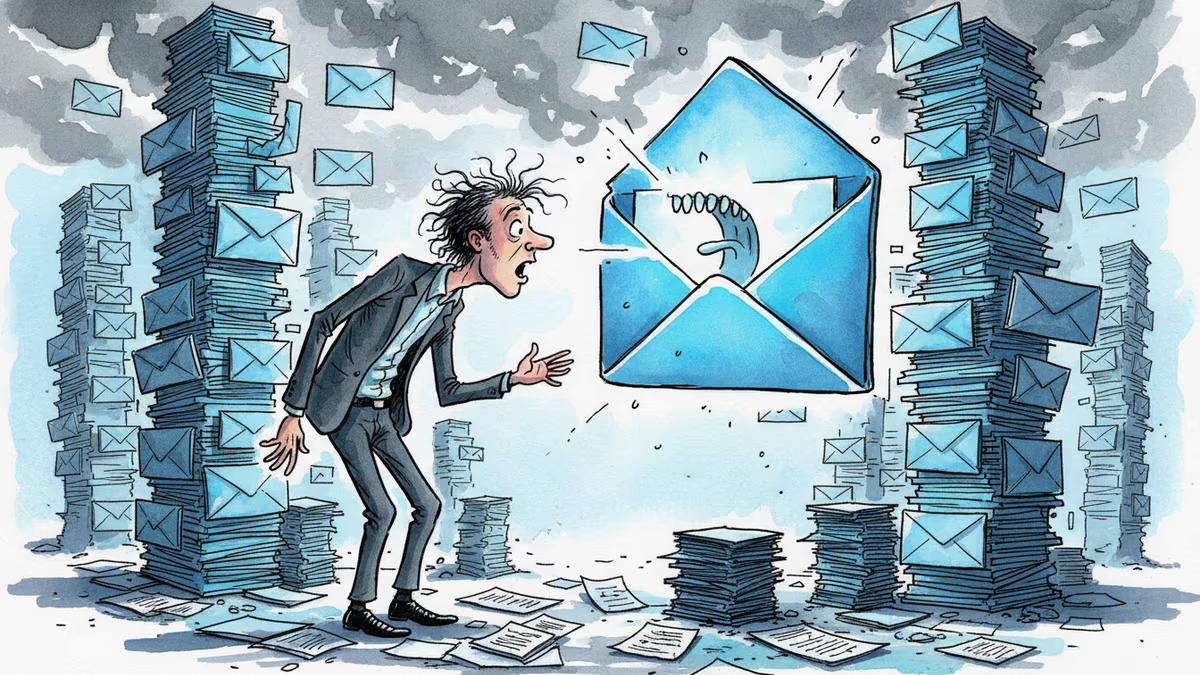
Google's Gmail Live lets you ask your inbox questions out loud. Announced at I/O 2026, it's AI's pitch to skeptics — and a reminder of how much Google already knows about you.

OpenAI has reorganized for the second time in a month, merging ChatGPT and Codex into a single agentic platform under president Greg Brockman's unified product leadership.
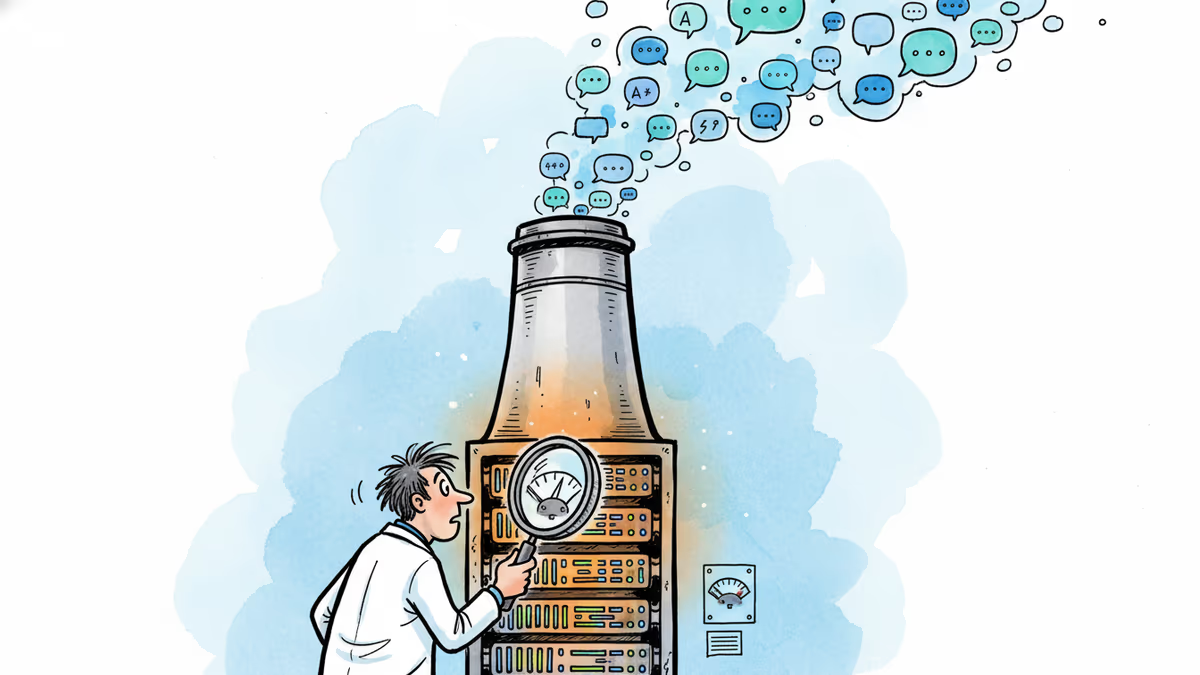
AI sustainability researcher Sasha Luccioni is launching a new venture to push for energy transparency in AI. Here's why Big Tech keeps the numbers hidden—and what's starting to change.
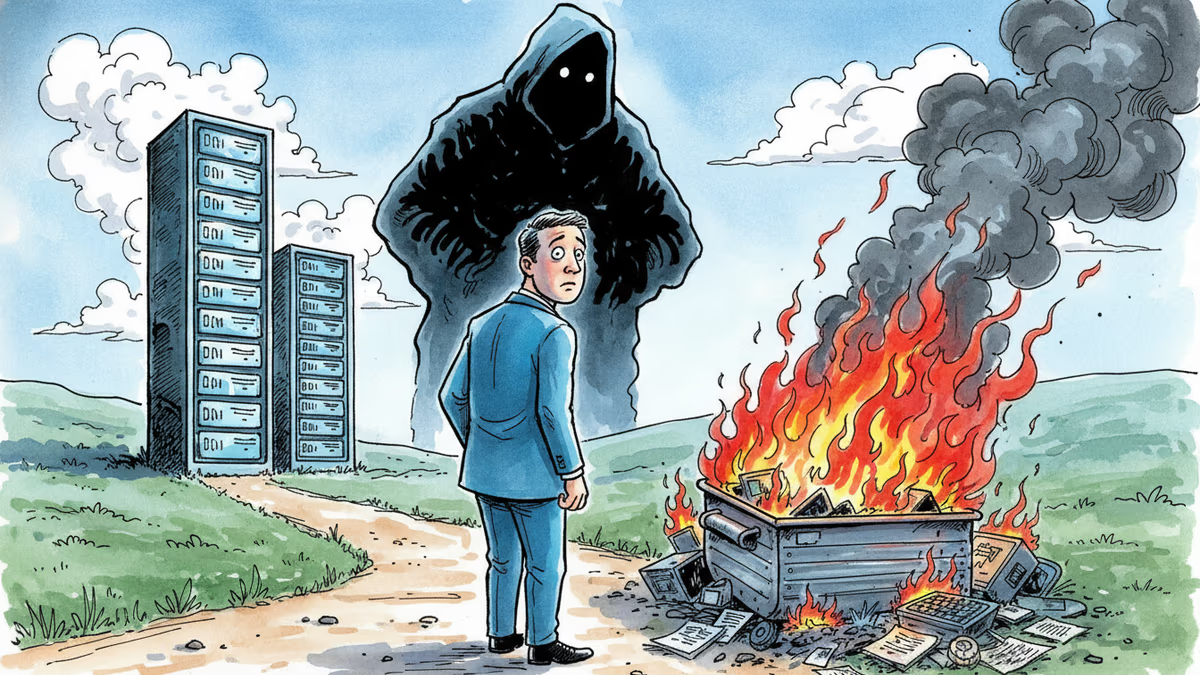
Emails revealed in the Musk v. Altman trial show Microsoft executives were deeply skeptical of OpenAI in 2017–2018. What actually changed their minds?
Google's Gmail Live lets you ask your inbox questions out loud. Announced at I/O 2026, it's AI's pitch to skeptics — and a reminder of how much Google already knows about you.
OpenAI has reorganized for the second time in a month, merging ChatGPT and Codex into a single agentic platform under president Greg Brockman's unified product leadership.
AI sustainability researcher Sasha Luccioni is launching a new venture to push for energy transparency in AI. Here's why Big Tech keeps the numbers hidden—and what's starting to change.
Emails revealed in the Musk v. Altman trial show Microsoft executives were deeply skeptical of OpenAI in 2017–2018. What actually changed their minds?
Thoughts
Share your thoughts on this article
Sign in to join the conversation