

Big Tech's $700B AI Infrastructure Bet: Genius or Bubble?
Amazon, Google, and Meta plan $700 billion in AI infrastructure spending for 2026. Wall Street is nervous, but tech CEOs double down. Who's right?
$700 Billion in One Year
In 2026 alone, Big Tech companies plan to spend $700 billion on AI infrastructure. Amazon leads with $200 billion, Google follows with $175-185 billion, and Meta commits $115-135 billion. That's more than the GDP of most countries.
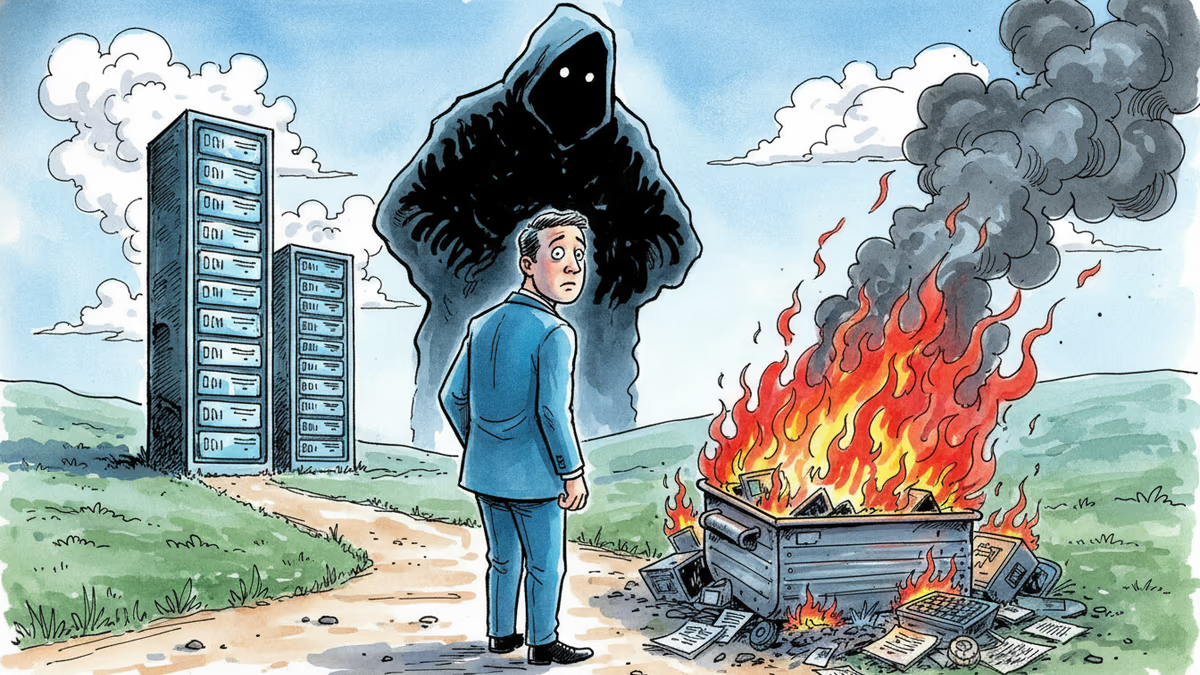
The catch? Nobody knows if this money will ever come back. Wall Street investors are getting nervous about an AI bubble, while tech CEOs insist there's no future without AI. It's the biggest bet in corporate history.
Oracle's Overnight Transformation
The most dramatic story belongs to Oracle. On June 30, 2025, the company announced a $30 billion cloud deal with an "unnamed partner" — later revealed to be OpenAI. Oracle's stock soared, briefly making founder Larry Ellison the world's richest person.
Three months later, they went even bigger: a five-year, $300 billion compute deal starting in 2027. Since OpenAI doesn't have $300 billion lying around, this represents a massive bet on exponential growth for both companies.
To put this in perspective: Oracle's entire 2024 cloud revenue was less than $30 billion. This single deal is worth 10 years of their previous business.
Nvidia's Circular Trading Strategy
Nvidia, the biggest winner of the AI boom, has gotten creative with its investments. Instead of cash, the company now trades GPUs directly for equity stakes. In September 2025, Nvidia "invested" $100 billion in OpenAI — but the deal was structured as GPUs-for-stock rather than traditional funding.
Similar arrangements followed with Elon Musk'sxAI and others. OpenAI even struck a separate GPU-for-equity deal with AMD. We're witnessing the emergence of a chip-based economy within the AI sector.
This creates a fascinating dynamic: Nvidia's GPUs are valuable because they're scarce, and by trading them directly into an ever-expanding data center ecosystem, Nvidia ensures they stay that way. But if AI momentum falters, these circular arrangements could unravel quickly.

Meta's Nuclear-Powered Ambitions
Meta plans to spend $600 billion on U.S. infrastructure through 2028. The centerpiece is "Hyperion," a 2,250-acre data center in Louisiana that will cost $10 billion to build and provide 5 gigawatts of computing power. The twist? It's partnered with a local nuclear power plant to handle the massive energy requirements.
A smaller facility in Ohio, dubbed "Prometheus," will run on natural gas starting in 2026. These projects highlight AI's growing environmental footprint. Musk's xAI built a hybrid data center and power plant in Memphis that quickly became one of the county's largest sources of air pollution.
The Stargate Stumble
Two days after his second inauguration, President Trump announced "Stargate" — a $500 billion joint venture between SoftBank, OpenAI, and Oracle to build AI infrastructure in America. Trump called it "the largest AI infrastructure project in history."
But cracks appeared quickly. Musk publicly questioned whether the project had adequate funding. By August, Bloomberg reported that partners were struggling to reach consensus. Construction of eight data centers in Abilene, Texas, continues, but the grand vision seems to have lost momentum.
Wall Street vs. Silicon Valley
A fascinating divide has emerged: tech executives are more bullish on AI than their own investors. The more companies spend on AI infrastructure, the more nervous Wall Street gets. Add mounting debt from data center construction, and you can hear CFOs across the valley grinding their teeth.
Amazon CEO Andy Jassy defended the spending: "We think this is a really unusually large, maybe once-in-a-lifetime type of opportunity." But investors worry about returns that may take years to materialize.
The dynamic creates an interesting tension: companies that don't invest risk falling behind, but companies that invest too much risk financial strain. It's a classic prisoner's dilemma on a trillion-dollar scale.
The Environmental Reckoning
Lost in the financial figures is the environmental cost. These data centers require enormous amounts of electricity — often more than entire cities. Meta's Louisiana facility will consume as much power as 3.75 million homes.
Companies are scrambling for clean energy solutions, from nuclear partnerships to renewable energy farms. But the timeline for clean infrastructure often doesn't match the urgency of AI development, leading to compromises that environmental groups are watching closely.
Authors
Related Articles

Google's Gmail Live lets you ask your inbox questions out loud. Announced at I/O 2026, it's AI's pitch to skeptics — and a reminder of how much Google already knows about you.

OpenAI has reorganized for the second time in a month, merging ChatGPT and Codex into a single agentic platform under president Greg Brockman's unified product leadership.

AI sustainability researcher Sasha Luccioni is launching a new venture to push for energy transparency in AI. Here's why Big Tech keeps the numbers hidden—and what's starting to change.
Emails revealed in the Musk v. Altman trial show Microsoft executives were deeply skeptical of OpenAI in 2017–2018. What actually changed their minds?
Google's Gmail Live lets you ask your inbox questions out loud. Announced at I/O 2026, it's AI's pitch to skeptics — and a reminder of how much Google already knows about you.
OpenAI has reorganized for the second time in a month, merging ChatGPT and Codex into a single agentic platform under president Greg Brockman's unified product leadership.
AI sustainability researcher Sasha Luccioni is launching a new venture to push for energy transparency in AI. Here's why Big Tech keeps the numbers hidden—and what's starting to change.
Emails revealed in the Musk v. Altman trial show Microsoft executives were deeply skeptical of OpenAI in 2017–2018. What actually changed their minds?
Thoughts
Share your thoughts on this article
Sign in to join the conversation