
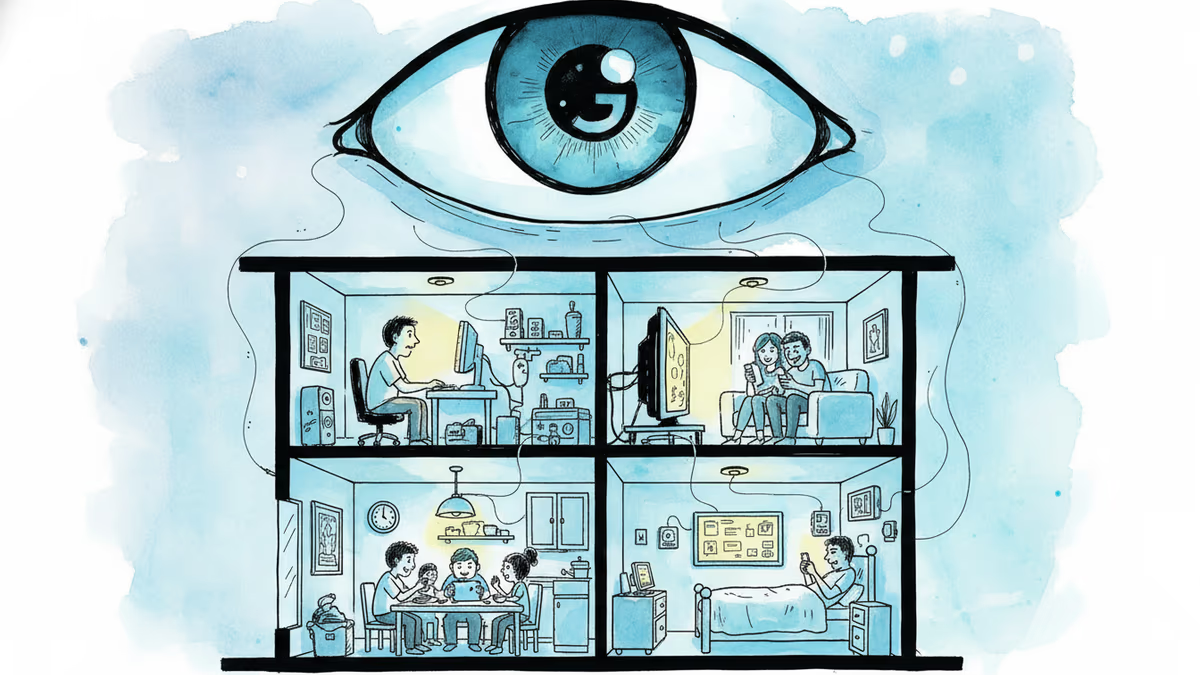
Google's AI Now Watches Your Home in Real Time
Google Home introduces Live Search feature enabling real-time camera analysis. Smart home convenience meets privacy concerns as AI monitors daily life 24/7
100 Million Eyes Just Got Smarter
Google's smart cameras worldwide can now tell you what's happening in your home right now, not just what already happened. The company's new "Live Search" feature marks a fundamental shift from passive recording to active monitoring.
Previously, you could ask "Who came by last night?" and get answers from recorded footage. Now you can ask "Is there a car in my driveway?" or "What's my dog doing?" and get instant answers from live camera feeds. It's the difference between a security tape and a digital security guard.
Anish Kattukaran, Google Home's chief, announced this alongside several other updates that address long-standing user frustrations with the platform.
The Smart Home Arms Race Intensifies
This isn't just about convenience—it's about control of the $80 billion smart home market. Amazon's Alexa has dominated voice commands, but Google's betting on vision as the next frontier.
The timing matters. Home security concerns have spiked 23% since 2022, according to industry surveys. Parents want to check on kids, pet owners monitor their animals, and elderly care is increasingly moving into homes. Google's positioning itself as the solution to all three.

But competitors aren't sleeping. Apple's HomeKit emphasizes privacy-first design, while Amazon recently acquired Ring and is developing similar capabilities. The question isn't whether real-time AI monitoring will become standard—it's who'll control it.
Privacy Advocates Sound the Alarm
Consumer advocacy groups are raising red flags. "We're normalizing 24/7 surveillance in the name of convenience," says one privacy researcher. "Today it's 'Is my package here?' Tomorrow it's behavioral analysis and mood tracking."
The concern isn't hypothetical. Google already uses camera data for targeted advertising in other products. While the company promises Live Search data stays local, critics point out that policies can change—and often do.
European regulators are already scrutinizing the feature under GDPR guidelines. The question: Does asking your AI about your own home constitute data processing that requires explicit consent?
Beyond Security: The Invisible Assistant
Google's vision extends far beyond security monitoring. The updated Gemini models can now handle complex, contextual queries. "Is the baby's room too bright for nap time?" "Did I leave the stove on?" "Are the plants getting enough sunlight?"
This positions Google as not just a smart home controller, but a household management system. It's a subtle but significant shift—from responding to commands to proactively understanding your environment.
The implications ripple beyond individual homes. Insurance companies are already offering discounts for smart security systems. How long before they require real-time monitoring for coverage? Will "dumb" homes become uninsurable?
Authors
Related Articles

In a post-Google I/O interview, Sundar Pichai acknowledged flawed search results, real AI anxiety, and an AGI timeline that makes the label irrelevant. Here's what he said — and what it means.

Google is building AI agents that search the web proactively, without user prompting. That's not just a product update — it's a fundamental shift in who controls the information you receive.

Google unveiled the 'Googlebook' platform to replace Chromebook and ChromeOS—but revealed zero hardware specs. What's the strategy, and what does it mean for users, manufacturers, and the education market?

After 15 years of fragmented mobile messaging, Apple and Google are rolling out end-to-end encrypted RCS messaging between iPhones and Android devices. Here's what changed, why it took so long, and what it means for your privacy.
In a post-Google I/O interview, Sundar Pichai acknowledged flawed search results, real AI anxiety, and an AGI timeline that makes the label irrelevant. Here's what he said — and what it means.
Google is building AI agents that search the web proactively, without user prompting. That's not just a product update — it's a fundamental shift in who controls the information you receive.
Google unveiled the 'Googlebook' platform to replace Chromebook and ChromeOS—but revealed zero hardware specs. What's the strategy, and what does it mean for users, manufacturers, and the education market?
After 15 years of fragmented mobile messaging, Apple and Google are rolling out end-to-end encrypted RCS messaging between iPhones and Android devices. Here's what changed, why it took so long, and what it means for your privacy.
Thoughts
Share your thoughts on this article
Sign in to join the conversation