

The Battery Breakthrough That's Making Giants Nervous
Donut Lab's solid-state battery passed independent testing, but the real question isn't about performance—it's about production scale and industry disruption.
When Finnish startup Donut Lab claimed earlier this year to have cracked the solid-state battery code, industry veterans rolled their eyes. Another startup promising the moon with battery tech—they'd seen it before. But this week's independent test results from Finland's state-owned VTT Technical Research Centre are forcing a second look.
The Numbers Don't Lie
The test results were unambiguous: 3x faster charging speeds compared to conventional lithium-ion batteries, and thermal stability up to 185°F. These aren't incremental improvements—they're the kind of performance leaps that could reshape the electric vehicle market overnight.
But here's the thing everyone's really wondering: Can a Finnish startup actually manufacture these batteries at scale?
The Production Reality Check
Solid-state batteries have been the "next big thing" for over a decade. Toyota, Samsung, and QuantumScape have all promised breakthroughs, only to hit manufacturing roadblocks. The theoretical advantages are clear—faster charging, higher energy density, better safety. The practical challenges? That's where dreams meet reality.

Donut Lab claims their approach sidesteps traditional production headaches, but they haven't disclosed their manufacturing process. Industry analysts remain skeptical. "Performance in the lab is one thing," says battery expert Dr. Sarah Chen. "Producing millions of units consistently is entirely different."
The Domino Effect
If Donut Lab can actually deliver at scale, the implications ripple far beyond Finland. Tesla has been betting on incremental improvements to lithium-ion technology. Ford and GM have locked into long-term battery supply contracts. A true solid-state breakthrough could leave them scrambling to renegotiate deals or risk falling behind.
Meanwhile, Chinese battery giants like CATL and BYD are watching closely. They've dominated through manufacturing efficiency, not necessarily cutting-edge tech. A paradigm shift toward solid-state could level the playing field—or tilt it toward whoever can scale fastest.
The Skeptic's Case
Not everyone's convinced. Battery industry veteran Mike Rodriguez points out that Donut Lab has only tested small prototype cells, not full automotive battery packs. "Scaling from prototype to production isn't just about making bigger batteries," he explains. "It's about maintaining quality control, managing heat distribution, and doing it all cost-effectively."
The startup's funding situation also raises questions. While they've secured Series A funding, mass production would require hundreds of millions more—money that typically comes with strings attached from automotive partners or battery manufacturers.
Authors
Related Articles

Finnish startup Donut Lab has cleared its biggest credibility hurdle: independent testing by state-owned VTT confirms its solid-state battery is the real thing. What does this mean for the race to commercialize next-gen batteries?

Rivian targets 20,000 R2 SUV sales in six months, matching Tesla Model Y's pace. But can it succeed without federal tax credits in a challenging EV market?
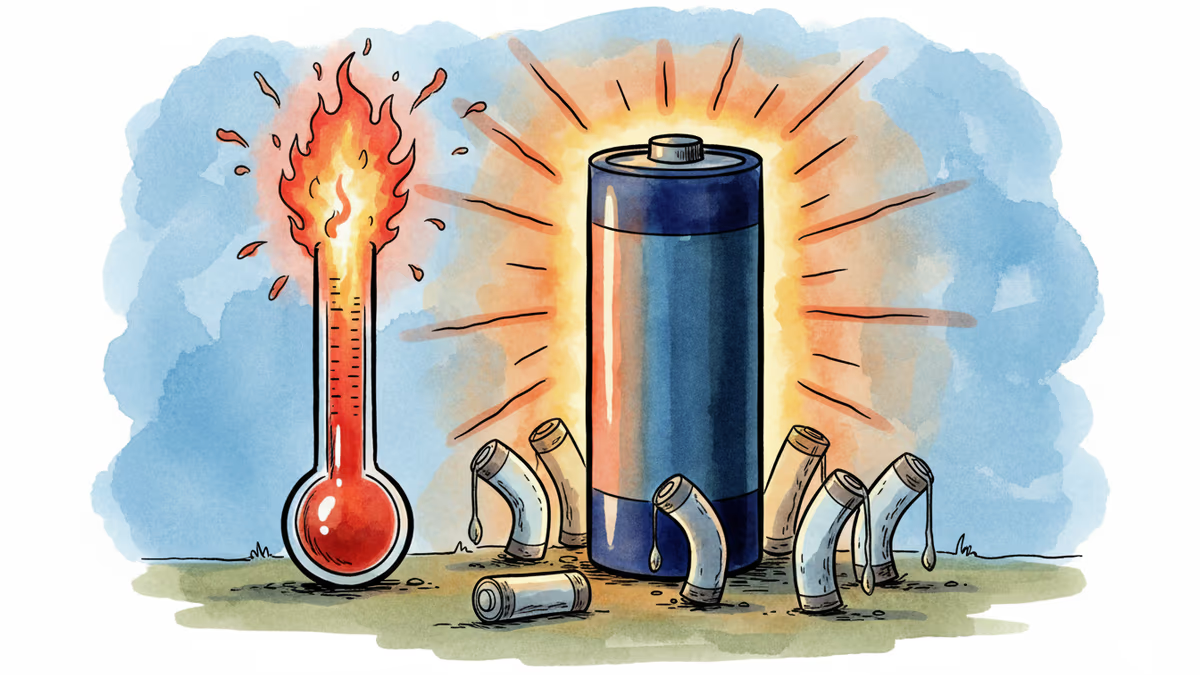
Finnish startup Donut Lab's solid-state battery actually gains capacity at extreme heat, challenging everything we know about EV battery performance in hot climates.

Honor's Magic V6 claims the thinnest foldable crown at 4mm, but the real innovation lies in its 6,600mAh battery. A new battleground emerges in the foldable wars.
Finnish startup Donut Lab has cleared its biggest credibility hurdle: independent testing by state-owned VTT confirms its solid-state battery is the real thing. What does this mean for the race to commercialize next-gen batteries?
Rivian targets 20,000 R2 SUV sales in six months, matching Tesla Model Y's pace. But can it succeed without federal tax credits in a challenging EV market?
Finnish startup Donut Lab's solid-state battery actually gains capacity at extreme heat, challenging everything we know about EV battery performance in hot climates.
Honor's Magic V6 claims the thinnest foldable crown at 4mm, but the real innovation lies in its 6,600mAh battery. A new battleground emerges in the foldable wars.
Thoughts
Share your thoughts on this article
Sign in to join the conversation