

Swimming Robots Smaller Than Salt Grains Break Physics
US researchers developed fully autonomous 0.3mm robots that swim using electric fields instead of moving parts. After 40 years, they've finally cracked the 1mm barrier.
A robot so small it makes a grain of salt look massive is swimming through water right now. At 0.3mm long and 0.05mm thick, this microscopic machine just shattered a 40-year barrier that has stumped roboticists worldwide: the elusive 1-millimeter threshold.
The challenge wasn't just about making things smaller. In our everyday world, gravity and inertia rule. But shrink down to microscopic scales, and physics flips the script entirely. Viscosity and drag become the dominant forces, turning water into something that feels like thick tar for tiny mechanical limbs.
Researchers at the University of Pennsylvania and University of Michigan found a solution that throws conventional robotics out the window.
The Electric Ocean
Instead of swimming like fish—pushing water backward to move forward—these robots generate electric fields around themselves. The fields nudge charged particles in the liquid, which then drag nearby water molecules along, creating currents around the robot.
It's as if the robot isn't moving at all, but the entire ocean is flowing around it.
"We've miniaturized an autonomous robot to 1/10,000th the size of conventional robots," says Mark Miskin, assistant professor at Penn. "This opens up a completely new scale for programmable robotics."
The genius lies in the durability. With no moving parts, these robots can swim continuously for months. Manufacturing cost? Just 1 cent per unit. They can be produced in batches of several hundred at once.
Computing on 75 Nanowatts
Propulsion alone doesn't make a robot autonomous. It needs to sense, decide, and navigate—all while running on a computer smaller than 1mm.
Enter David Blaauw's team at the University of Michigan, holders of the world record for smallest computer. When they met Miskin at a Defense Advanced Research Projects Agency presentation, they knew their technologies were perfect complements. It took five years to make it work.

The biggest hurdle? Power. The robot's solar panels generate just 75 nanowatts—less than 1/100,000th of what a smartwatch consumes. The team designed special circuits that operate at extremely low voltages and condensed complex programs into single instructions that fit in tiny memory spaces.
Dancing Data
These robots can detect minute temperature changes through electronic sensors. But they're too small for robust communication components, so they borrowed a trick from the insect world.
The robots translate sensor readings into "dance moves." Researchers observe through microscopes and decode the information. "It's very similar to how honeybees communicate," Blaauw explains.
Each robot gets a unique ID and can receive different instructions, enabling swarm collaboration on complex tasks.
Medical Revolution in Miniature
This breakthrough could transform medicine as we know it. Imagine robots swimming through your bloodstream, monitoring individual cells, or delivering drugs with pinpoint precision. Cancer treatment could become as targeted as a guided missile rather than carpet bombing with chemotherapy.
For manufacturing, these robots could assemble components at scales impossible for human hands or traditional machinery. Semiconductor fabrication, precision instruments, even repairing microscopic defects in materials—the applications seem limitless.
But questions remain. How do we ensure safety when robots operate inside living bodies? What happens if they malfunction or get stuck? Who's liable when a swarm of microscopic robots makes a mistake?
The Regulatory Maze
The FDA will need entirely new frameworks to evaluate robots that operate at cellular scales. Current medical device regulations weren't designed for autonomous swarms smaller than the period at the end of this sentence.
European regulators are already grappling with AI governance—now they'll need to consider AI systems that can literally swim through your veins. The intersection of robotics, AI, and medicine creates regulatory complexity we've never faced before.
Then there's the manufacturing challenge. Moving from laboratory prototypes to billion-unit production requires entirely new fabrication techniques. The semiconductor industry spent decades perfecting nanoscale manufacturing—microrobotics will need its own revolution.
The 1mm barrier has fallen. The question isn't whether these robots will transform medicine and manufacturing—it's whether we're ready for what comes next.
Authors
Related Articles

Samsung Electronics' union branch revealed that 84% of survey respondents oppose the government's roughly $290 billion (₩400 trillion) semiconductor megaproject in Gwangju. Government, management, the union and shareholders are all reading the same national project in sharply different ways.

Nvidia shipped roughly a billion RISC-V cores in 2024, then announced it would run CUDA on the open standard. We break down how royalty-free instruction sets and open software stacks are trying to route around CUDA's lock-in. Part 2 of the Semiconductor Sovereignty series.
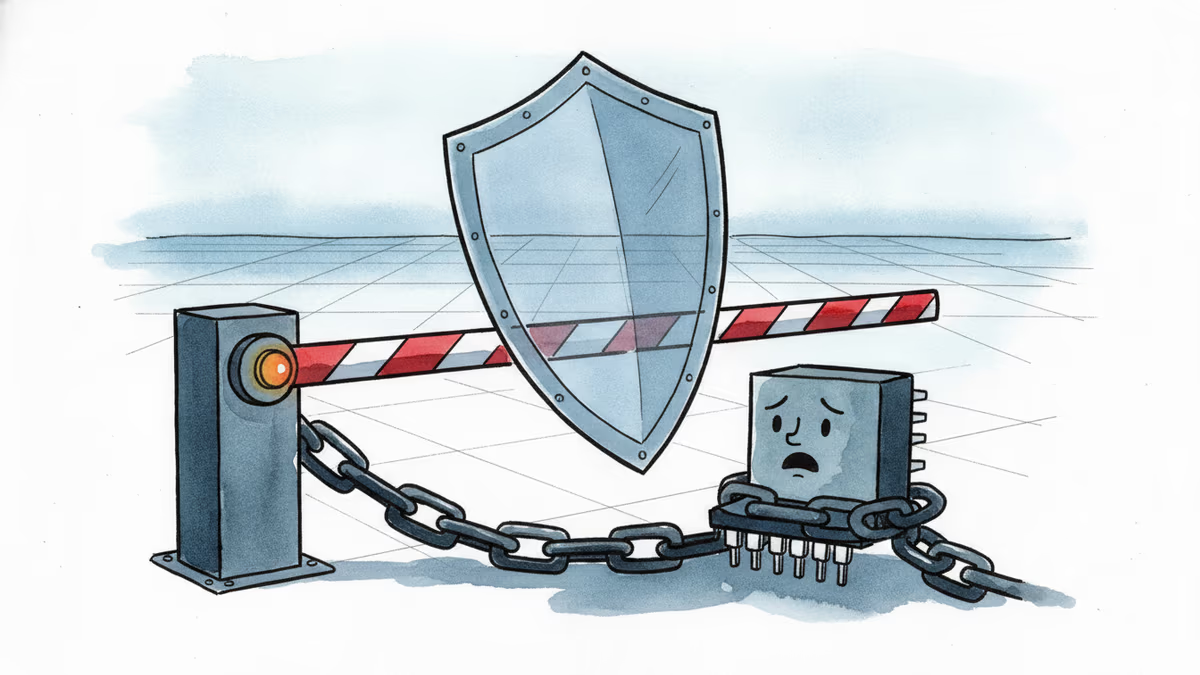
US AI-chip export controls split into three layers in the first half of 2026 — January easing, a May crackdown on circumvention, and a pending bill. Nvidia erased China from its guidance and still posted a record $81.6 billion quarter. A look at the export policy that both shields and cages it.
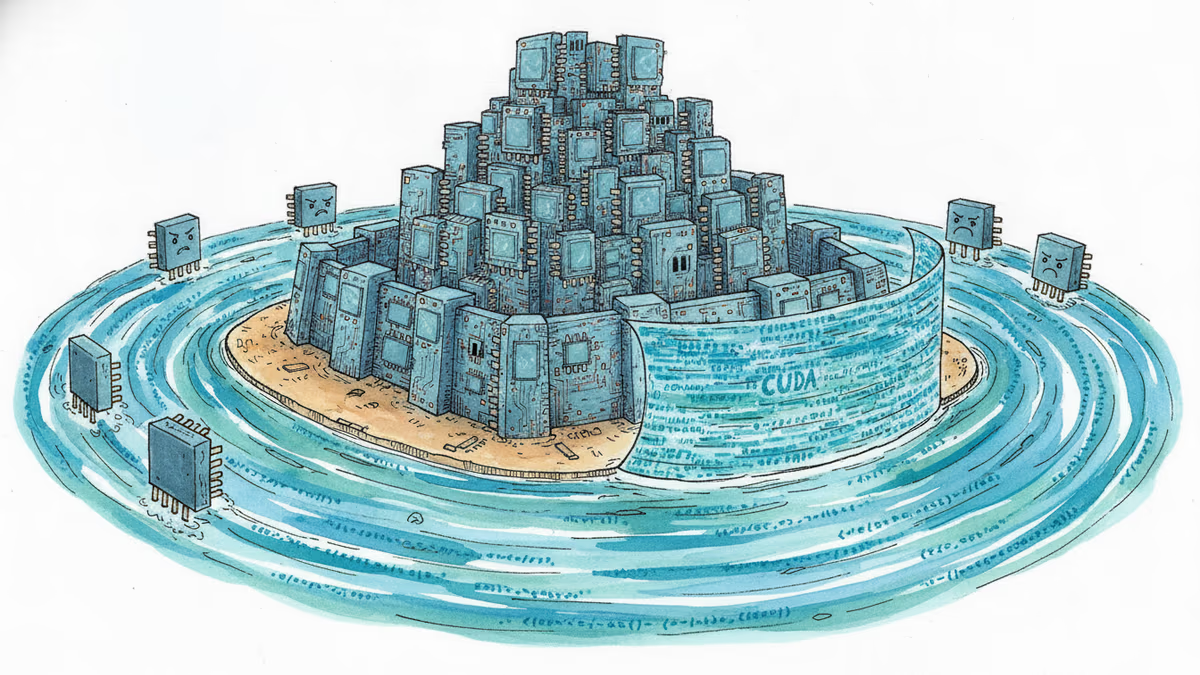
AMD's MI325X matches or beats Nvidia on memory and bandwidth — yet Nvidia's 86-92% share holds. The real moat is CUDA, 20 years in the making. Part 1 of 4.
Samsung Electronics' union branch revealed that 84% of survey respondents oppose the government's roughly $290 billion (₩400 trillion) semiconductor megaproject in Gwangju. Government, management, the union and shareholders are all reading the same national project in sharply different ways.
Nvidia shipped roughly a billion RISC-V cores in 2024, then announced it would run CUDA on the open standard. We break down how royalty-free instruction sets and open software stacks are trying to route around CUDA's lock-in. Part 2 of the Semiconductor Sovereignty series.
US AI-chip export controls split into three layers in the first half of 2026 — January easing, a May crackdown on circumvention, and a pending bill. Nvidia erased China from its guidance and still posted a record $81.6 billion quarter. A look at the export policy that both shields and cages it.
AMD's MI325X matches or beats Nvidia on memory and bandwidth — yet Nvidia's 86-92% share holds. The real moat is CUDA, 20 years in the making. Part 1 of 4.
Thoughts
Share your thoughts on this article
Sign in to join the conversation