
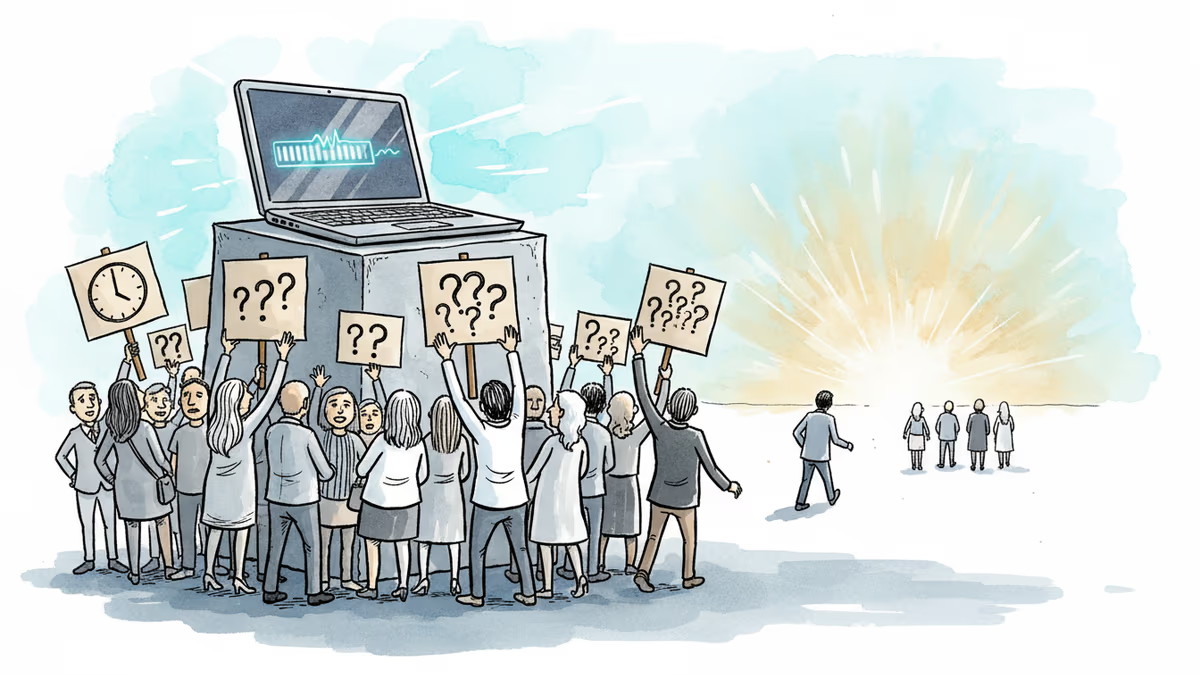
The World's Best Laptop Has a Design Problem
Apple's M5 Max MacBook Pro benchmarks like a workstation, games like a dedicated GPU rig, and runs local AI faster than ever. But it's also the same chassis Apple's been selling since 2021. Is that a problem?
Apple just raised the price again. Removed the 1TB option entirely. Shipped the same chassis it's been selling since 2021. And somehow still built the most powerful laptop on the market. That tension is the whole story of the M5 Max MacBook Pro.
What the Numbers Actually Mean
Let's be direct about the performance, because the numbers are genuinely unusual.
The M5 Max's integrated GPU trades blows with an NVIDIA RTX 5070 Ti — the kind of discrete graphics card you'd find in a dedicated gaming rig. Running Cyberpunk 2077 at Ultra settings, no upscaling, no tricks: 62fps. Medium settings: 88fps. Against the M3 Max, GPU scores are up 43% in Cinebench 2024.
The AI story is just as striking. Each of the 40 GPU cores now carries its own neural accelerator. The result: 49% faster on Geekbench AI versus the M3 Max. In LM Studio, running a 17-billion parameter Llama-2 model locally generates 12.61 tokens per second — 31% faster than the previous generation, and close enough to free-tier ChatGPT speeds to matter for real workflows. Storage read/write speeds have roughly doubled thanks to a new PCIe 5 SSD controller.
There's also a quiet architectural shift worth noting. The M5 Max is no longer a single monolithic chip — it's two pieces of silicon fused together using the same architecture previously reserved for the Ultra chips in the Mac Studio desktop. The immediate performance gains from this change are modest, but it signals where Apple's chip roadmap is heading.
The Awkward Truth
Here's what Apple didn't change: everything else.
The chassis is five years old. The display is still Mini-LED, not OLED. The weight is still 4.7 pounds. The only physical change on the M5 Max versus the M4 Max is that some key labels have been swapped for arrow symbols on US keyboards — matching the UK layout. That's it.

And the reports are hard to ignore: next year's MacBook Pro is expected to arrive with a touchscreen, a tandem OLED display, a thinner body, and potentially more. Buying the M5 Max today means paying full price for the last iteration of a design that's likely about to be replaced.
The pricing reflects the confidence — or the audacity, depending on your perspective. Apple removed the 1TB storage option from the 16-inch lineup entirely, pushing the starting price to $3,899. Want 128GB of unified memory to run serious local AI models? That requires the Max chip configuration, and the price climbs accordingly. The Pro chip caps out at 64GB.
Who This Is Actually For
The M5 Max makes sense for a specific type of buyer: video editors, game developers, machine learning engineers running models locally, and anyone in DaVinci Resolve, Xcode, or ComfyUI for eight hours a day. For those users, there's genuinely no Windows alternative that matches both the performance and the battery life. The Asus ProArt P16 comes close on raw power but doesn't compete on endurance.
For everyone else — hobbyist coders, casual content creators, students — this machine is significant overkill, and waiting for next year's redesign is probably the smarter financial move.
There's also a 14-inch caveat worth mentioning. Reports suggest the M5 Max in the 14-inch model may actually drain battery while plugged in under heavy load, because the 96-watt charger can't keep up with peak power draw. That's unverified, but it's a meaningful concern for anyone considering the smaller form factor.
The Bigger Picture: Local AI as the New Benchmark
The most interesting shift in this product cycle isn't the GPU or the CPU — it's what Apple is positioning this machine for. The marketing has quietly moved. This is no longer just a laptop for video editors. It's being pitched as an on-device AI workstation: running large language models locally, accelerating postproduction with AI tools, powering coding assistants without sending data to the cloud.
That framing matters beyond Apple. If local AI processing becomes a standard expectation for professional laptops — rather than a premium differentiator — it reshapes what every laptop maker has to compete on. Intel, Qualcomm, and AMD are all chasing this benchmark now. The M5 Max just set it considerably higher.
For consumers, the privacy angle is real. Running a 17-billion parameter model locally means your code, your creative work, and your prompts never leave your machine. In a regulatory environment where data sovereignty is increasingly scrutinized — especially in Europe — that's not a minor footnote.
Authors
Related Articles
After 15 years of fragmented mobile messaging, Apple and Google are rolling out end-to-end encrypted RCS messaging between iPhones and Android devices. Here's what changed, why it took so long, and what it means for your privacy.
Apple agreed to pay $250 million to settle claims it misled iPhone 16 buyers about Apple Intelligence features. What this means for consumers, Big Tech marketing, and the AI industry.
Apple quietly removed the entry-level $599 Mac Mini, raising the starting price to $799 — just one day after Tim Cook warned of chip supply constraints on the earnings call.

Apple names John Ternus, its hardware engineering chief, as the next CEO. The shift from operator to product person signals where Apple thinks its next decade of growth will come from — and raises real questions about what comes next.
After 15 years of fragmented mobile messaging, Apple and Google are rolling out end-to-end encrypted RCS messaging between iPhones and Android devices. Here's what changed, why it took so long, and what it means for your privacy.
Apple agreed to pay $250 million to settle claims it misled iPhone 16 buyers about Apple Intelligence features. What this means for consumers, Big Tech marketing, and the AI industry.
Apple quietly removed the entry-level $599 Mac Mini, raising the starting price to $799 — just one day after Tim Cook warned of chip supply constraints on the earnings call.
Apple names John Ternus, its hardware engineering chief, as the next CEO. The shift from operator to product person signals where Apple thinks its next decade of growth will come from — and raises real questions about what comes next.
Thoughts
Share your thoughts on this article
Sign in to join the conversation