
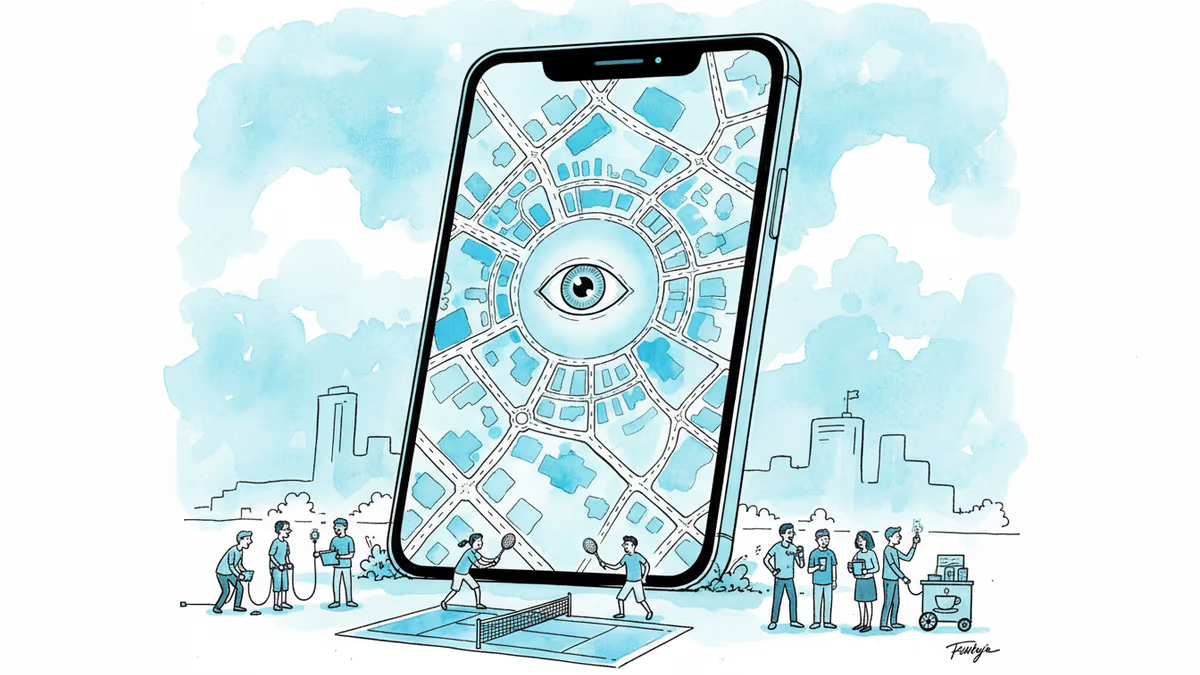
Google Maps Learns to Read Your Mind — At a Cost
Google Maps' new Gemini-powered Ask Maps and Immersive Navigation features promise to turn the app into a conversational AI agent. But smarter maps mean deeper data collection.
"My phone is dying, where can I charge it without waiting in a long line for coffee?" Until now, you'd need to break that into three separate searches. As of today, Google Maps handles it in one.
What Google Actually Announced
Google unveiled two significant updates to Google Maps on Thursday. The first is Ask Maps, a conversational search feature powered by Gemini. The second is Immersive Navigation, a ground-up redesign of the driving experience.
Ask Maps is the more conceptually ambitious of the two. Instead of typing keywords, users can ask layered, real-world questions in plain language. Planning a road trip through the Grand Canyon, Horseshoe Bend, and Coral Dunes? Ask Maps will suggest stops along the way, complete with ETAs, tips from real visitors, and details like how to snag a free entry ticket or find a trail that doesn't show up on the standard map. The feature also personalizes responses using signals from a user's search history and saved places. Ask someone who's searched for vegan spots before to find "a cozy place for four at 7pm," and Maps may already know to filter for plant-based menus. Ask Maps is live now in the U.S. and India on Android and iOS, with desktop support coming soon.
Immersive Navigation is a visual and functional overhaul of the driving interface. The app now renders nearby buildings, overpasses, and terrain in 3D — similar to what Apple Maps has offered for some time. Road details like lanes, crosswalks, traffic lights, and stop signs are now visible on screen. Voice guidance has been rewritten to sound less robotic: instead of "turn in 0.4 miles," you'll hear "go past this exit and take the next one for Illinois 43 South." When suggesting alternate routes, Maps now spells out the trade-offs — "this way is 15 minutes longer but avoids traffic; that way is faster but has a toll." Real-time alerts for construction and crashes draw from both the Google Maps and Waze communities. The rollout begins in the U.S. today and will expand to CarPlay, Android Auto, and vehicles with Google built-in over the coming months.
This isn't Google's first Gemini integration into Maps. Late last year, the company began using the AI to answer questions about places along a route and to reference landmarks — gas stations, restaurants, famous buildings — in navigation instructions instead of just distances. Thursday's update is a significant expansion of that foundation.
Why This Matters Beyond the Feature List
The timing isn't incidental. Google Maps sits at a peculiar intersection: it's a utility that over a billion people use monthly, and it's also one of the most valuable data pipelines feeding Google's advertising business. As conversational AI — led by ChatGPT, Perplexity, and others — begins to eat into traditional search behavior, Maps faces a strategic imperative: evolve into an AI agent or risk becoming a commodity layer that other AI systems route around.

The Ask Maps feature is essentially Google saying: don't ask ChatGPT to plan your trip and then open Maps for directions. Do it all here. That's a direct response to the fragmentation happening in the AI assistant space, where users increasingly stitch together multiple tools to accomplish what should be a single task.
For drivers specifically, Immersive Navigation addresses a real friction point. The #1 complaint in navigation UX research isn't getting lost — it's the cognitive load of interpreting abstract instructions in real time. "Turn right in 300 feet" means nothing when you're approaching a complex interchange at 65 mph. A 3D view that shows you exactly which lane to be in, with a voice that explains why you're staying on the highway for one more exit, is a genuinely different experience.
Three Groups Watching This Closely
For everyday drivers and commuters, the practical upside is real. Less mental effort navigating unfamiliar cities, fewer missed exits, better-informed route decisions. The personalization angle — Maps knowing your dietary preferences before you ask — will feel either delightful or unsettling depending on how you think about data.
**For Apple, Waze, and mapping competitors**, the pressure is intensifying. Apple Maps has invested heavily in 3D visuals and lane guidance, and now Google is closing that gap while simultaneously adding an AI conversation layer that Apple hasn't matched. Waze, which Google owns, now contributes data to the main Maps product — an integration that raises questions about whether Waze's independent identity has a long-term future.
For privacy advocates and regulators, Ask Maps' personalization engine is a flashpoint. The feature explicitly uses saved places, search history, and behavioral signals to tailor responses. In the EU, Google has faced repeated scrutiny over location data practices. In the U.S., the FTC has shown increasing interest in how AI-powered apps use personal data. A feature that knows you're vegan, tracks where you go after work, and understands your social calendar is useful — and it's also a remarkably detailed profile.
The Deeper Question About Convenience
There's a pattern worth naming here. Every generation of navigation technology has traded something for convenience. Paper maps gave way to GPS units, which gave way to smartphone apps, which are now giving way to AI agents that anticipate needs before you articulate them. Each transition made getting around easier. Each also moved more of the decision-making — and the data — away from the individual.
The question isn't whether Ask Maps is useful. It clearly is. The question is what it means when the app that knows where you're going also knows why you're going there, who you're meeting, what you like to eat, and how your preferences have shifted over time.
Authors
Related Articles

Google's Live Translate now works on iOS and in 12 countries, turning any headphones into a real-time translation device powered by Gemini AI. Here's what it means beyond the convenience.
After 15 years of appeals, Google receives conditional approval to export high-precision geographic data from South Korea, enabling full Google Maps functionality and challenging local navigation apps.

Google Photos launches 'Me Meme,' an AI feature that puts you in famous meme templates. Learn about the Gemini Nano Banana tech and how to use it in 2026.
Google announces 'Personal Intelligence' for Gemini, allowing it to connect with Gmail, Photos, and YouTube. Discover how this upgrade personalizes your AI experience.
Google's Live Translate now works on iOS and in 12 countries, turning any headphones into a real-time translation device powered by Gemini AI. Here's what it means beyond the convenience.
After 15 years of appeals, Google receives conditional approval to export high-precision geographic data from South Korea, enabling full Google Maps functionality and challenging local navigation apps.
Google Photos launches 'Me Meme,' an AI feature that puts you in famous meme templates. Learn about the Gemini Nano Banana tech and how to use it in 2026.
Google announces 'Personal Intelligence' for Gemini, allowing it to connect with Gmail, Photos, and YouTube. Discover how this upgrade personalizes your AI experience.
Thoughts
Share your thoughts on this article
Sign in to join the conversation