
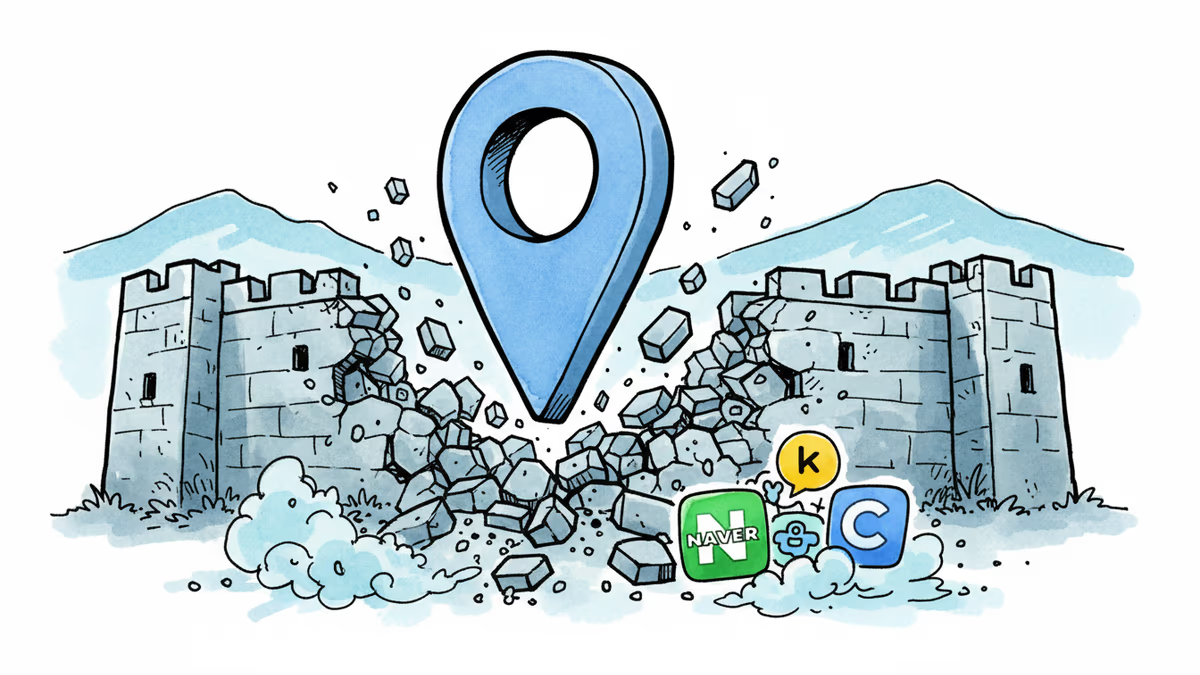
Google Maps Finally Wins 15-Year Battle to Enter South Korea
After 15 years of appeals, Google receives conditional approval to export high-precision geographic data from South Korea, enabling full Google Maps functionality and challenging local navigation apps.
48 hours. That's how long it took for South Korean navigation app stocks to start trembling after Google received conditional approval to export high-precision geographic data from the country. After 15 years of bureaucratic battles, Google Maps is finally coming to South Korea—properly.
This isn't just another regulatory approval. It's the end of one of the world's most peculiar digital trade wars, where a tech giant was essentially locked out of an entire nation's mapping ecosystem due to national security concerns.
The 15-Year Standoff
Since 2011, Google has been asking South Korea for permission to take detailed map data overseas. The answer was always no. The reason? South Korea remains technically at war with North Korea, and officials worried that Google's satellite imagery combined with precise coordinate data could expose sensitive military installations.
Google had been operating with one hand tied behind its back—providing maps using high-resolution, 1:5,000 scale data but unable to offer turn-by-turn navigation, real-time traffic updates, or detailed business listings. Tourists and expats have struggled with this "half-functional" Google Maps for over a decade.
The government's demands were clear: set up a data center in South Korea and blur out sensitive locations. Google refused, leading to a 15-year stalemate.
Victory Comes with Strings Attached
The conditional approval comes with strict rules that read like a national security manual. All data must be verified by the government before leaving the country. Military and infrastructure sites must remain obscured. Historical imagery in Google Earth and Street View must blur sensitive locations.
Most significantly, Google can only export "essential data for navigation and routing"—coordinate data must be either removed or limited. All processing must happen on servers operated by Google's local partners, not Google's own infrastructure.

The government has also implemented a "red button" mechanism for emergency situations, allowing rapid response if national security threats emerge.
Local Players Brace for Impact
South Korea's domestic mapping market has thrived in Google's absence. Naver Map, T Map, and Kakao Map have enjoyed what amounts to protection from foreign competition. Now that's changing.
But the impact may be more nuanced than a simple market disruption. Local apps excel at Korean-language search and hyper-local information—advantages that won't disappear overnight. The immediate beneficiaries will likely be tourists and international residents who have long struggled with Korean-only navigation apps.
For domestic players, this could be a wake-up call. Kakao and Naver have been expanding internationally, and Google's entry might accelerate their global ambitions as they face real competition at home.
Tourism vs. Security Trade-offs
The Ministry of Land, Infrastructure and Transport explicitly cited tourism as a driving factor. Foreign visitors have long complained about the uselessness of Google Maps in South Korea, forcing them to rely on local apps with limited English support.
Security experts remain skeptical. Despite the restrictions, they argue that any export of high-precision geographic data carries inherent risks, especially given the ongoing tensions with North Korea.
The Broader Digital Sovereignty Question
South Korea's decision reflects a broader global tension between digital sovereignty and international connectivity. China still blocks Google Maps entirely. The EU restricts data transfers through GDPR. India has its own mapping restrictions.
Google hasn't announced whether it will establish a data center in South Korea, though it operates facilities across Asia in Singapore, Taiwan, Japan, Thailand, and Malaysia. The company's response to these conditions will signal how far tech giants are willing to go to enter restricted markets.
Authors
Related Articles

Granola's AI meeting app claims notes are "private by default," but anyone with a link can view them—and your data trains their AI unless you opt out. Here's what that means.

A complete guide to backing up your Android phone in 2026 — Google One, Samsung Cloud, local storage, and the 2FA codes most people forget until it's too late.

Google Maps' new Gemini-powered Ask Maps and Immersive Navigation features promise to turn the app into a conversational AI agent. But smarter maps mean deeper data collection.
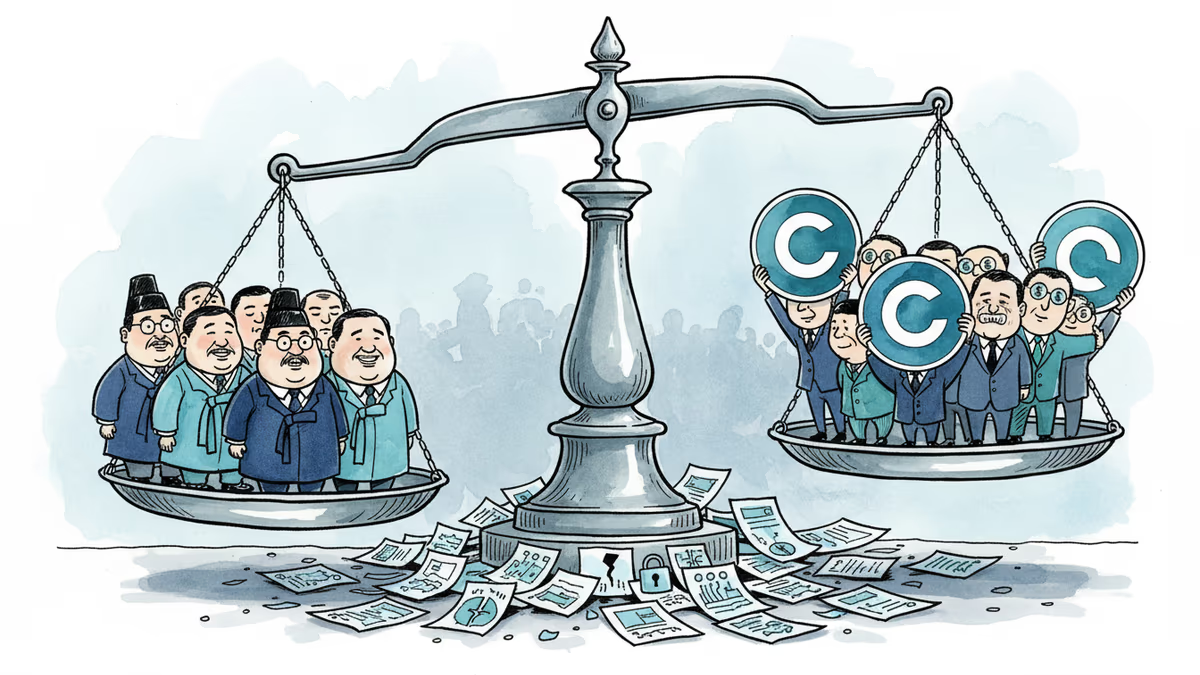
Coupang's data breach escalates into international arbitration under US-Korea FTA as American investors claim discriminatory treatment by Korean government
Granola's AI meeting app claims notes are "private by default," but anyone with a link can view them—and your data trains their AI unless you opt out. Here's what that means.
A complete guide to backing up your Android phone in 2026 — Google One, Samsung Cloud, local storage, and the 2FA codes most people forget until it's too late.
Google Maps' new Gemini-powered Ask Maps and Immersive Navigation features promise to turn the app into a conversational AI agent. But smarter maps mean deeper data collection.
Coupang's data breach escalates into international arbitration under US-Korea FTA as American investors claim discriminatory treatment by Korean government
Thoughts
Share your thoughts on this article
Sign in to join the conversation