
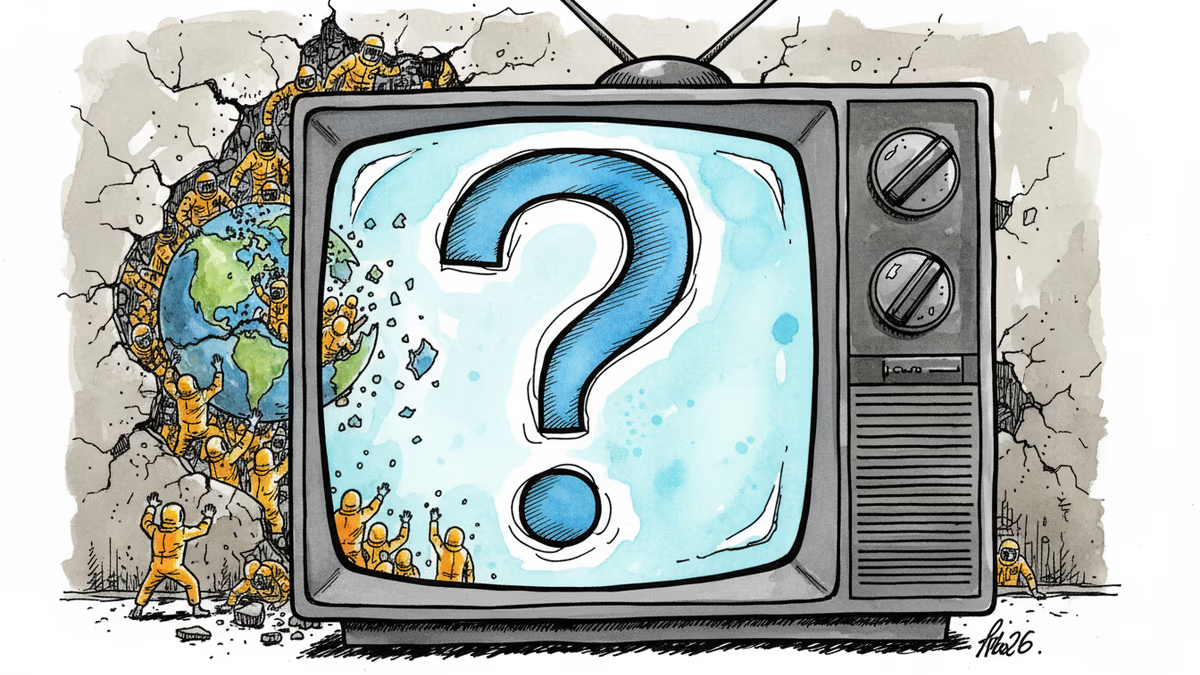
Stop Asking If You Should Panic About Hantavirus
The MV Hondius hantavirus outbreak isn't the real story. The real story is how media fear-framing is obscuring the slow collapse of the global public health system designed to protect us.
If a news headline asks whether you should panic, the answer is almost always no. That's not reassurance — it's a structural flaw baked into how we cover disease outbreaks.
For two weeks, coverage of the hantavirus cluster aboard the cruise ship MV Hondius has been organized around a single axis: should you, the reader, be afraid? "Should you worry about hantavirus?" "Should you panic?" "Should you freak out?" There's even an informal rule in journalism about this — a question posed in a headline almost never expects a "yes" for an answer. The framing is designed to reassure. And that's precisely the problem.
What Actually Happened
As of May 12, 2026, the MV Hondius outbreak had produced 11 confirmed or probable hantavirus cases and 3 deaths. After some early confusion — understandable given that a seaborne hantavirus outbreak is genuinely unprecedented — the response machinery kicked into gear. Spain accepted the vessel at Tenerife in the Canary Islands despite local objections, citing legal and moral obligations. Passengers were met dockside by workers in hazmat suits. 18 US-bound passengers are being held in dedicated quarantine units; the planes that carried them home were fitted with special biocontainment equipment. Other contacts around the world are being isolated and monitored.
The reassurances from officials have been consistent and, technically, accurate. WHO Director-General Tedros Adhanom Ghebreyesus told Tenerife residents: "This is not another Covid." WHO epidemic chief Maria Van Kerkhove told reporters: "This is not SARS-CoV-2. This is not the start of a Covid pandemic." Acting CDC Director Jay Bhattacharya said on CNN that "we don't want to cause a public panic." If you are not a passenger or close contact of someone aboard the Hondius, the most likely outcome — based on everything we know about hantavirus — is that this outbreak will be contained and will not affect you directly.
So: no, you should not panic. But that's where the useful part of this framing ends.
The Question Nobody's Asking

The "should you panic?" structure has one predictable effect: it forces every responsible public health official into a single, mandatory register. They must say "no." They have no other option. And by saying "no," they flatten a genuinely complicated situation into a binary — either it's coming for you, or it isn't worth your attention.
But the implicit logic is faulty. The fact that the general public has nothing immediate to fear does not mean this situation is normal or fine. A respiratory disease outbreak with some person-to-person transmission, a fatality rate of roughly 40%, no vaccine, and no cure, aboard a vessel carrying hundreds of passengers — that is not a normal situation. The gap between the "don't panic" messaging and what people can actually see on their screens gets filled, reliably, by TikTok creators predicting human extinction. That's not a media literacy problem. It's a framing vacuum that irresponsible voices are happy to occupy.
There are also legitimate scientific uncertainties that the reassurance framing papers over. The total documented record of person-to-person hantavirus transmission across all known outbreaks amounts to roughly 300 cases worldwide. A 2018 outbreak produced three super-spreader events before it was suppressed. When the WHO says person-to-person transmission generally requires "close prolonged contact," that describes the median — not the tail risk. Early Covid-era assurances about transmission dynamics were later revised dramatically. The cost of over-caution here is small. The cost of being wrong in the other direction is not.
Some experts, including Harvard's Joseph Allen and former White House Covid coordinator Ashish Jha, have argued for more stringent quarantine measures for Hondius passengers rather than the self-monitoring approach applied to those deemed lower risk. The 2003 SARS outbreak killed fewer than 800 people globally — and still cost the world economy at least $40 billion. The calculus of caution is asymmetric, and it should not be driven by managing audience feelings.
The Infrastructure Nobody's Talking About
If there's something genuinely worth sustained public attention in this story, it's this: the global public health system designed to catch and contain exactly this kind of outbreak is being quietly dismantled.
The CDC has shed roughly a quarter of its staff since January 2025. Its acting director is simultaneously running the National Institutes of Health. Georgetown's Lawrence Gostin told the Associated Press flatly that "the CDC is not even a player" in the global response to the Hondius outbreak. Meanwhile, Argentina — the country where this outbreak most likely originated — withdrew from the WHO just two weeks before the Hondius departed its waters, following the United States' own exit from the organization.
The international disease surveillance and response network that helped suppress SARS, contain MERS, and eventually — imperfectly, at enormous cost — manage Covid, depends on trust, data-sharing, and institutional capacity that is currently eroding in several major nodes simultaneously. That erosion doesn't generate the same visceral headlines as a cruise ship quarantine. But it is the structural condition that determines whether the next outbreak, whatever it is, gets caught early or doesn't.
Hantavirus will almost certainly not become a pandemic. The biology, the historical record, and the current response all point in the same direction. But "almost certainly" is doing real work in that sentence, and the systems that turn "almost certainly" into "definitely" are under strain in ways that a two-week cycle of "should you panic?" coverage doesn't capture.
This content is AI-generated based on source articles. While we strive for accuracy, errors may occur. We recommend verifying with the original source.
Related Articles
The WHO declared an Ebola emergency in May 2026. But this outbreak is caused by the Bundibugyo strain — and no approved vaccine or treatment exists for it. Here's why that changes everything.
The UK's generational tobacco ban—permanent for anyone born after 2009—isn't just a health policy. It reveals how decades of 'grudging toleration' quietly build the case for outright bans, with implications for social media and gambling apps.
Trump withdrew Casey Means's surgeon general nomination, signaling the limits of the MAHA movement. What happens when wellness culture tries to become public health policy?
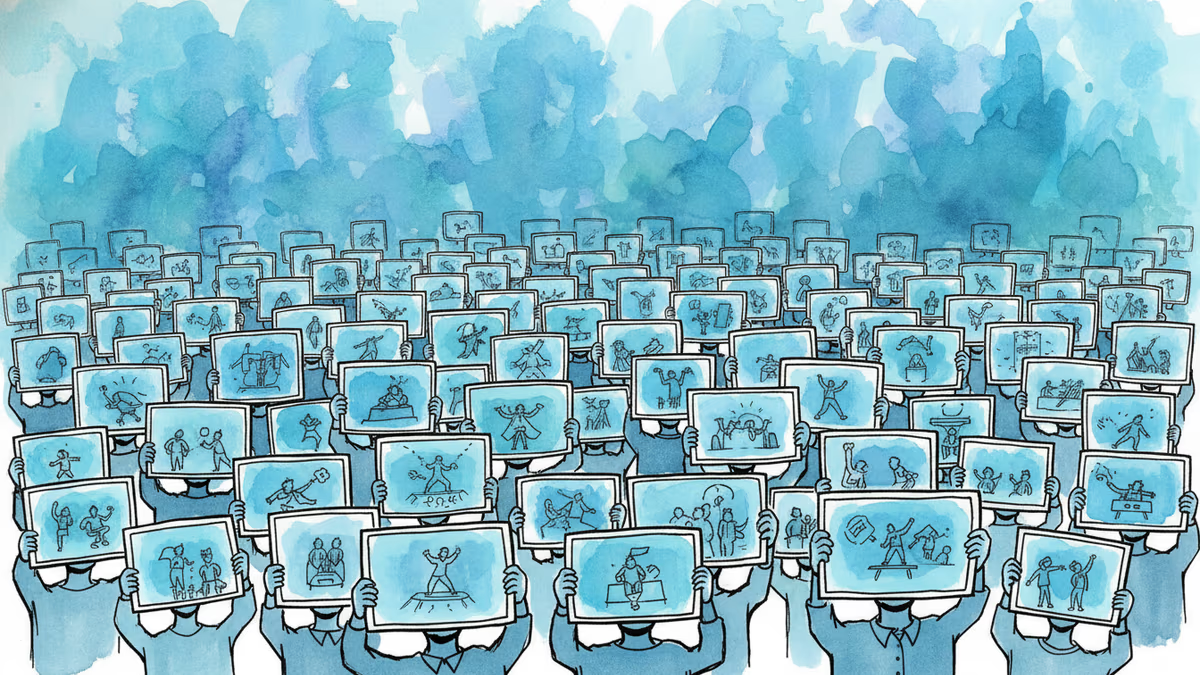
Megan Garber's new book Screen People argues that internet culture has trained us to see each other as characters in an endless show—and that this is making us sick.
The WHO declared an Ebola emergency in May 2026. But this outbreak is caused by the Bundibugyo strain — and no approved vaccine or treatment exists for it. Here's why that changes everything.
The UK's generational tobacco ban—permanent for anyone born after 2009—isn't just a health policy. It reveals how decades of 'grudging toleration' quietly build the case for outright bans, with implications for social media and gambling apps.
Trump withdrew Casey Means's surgeon general nomination, signaling the limits of the MAHA movement. What happens when wellness culture tries to become public health policy?
Megan Garber's new book Screen People argues that internet culture has trained us to see each other as characters in an endless show—and that this is making us sick.
Thoughts
Share your thoughts on this article
Sign in to join the conversation