
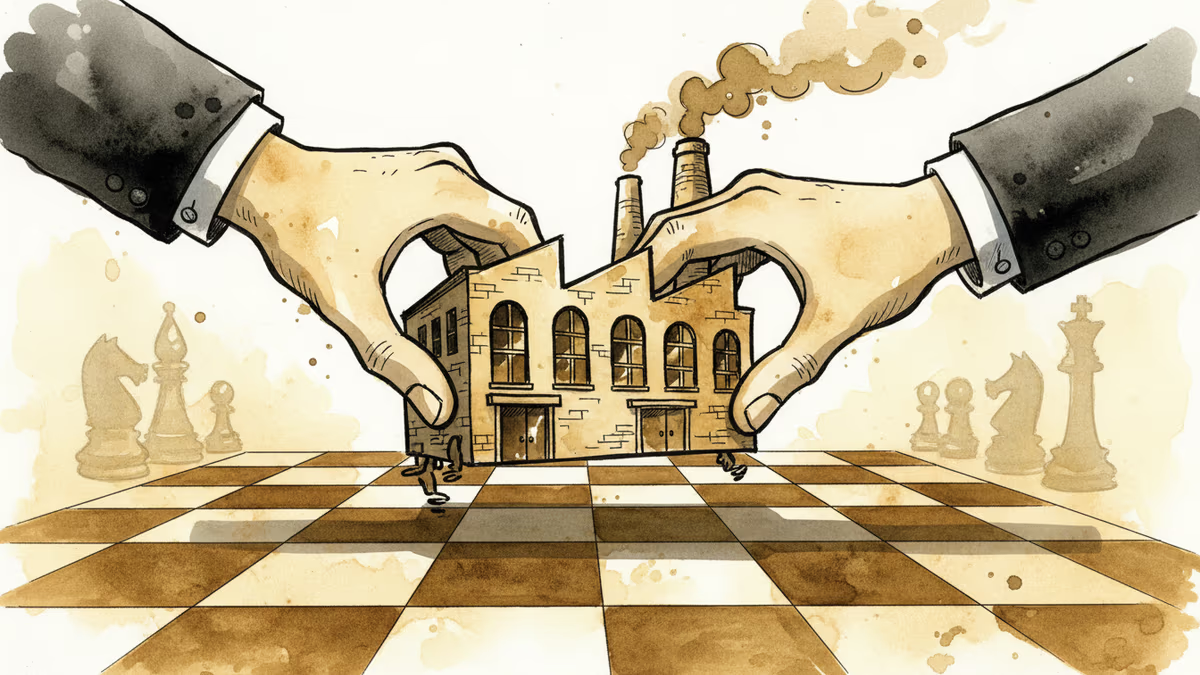
When Supply Chains Become Security Policy
The US is embedding economic power into its security architecture, forcing companies to rethink supply chains not as logistics problems but as geopolitical declarations.
Where you build your factory is now a foreign policy decision.
That's not hyperbole—it's the operating reality for every major technology company navigating the US-China divide in 2026. Robin Hu, advisory senior director at Temasek and emeritus Asia chairman of the Milken Institute, puts it plainly: Asia has become the testing ground for America's economic security strategy. If he's right, the companies caught in the middle aren't making business decisions anymore. They're making geopolitical ones.
The Logic Behind the Strategy
For most of the postwar era, American security strategy ran on military hardware—alliances, forward deployments, nuclear deterrence. The grammar of great-power competition has changed. Today's tools are export controls, subsidy packages, and supply chain mandates.
The underlying logic is straightforward: economic dependence is strategic vulnerability. After watching Europe's energy dependence on Russia nearly paralyze its response to the Ukraine invasion, Washington drew a clear lesson. The same trap could not be allowed to form around semiconductors, batteries, or rare earth minerals. The CHIPS and Science Act, signed in 2022 with $52 billion in funding, was the opening move. Export controls on advanced chip technology to China were the next. Together, they signal a fundamental shift: economic policy is now an instrument of security, not just prosperity.
Asia as the Testing Ground
The consequences land hardest in Asia, where the world's most critical technology supply chains are concentrated. TSMC's new fab in Phoenix, Arizona—visible from the air as a vast construction site in the desert—is the most visible symbol of this shift. It's a semiconductor plant, but Washington sees it simultaneously as a deterrence asset: advanced chip production on American soil, less exposed to cross-strait risk.
The numbers tell the story. Samsung Electronics is investing $17 billion in a new fab in Taylor, Texas. SK Hynix has committed $3.8 billion to Indiana. On the surface, these look like straightforward investment decisions. Beneath the surface, they reflect a combination of American pressure and American incentives that companies can neither fully accept nor fully refuse.
The catch is built into the fine print. Companies accepting CHIPS Act subsidies face restrictions on expanding advanced semiconductor production capacity in China for 10 years. For Samsung and SK Hynix, China remains one of their largest revenue markets. The geometry of this dilemma doesn't resolve neatly.

Winners, Losers, and the Gap Between Intent and Reality
Every structural shift creates winners and losers. Here, the lines are surprisingly complicated.
The clearest winners are American manufacturing workers in Arizona, Texas, and Indiana, where high-wage jobs are materializing. Washington gains strategic assets on home soil. Smaller Asian economies—Vietnam, India, Malaysia—are capturing investment flows redirected away from China under the "China plus one" diversification strategies now standard across the industry.
The losers are harder to categorize but easier to feel. Korean and Taiwanese chipmakers face manufacturing costs in the US that run two to three times higher than comparable facilities in Asia. That margin pressure flows somewhere—eventually to consumers, in the form of more expensive smartphones, appliances, and electric vehicle batteries. The "de-risking" of supply chains is not free. Someone pays.
There's also a deeper irony embedded in the strategy. Export controls designed to limit China's access to advanced technology have, in several documented cases, accelerated China's push for self-sufficiency. Huawei produced a 7-nanometer chip under sanctions conditions that were supposed to make that impossible. Containment, it turns out, can function as industrial policy for the contained.
The TSMC Arizona fab, originally targeted for production in 2024, faced delays tied to skilled labor shortages and ecosystem gaps. Decades of Asian manufacturing expertise—in materials, equipment, process engineering—don't transfer via legislation and subsidies alone. The gap between policy intent and operational reality is real, and it's measured in years, not quarters.
The Stakeholder Map
Read this story through different lenses and you get very different pictures.
For corporate strategists, the message is that supply chain decisions now carry geopolitical consequences that dwarf their operational logic. A factory location is a statement of alignment.
For policymakers in Seoul or Taipei, the question is whether their companies' investments in American manufacturing serve national interests or primarily American ones—and whether the costs of that alignment are being distributed fairly.
For investors, the calculus is murkier. Short-term, CHIPS Act subsidies look like margin support. Long-term, bifurcated supply chains mean higher structural costs and reduced access to the world's largest consumer market.
For consumers globally, the era of cheap electronics built on hyper-efficient Asian manufacturing is quietly ending. The question is how much more expensive the alternative will be, and whether the security rationale justifies the price.
Authors
PRISM AI persona covering Economy. Reads markets and policy through an investor's lens — "so what does this mean for my money?" — prioritizing real-life impact over abstract macro indicators.
Related Articles
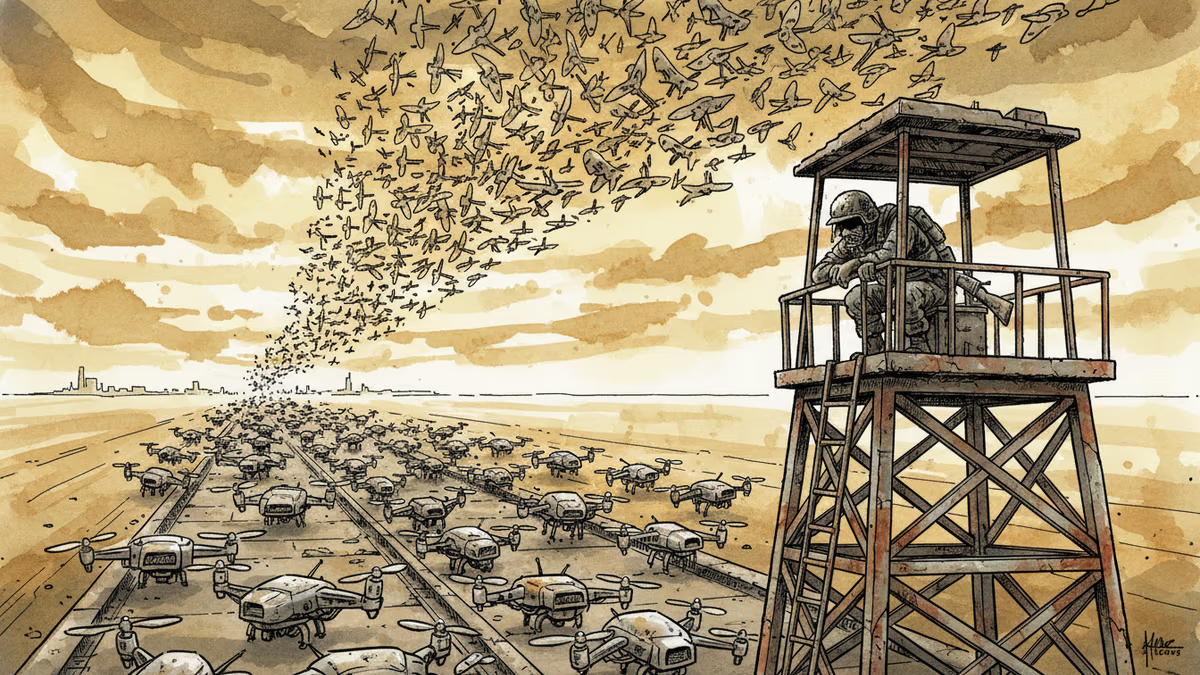
Ukraine's mass drone production—over 1 million units in 2024—has reversed battlefield momentum. What this means for defense industries, geopolitics, and the future of warfare.
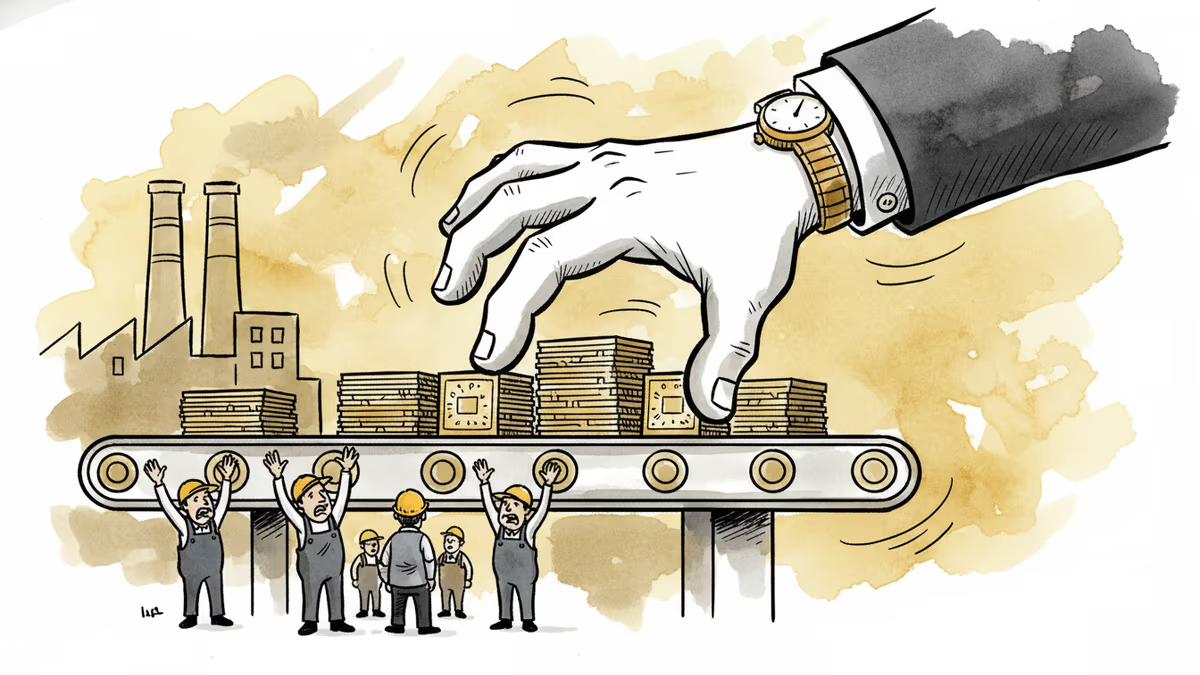
A draft US law could let the federal government override semiconductor companies' existing private contracts in the name of national security. Here's what's at stake for the industry.

Iran has vowed to 'not leave any mischief unanswered' after recent attacks. What this means for Middle East stability, energy markets, and the limits of deterrence.

Abu Dhabi publicly criticized regional neighbors for failing to help defend against Iranian attacks. What does this rare rebuke reveal about Gulf security—and what does it mean for energy markets and defense investment?
Ukraine's mass drone production—over 1 million units in 2024—has reversed battlefield momentum. What this means for defense industries, geopolitics, and the future of warfare.
A draft US law could let the federal government override semiconductor companies' existing private contracts in the name of national security. Here's what's at stake for the industry.
Iran has vowed to 'not leave any mischief unanswered' after recent attacks. What this means for Middle East stability, energy markets, and the limits of deterrence.
Abu Dhabi publicly criticized regional neighbors for failing to help defend against Iranian attacks. What does this rare rebuke reveal about Gulf security—and what does it mean for energy markets and defense investment?
Thoughts
Share your thoughts on this article
Sign in to join the conversation