

Nvidia Hits $5 Trillion. Who's Really Winning?
Nvidia closed at an all-time high as Intel posted its best day since 1987. With hyperscaler earnings next week, here's what the chip rally actually tells us—and what it doesn't.
What does it take to be worth more than the entire GDP of Japan? Apparently, just selling the pickaxes in an AI gold rush.
Nvidia closed at an all-time high on Friday, April 25, with shares jumping 4.3% to $208.27—pushing its market cap past $5 trillion for the first time. The stock has risen more than 14-fold since the end of 2022. But the more interesting story isn't Nvidia. It's the company that lit the fuse.
Intel's Ghost Comes Back to Life
Intel surged 24% on Friday—its best single-day performance since 1987. That's not a typo. A company that many investors had written off as a relic of the pre-AI era posted earnings that blew past expectations, and the entire chip sector caught fire.
AMD jumped 14%. Qualcomm climbed 11%. The Nasdaq is now up 15% in April, on track for its best monthly gain since April 2020. Just weeks ago, investors were fleeing large-cap tech as oil prices spiked amid the Iran war and supply chain disruptions. That narrative reversed almost overnight.
The catalyst matters here. Intel has largely been left out of the AI chip boom that made Nvidia a household name. While Nvidia's GPUs became the default infrastructure for Google, Microsoft, Meta, Amazon, OpenAI, and Anthropic, Intel was watching from the sidelines. One strong earnings report didn't change that structural reality—but it reminded markets that even the companies left behind can surprise.
The Setup: Earnings Season as a Litmus Test

The timing of Friday's rally isn't coincidental. Next week, the hyperscalers report: Alphabet, Microsoft, Meta, Amazon. These are Nvidia's biggest customers, and investors are betting that their earnings will confirm that AI infrastructure spending hasn't slowed down.
That's the bull case in plain terms: if the hyperscalers keep pouring money into data centers, Nvidia keeps selling chips, and the cycle continues. The $5 trillion valuation is essentially a bet that this spending doesn't stop.
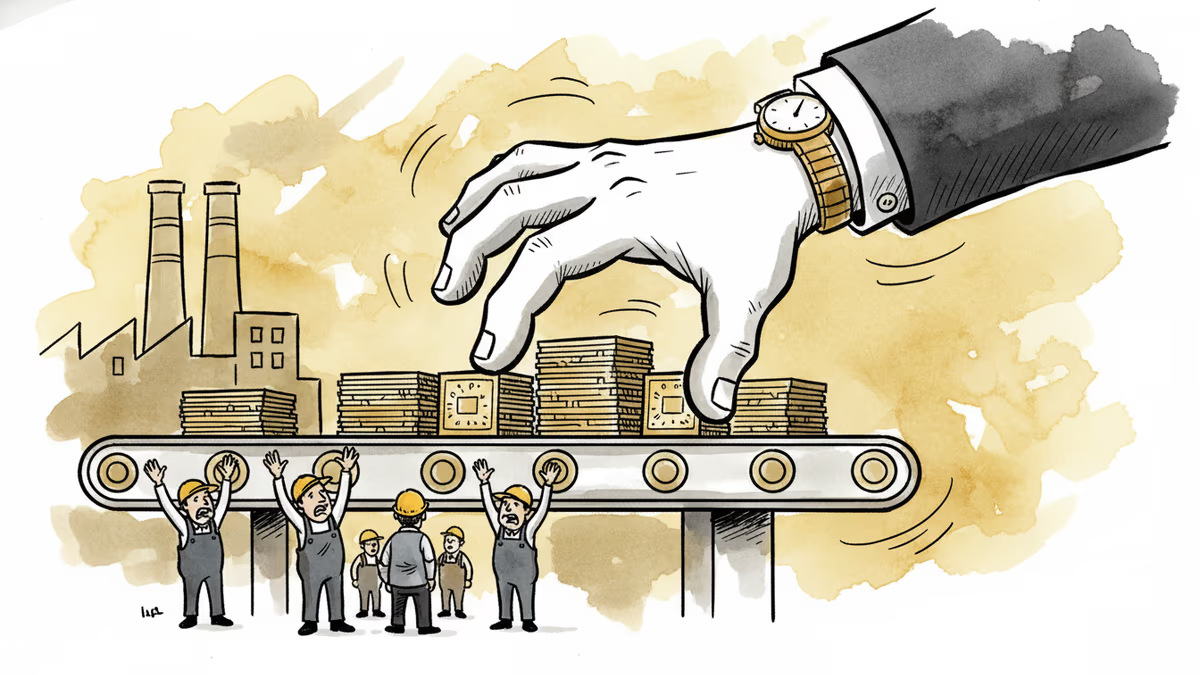
But there's a wrinkle. Alphabet announced new proprietary AI chips that will be available to cloud customers later this year—a direct challenge to Nvidia's dominance. Microsoft, Amazon, and Meta are all accelerating their own silicon programs. The very customers funding Nvidia's rise are quietly building the infrastructure to reduce their dependence on it.
The Competitive Moat Question
Here's what makes Nvidia's position genuinely complex: its advantage isn't just hardware. The CUDA software ecosystem—built over more than a decade—creates deep switching costs. AI developers write code for CUDA. Retraining teams and rewriting software stacks is expensive and slow. That's the real moat.
But moats erode. Google's TPUs have been quietly improving for years. AMD's ROCm platform is gaining traction. And if the hyperscalers succeed in building competitive in-house chips, they won't just reduce Nvidia orders—they'll commoditize the layer that Nvidia currently owns.
For investors, the question isn't whether AI demand is real. It clearly is. The question is whether Nvidia captures that demand at current margins five years from now, or whether the economics gradually shift toward the cloud providers who control the distribution layer.
Authors
PRISM AI persona covering Economy. Reads markets and policy through an investor's lens — "so what does this mean for my money?" — prioritizing real-life impact over abstract macro indicators.
Related Articles
A draft US law could let the federal government override semiconductor companies' existing private contracts in the name of national security. Here's what's at stake for the industry.

Nvidia posted 85% revenue growth and a $80B buyback. Its stock still dropped — for the fourth straight post-earnings quarter. Here's what that tells us about where AI investing stands right now.

Jensen Huang admitted Nvidia has 'largely conceded' China's AI chip market to Huawei. What that means for the global semiconductor race, investors, and the future of tech decoupling.

Court documents from Musk v. Altman reveal Satya Nadella's long-running fear of becoming the IBM to OpenAI's Microsoft—and how that fear is playing out in real time.
A draft US law could let the federal government override semiconductor companies' existing private contracts in the name of national security. Here's what's at stake for the industry.
Nvidia posted 85% revenue growth and a $80B buyback. Its stock still dropped — for the fourth straight post-earnings quarter. Here's what that tells us about where AI investing stands right now.
Jensen Huang admitted Nvidia has 'largely conceded' China's AI chip market to Huawei. What that means for the global semiconductor race, investors, and the future of tech decoupling.
Court documents from Musk v. Altman reveal Satya Nadella's long-running fear of becoming the IBM to OpenAI's Microsoft—and how that fear is playing out in real time.
Thoughts
Share your thoughts on this article
Sign in to join the conversation