
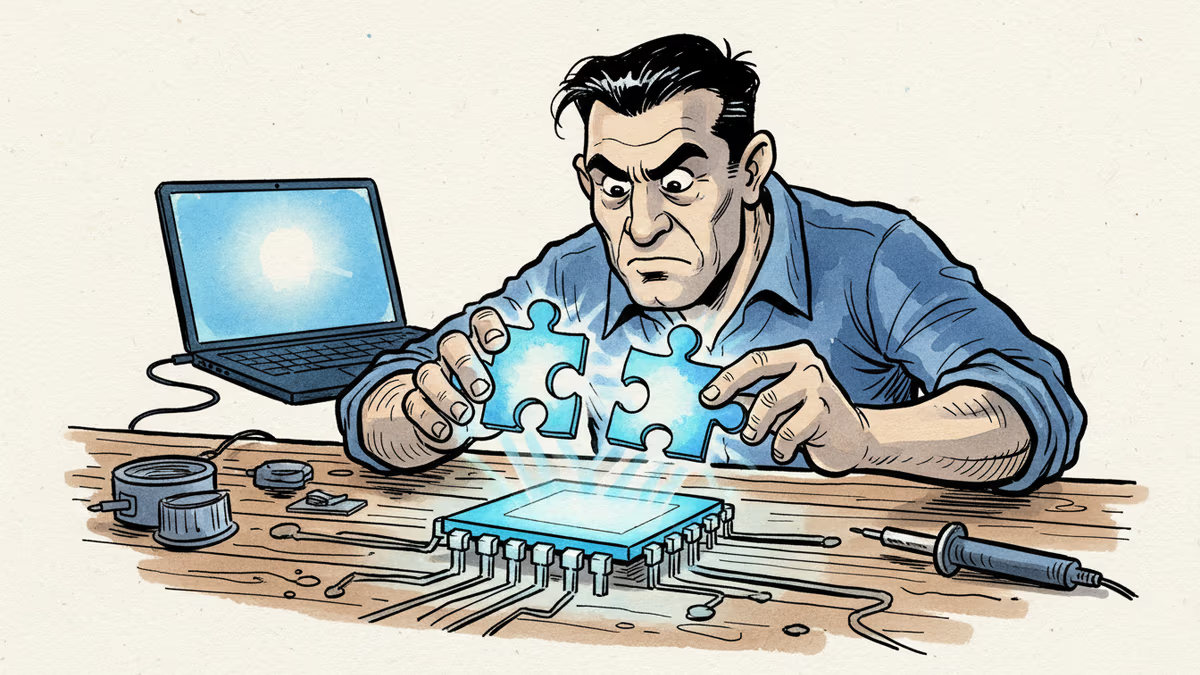
Apple's M5 Is No Longer One Chip — Here's Why That Matters
Apple's M5 Pro and M5 Max abandon the monolithic chip design for a split-die "Fusion Architecture." What this quiet engineering shift means for consumers, the industry, and the future of silicon.
The Chip That Used to Be One Thing Is Now Two
For years, Apple's pitch on its custom silicon was elegantly simple: everything in one place, talking to everything else at maximum speed. One die, no compromises, no seams. That philosophy just quietly changed.
With the M5 Pro and M5 Max, Apple has moved away from the monolithic chip design that defined the M1 through M4 generations. Instead of cramming CPU cores, GPU cores, memory controllers, and everything else onto a single piece of silicon, the new chips split the work across two separate dies — one handling the CPU side, one handling the GPU side — then package them together into what looks and behaves like a single chip. Apple calls it the "Fusion Architecture."
The numbers make the logic visible. Both the M5 Pro and M5 Max share the same 18-core CPU die. The GPU die is where they diverge: Pro gets a 20-core GPU die, Max gets a 40-core version. Since the memory controller lives on the GPU die, the Max also pulls ahead on memory bandwidth and maximum memory capacity.
This Isn't New — But It Is Significant
The Fusion Architecture isn't a brand-new concept inside Apple. It's the same approach used to build the M1 Ultra and M2 Ultra — essentially two Max chips fused together for the Mac Studio and Mac Pro. What's changed is the level at which Apple is applying it. This time, the split-die approach starts at the Pro tier, not just the flagship.
That's a meaningful shift in strategy. The semiconductor industry has been moving in this direction for years. Intel calls its version "tiles," AMD calls them "chiplets." The underlying logic is the same: smaller dies have higher manufacturing yields. When you're etching billions of transistors onto silicon, a single defect can kill an entire large die. Break it into smaller pieces, and you lose less material to defects — and gain the ability to mix and match components more flexibly.

The fact that M5 Pro and M5 Max share a CPU die is the clearest sign of that flexibility. Apple can now tune GPU performance independently without redesigning the entire chip. It's a manufacturing efficiency play dressed up as an architecture announcement.
What Consumers Actually Get — And What They Don't
For the person buying a new MacBook Pro, the day-to-day experience is straightforward: faster video exports, smoother 3D renders, better performance-per-watt. The internal architecture is invisible at the application layer. Creative professionals — video editors, motion designers, ML researchers — will notice the raw throughput gains. Most other users will notice the battery life holding steady even as performance climbs.
What consumers don't get is a reason to upgrade if they're already on M3 or M4. The generational leap here is real but incremental for typical workflows. The more consequential change is structural, and its payoff compounds over time.
For professionals evaluating the Mac Studio or MacBook Pro against Windows workstations, the calculus is shifting. A 40-core GPU with unified memory architecture is a different class of machine for AI inference workloads than what was available in consumer laptops 18 months ago. The gap between "laptop chip" and "workstation chip" is narrowing faster than the price gap is.
The Industry Reads Between the Lines
TSMC, which manufactures M5 chips on its 3nm second-generation process, is the quiet winner in this transition. Apple's adoption of advanced packaging — the technology that makes multi-die chips behave as one — deepens its reliance on TSMC's CoWoS and SoIC packaging capabilities. For Samsung Foundry, which lost Apple's chip business years ago, this trajectory makes a return path harder, not easier.
For AMD and Intel, Apple's move is both validation and pressure. Validation, because it confirms that chiplet-style design is the direction high-performance computing is heading. Pressure, because Apple is implementing it with a level of software-hardware integration that x86 vendors can't easily replicate — the unified memory model, in particular, remains a structural advantage that no amount of chiplet stacking on the PC side has matched.
Investors watching the AI PC narrative should note: the M5 Max with 128GB of unified memory is quietly one of the most capable on-device AI inference platforms available outside of a data center. As local AI workloads grow — whether for privacy reasons, latency reasons, or cost reasons — that matters more than any benchmark number.
Authors
Related Articles

Five stories from late September, traced to where the paper trail stops: Korea's export record, Nvidia's Hugging Face 8-K, a US-China AI channel, the UN on AI, and rising births.

The US government invested $2 billion in quantum computing startups, but Congress says the money was never authorized for that purpose. The fate of IBM-backed Anderon hangs in the balance.

Beijing added an Nvidia gaming chip to its customs ban list the same week Jensen Huang visited China with Trump. Here's what it means for the chip war—and who actually wins.

After 15 years of fragmented mobile messaging, Apple and Google are rolling out end-to-end encrypted RCS messaging between iPhones and Android devices. Here's what changed, why it took so long, and what it means for your privacy.
Five stories from late September, traced to where the paper trail stops: Korea's export record, Nvidia's Hugging Face 8-K, a US-China AI channel, the UN on AI, and rising births.
The US government invested $2 billion in quantum computing startups, but Congress says the money was never authorized for that purpose. The fate of IBM-backed Anderon hangs in the balance.
Beijing added an Nvidia gaming chip to its customs ban list the same week Jensen Huang visited China with Trump. Here's what it means for the chip war—and who actually wins.
After 15 years of fragmented mobile messaging, Apple and Google are rolling out end-to-end encrypted RCS messaging between iPhones and Android devices. Here's what changed, why it took so long, and what it means for your privacy.
Thoughts
Share your thoughts on this article
Sign in to join the conversation