
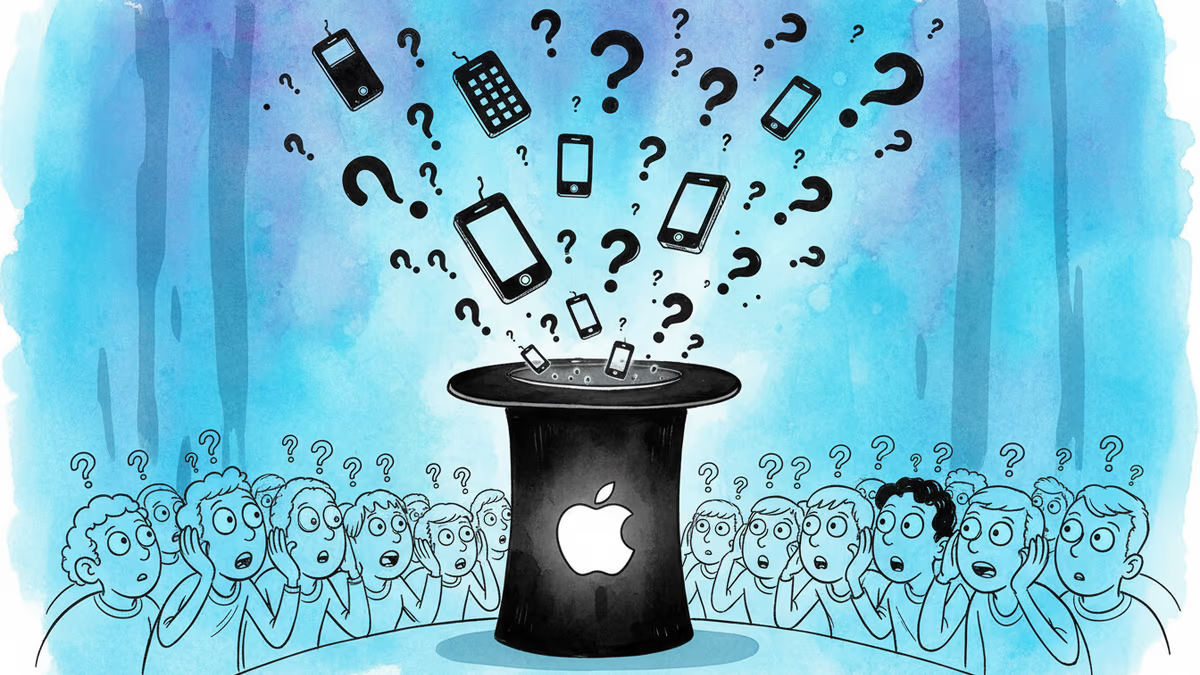
Apple's March 4 'Special Experience' - What's Really Coming?
Apple announces a March 4 event in NYC branded as 'Special Apple Experience.' With iPhone 17e rumors swirling and budget phone market heating up, what's Apple's next move?
The $599 Question That Could Reshape Everything
Apple just dropped an invitation for March 4, calling it a "Special Apple Experience." True to form, they've revealed absolutely nothing about what they're actually announcing. But here's what the rumor mill—and some strategic thinking—tells us about what might be coming.
The event kicks off at 9 AM ET in New York City. While Apple doesn't follow a rigid release schedule for most products, recent speculation points toward one particular device that could shake up the budget phone landscape.
Enter the iPhone 17e: Budget Phone, Premium Ambitions
The iPhone 17e represents Apple's latest attempt to crack the code on affordable premium. This updated budget-oriented device will reportedly pack an A19 chip—the same processor powering the base iPhone 17. Add MagSafe charging to the mix, and you've got a compelling value proposition.
But let's manage expectations. Don't expect the multi-camera arrays that define Apple's flagship phones. The company's strategic differentiation remains intact.
The real story, though, isn't about specs—it's about pricing strategy.

The Crowded Middle: Apple's $600-800 Problem
Here's where things get interesting. Right now, the iPhone 16, iPhone 17, and 16e are all clustered in that $600-800 sweet spot. If Apple launches another $599 device into this already crowded space, it won't exactly set the market on fire.
But what if they're planning something different? What if this isn't just about adding another option, but about redefining what "budget" means in the Apple ecosystem?
The Broader Stakes: Ecosystem vs. Hardware
For Apple, budget phones aren't really about the hardware—they're about the gateway drug. Every iPhone 17e sold is a potential customer locked into Apple's services ecosystem for years to come. That $99 annual iCloud subscription, those App Store purchases, the inevitable AirPods upgrade—the math adds up quickly.
Competitors like Samsung and Google are watching closely. Samsung's Galaxy A series dominates the mid-range globally, while Google's Pixel a-series has carved out its own niche. Apple's entry could force everyone to recalibrate their strategies.
What Wall Street's Really Watching
Investors aren't just looking at unit sales—they're watching average selling prices (ASPs) and services revenue. A successful budget iPhone that cannibalizes higher-margin models could actually hurt Apple's bottom line in the short term, even if it expands market share.
The question becomes: Can Apple thread the needle between accessibility and profitability?
Authors
Related Articles
After 15 years of fragmented mobile messaging, Apple and Google are rolling out end-to-end encrypted RCS messaging between iPhones and Android devices. Here's what changed, why it took so long, and what it means for your privacy.
Apple agreed to pay $250 million to settle claims it misled iPhone 16 buyers about Apple Intelligence features. What this means for consumers, Big Tech marketing, and the AI industry.
Apple quietly removed the entry-level $599 Mac Mini, raising the starting price to $799 — just one day after Tim Cook warned of chip supply constraints on the earnings call.

Apple names John Ternus, its hardware engineering chief, as the next CEO. The shift from operator to product person signals where Apple thinks its next decade of growth will come from — and raises real questions about what comes next.
After 15 years of fragmented mobile messaging, Apple and Google are rolling out end-to-end encrypted RCS messaging between iPhones and Android devices. Here's what changed, why it took so long, and what it means for your privacy.
Apple agreed to pay $250 million to settle claims it misled iPhone 16 buyers about Apple Intelligence features. What this means for consumers, Big Tech marketing, and the AI industry.
Apple quietly removed the entry-level $599 Mac Mini, raising the starting price to $799 — just one day after Tim Cook warned of chip supply constraints on the earnings call.
Apple names John Ternus, its hardware engineering chief, as the next CEO. The shift from operator to product person signals where Apple thinks its next decade of growth will come from — and raises real questions about what comes next.
Thoughts
Share your thoughts on this article
Sign in to join the conversation