
Apple's $599 MacBook Neo: Cheap or Just Compromised?
Apple's new $599 MacBook Neo promises affordability, but comparing it to older MacBook Airs reveals a complex value proposition that might leave buyers confused.
The $599 Question That's Harder Than It Looks
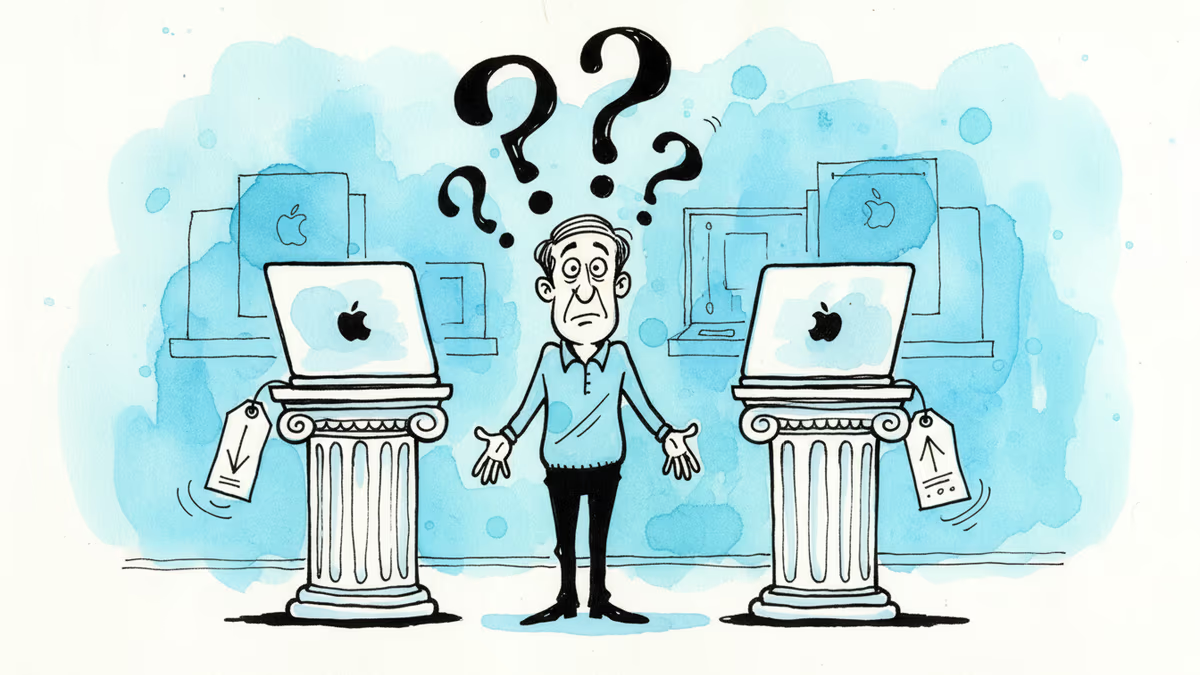
When Apple announced the MacBook Neo today at $599, my first instinct wasn't excitement—it was skepticism. "Why not just get an older Air?" seemed like the obvious question. Turns out, it's more complicated than that.
The Neo starts at $599 with an A18 Pro processor, 8GB of memory, and 256GB storage. The top configuration adds TouchID and 512GB storage for $699. What you're giving up is significant: no Thunderbolt ports (just USB-C), a basic display, mechanical trackpad instead of haptic, and various other cost-cutting measures.
The Vanishing Alternative
Here's where Apple's strategy gets clever—and potentially frustrating for consumers. The new M5 MacBook Air starts at $1,099 with 16GB memory and 512GB of much faster storage. That's a $500 jump from the Neo's base price.

But here's the catch: finding older MacBook Airs is becoming increasingly difficult. Apple has a history of quietly reducing supply of previous-generation models when new ones launch. That "just get an older Air" advice? It might not be practical much longer.
Students might find the Neo appealing for basic tasks—documents, web browsing, video streaming. But professionals could quickly hit the 8GB memory wall, especially with modern web apps that are notorious memory hogs.
The Broader Market Reality
This launch comes as the laptop market faces interesting pressures. Chromebooks have proven there's demand for affordable, capable machines. Meanwhile, Windows laptops in the $600-800 range often offer better specs on paper.
Apple's betting that macOS and ecosystem integration justify the premium, even in a "budget" model. For users already invested in iPhone and iPad, that might be true. For everyone else? The value proposition gets murky.
Retailers are likely thrilled—the Neo gives them an entry point to upsell customers to higher-margin models. "For just $400 more, you get double the memory and storage..." becomes an easy pitch.
Authors
Related Articles
After 15 years of fragmented mobile messaging, Apple and Google are rolling out end-to-end encrypted RCS messaging between iPhones and Android devices. Here's what changed, why it took so long, and what it means for your privacy.
Apple agreed to pay $250 million to settle claims it misled iPhone 16 buyers about Apple Intelligence features. What this means for consumers, Big Tech marketing, and the AI industry.
Apple quietly removed the entry-level $599 Mac Mini, raising the starting price to $799 — just one day after Tim Cook warned of chip supply constraints on the earnings call.
Apple names John Ternus, its hardware engineering chief, as the next CEO. The shift from operator to product person signals where Apple thinks its next decade of growth will come from — and raises real questions about what comes next.
After 15 years of fragmented mobile messaging, Apple and Google are rolling out end-to-end encrypted RCS messaging between iPhones and Android devices. Here's what changed, why it took so long, and what it means for your privacy.
Apple agreed to pay $250 million to settle claims it misled iPhone 16 buyers about Apple Intelligence features. What this means for consumers, Big Tech marketing, and the AI industry.
Apple quietly removed the entry-level $599 Mac Mini, raising the starting price to $799 — just one day after Tim Cook warned of chip supply constraints on the earnings call.
Apple names John Ternus, its hardware engineering chief, as the next CEO. The shift from operator to product person signals where Apple thinks its next decade of growth will come from — and raises real questions about what comes next.
Thoughts
Share your thoughts on this article
Sign in to join the conversation