
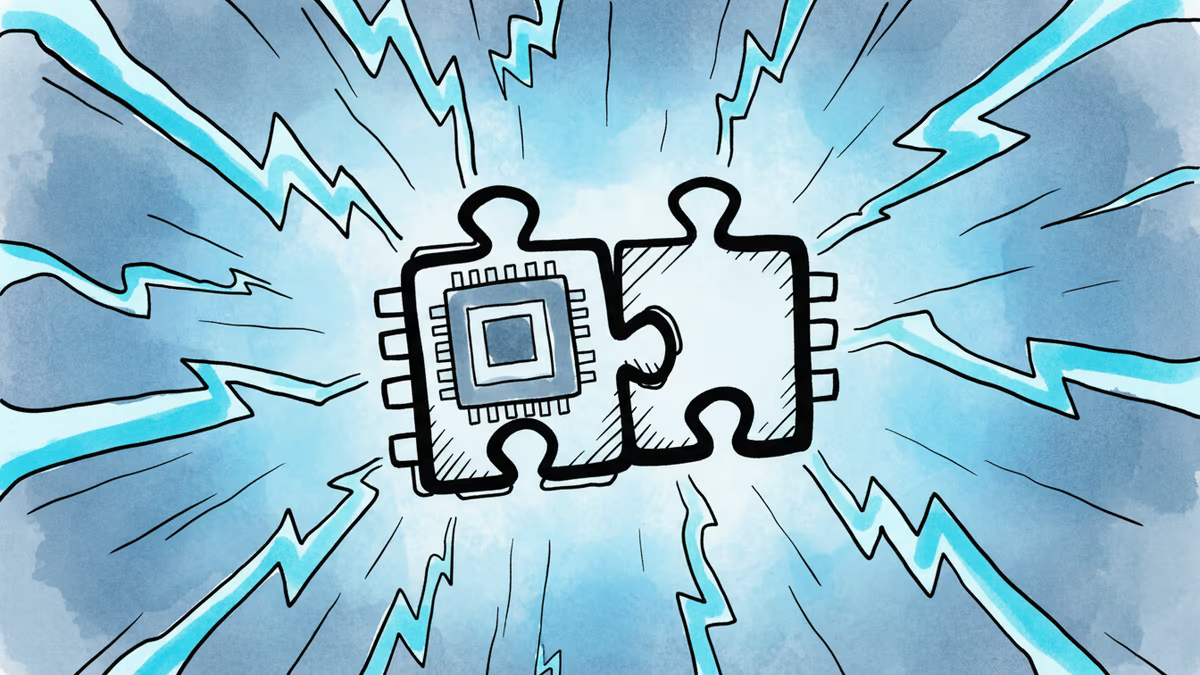
Apple's M5 Fusion Architecture: The Chiplet Revolution Goes Mainstream
Apple's M5 Pro and M5 Max introduce Fusion Architecture, merging two dies into one SoC. This chiplet approach could reshape semiconductor design paradigms across the industry.
When Two Becomes One: 614GB/s Changes Everything
Apple dropped the M5 Pro and M5 Max on Tuesday, and buried in the spec sheet is a number that tells a bigger story: 614GB/s memory bandwidth on the M5 Max. That's a 25% jump from the previous generation. But the real story isn't the number—it's the Fusion Architecture that makes it possible. By merging two separate dies into a single system-on-chip, Apple just made chiplet design mainstream. The question is: will the rest of the industry follow?
Breaking the Monolithic Mindset
For decades, the semiconductor playbook was simple: make transistors smaller, make chips faster. But with Moore's Law hitting physical limits, Apple's taken a different approach. Instead of cramming everything onto one massive die, the M5 series uses Fusion Architecture—two dies working as one unified SoC.
This isn't just about performance. It's about rethinking what a "chip" even means. The M5 Pro and M5 Max both pack 18-core CPUs, up from 14 cores in the M4 Pro and 16 in the M4 Max. But it's not just more cores—it's six "super cores" (Apple's term for its highest-performance cores) plus 12 all-new performance cores, delivering up to 30% better performance for pro workloads.
The architecture challenge here is massive. Getting two dies to behave like one chip requires solving latency, power management, and thermal issues that single-die designs never face. Apple's betting that this complexity is worth it—and early signs suggest they're right.
GPU Wars: The AI Battlefield
The GPU story is where things get really interesting. The M5 Max scales up to a 40-core GPU, with each core featuring a Neural Accelerator. Apple claims this delivers "over 4x the peak GPU compute for AI compared to the previous generation."
That's not just marketing speak. Graphics performance is up 20% overall, with ray-tracing workloads seeing 35% improvements. But the AI angle is what matters most. With every GPU core now packing dedicated AI acceleration, Apple's positioning these chips for the machine learning workloads that define the next decade of computing.

Memory tells the same story. The M5 Pro supports up to 64GB of unified memory (up from 48GB), while the M5 Max maintains 128GB support but bumps bandwidth to that eye-catching 614GB/s. For AI researchers and 3D animators—Apple's explicit target users—this isn't just nice-to-have. It's table stakes.
The Professional User Calculation
Apple's targeting is surgical. The M5 Pro aims at data modelers, post-production sound designers, and STEM students—users who need serious CPU/GPU performance but don't require absolute maximum specs. The M5 Max goes after 3D animators, app developers, and—tellingly—AI researchers who need maximum GPU compute and memory bandwidth.
That AI researcher callout isn't accidental. Apple's positioning the M5 Max as a legitimate alternative to NVIDIA's workstation GPUs for AI development. Whether it can actually compete with dedicated AI hardware remains to be seen, but the intent is clear.
Industry Ripple Effects
Apple's chiplet approach puts pressure on the entire semiconductor ecosystem. Intel's been talking about chiplets for years with limited success. AMD's made progress with their Zen architecture, but nothing as integrated as Apple's solution. NVIDIA's focused on raw AI performance rather than architectural innovation.
For memory manufacturers like Micron and Samsung, Apple's bandwidth demands create both opportunity and pressure. Higher-performance memory commands premium prices, but it also raises the bar for everyone else.
The foundry angle is equally complex. Apple's continued reliance on TSMC's cutting-edge processes gives the Taiwanese company enormous leverage. But it also creates supply chain risks that competitors might exploit.
The Broader Silicon Strategy
What Apple's really doing is redefining the relationship between hardware and software. By controlling the entire stack—from silicon to OS to applications—they can optimize in ways that traditional chip companies can't match.
This vertical integration advantage becomes more pronounced with each generation. While competitors focus on raw benchmarks, Apple optimizes for real-world workflows. The result is chips that often punch above their theoretical weight class.
The new MacBook Pro models with M5 chips are available for pre-order tomorrow, with general availability starting March 11. Pricing and specific configurations will tell us how aggressively Apple's positioning these chips against traditional workstation alternatives.
Authors
Related Articles

After 15 years of fragmented mobile messaging, Apple and Google are rolling out end-to-end encrypted RCS messaging between iPhones and Android devices. Here's what changed, why it took so long, and what it means for your privacy.
Apple agreed to pay $250 million to settle claims it misled iPhone 16 buyers about Apple Intelligence features. What this means for consumers, Big Tech marketing, and the AI industry.
Apple quietly removed the entry-level $599 Mac Mini, raising the starting price to $799 — just one day after Tim Cook warned of chip supply constraints on the earnings call.

Apple names John Ternus, its hardware engineering chief, as the next CEO. The shift from operator to product person signals where Apple thinks its next decade of growth will come from — and raises real questions about what comes next.
After 15 years of fragmented mobile messaging, Apple and Google are rolling out end-to-end encrypted RCS messaging between iPhones and Android devices. Here's what changed, why it took so long, and what it means for your privacy.
Apple agreed to pay $250 million to settle claims it misled iPhone 16 buyers about Apple Intelligence features. What this means for consumers, Big Tech marketing, and the AI industry.
Apple quietly removed the entry-level $599 Mac Mini, raising the starting price to $799 — just one day after Tim Cook warned of chip supply constraints on the earnings call.
Apple names John Ternus, its hardware engineering chief, as the next CEO. The shift from operator to product person signals where Apple thinks its next decade of growth will come from — and raises real questions about what comes next.
Thoughts
Share your thoughts on this article
Sign in to join the conversation