
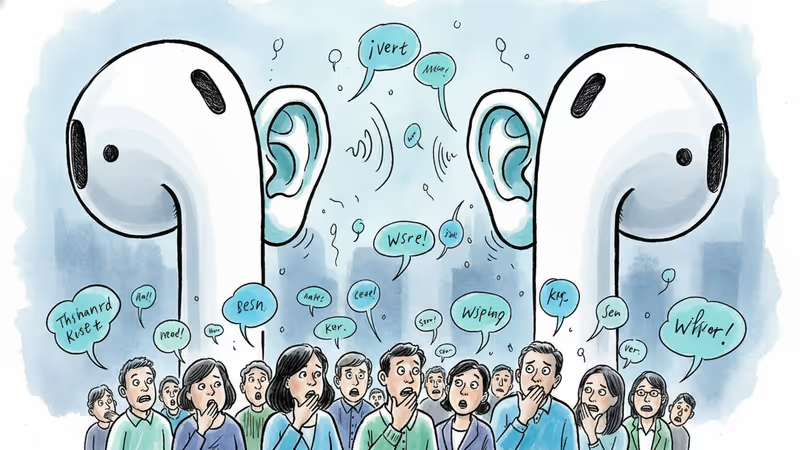
Apple's $2B Q.ai Deal: When Your AirPods Can Hear Whispers
Apple acquires Israeli AI startup Q.ai for nearly $2B, gaining whisper recognition and noise-canceling audio tech to enhance AirPods and Vision Pro capabilities.
$2 billion. That's what Apple just paid for Q.ai, an Israeli AI startup you've probably never heard of. But this little-known company might just revolutionize how your AirPods understand you.
According to Reuters, Q.ai specializes in imaging and machine learning technologies that enable devices to interpret whispered speech and enhance audio in noisy environments. Founded in 2022 and backed by Kleiner Perkins and Gradient Ventures, the startup is now Apple's second-largest acquisition ever, trailing only the $3 billionBeats Electronics deal in 2014.
The Whisper Revolution
Imagine AirPods that can understand you even when you're whispering in a library, or that can perfectly isolate your voice in a crowded subway station. That's the promise of Q.ai's technology.
Apple has already been adding AI features to its audio devices, including live translation capabilities introduced last year. But Q.ai's acquisition suggests Apple is thinking bigger. The company has also developed technology that detects subtle facial muscle activity—imagine controlling your Vision Pro headset with just a slight nod or lip movement.
What makes this deal particularly intriguing is the track record of Q.ai's CEO Aviad Maizels. This is his second sale to Apple. In 2013, he sold PrimeSense, a 3D-sensing company that played a crucial role in Apple's transition from fingerprint sensors to Face ID on iPhones. Lightning doesn't strike twice by accident.

The AI Hardware Arms Race
Apple, Meta, and Google are locked in an increasingly fierce battle to dominate the next wave of AI, and they've recently shifted focus to hardware. Meta's Ray-Ban smart glasses can now identify objects and translate languages in real-time. Google's Pixel Buds offer live translation features. Apple's Q.ai acquisition signals its intention to leapfrog the competition in audio AI.
The timing is no coincidence. This news broke just hours before Apple's quarterly earnings, where analysts expect around $138 billion in revenue and the company's strongest iPhone sales growth in four years. Apple is clearly betting big on AI-powered hardware as its next growth driver.
Beyond the Hype: Real-World Impact
But what does this actually mean for consumers? Consider the implications: AirPods that can perfectly filter out background noise during calls, translate whispered conversations in real-time, or even detect health issues through subtle changes in your voice patterns.
For businesses, the applications are equally compelling. Customer service representatives could use whisper-recognition technology in open offices. Healthcare workers could dictate notes without disturbing patients. The possibilities extend far beyond consumer electronics.
Yet this also raises privacy questions. If your earbuds can hear and interpret whispers, what happens to that data? Apple's emphasis on on-device processing may provide some comfort, but the trade-offs between convenience and privacy remain complex.
Authors
Related Articles
After 15 years of fragmented mobile messaging, Apple and Google are rolling out end-to-end encrypted RCS messaging between iPhones and Android devices. Here's what changed, why it took so long, and what it means for your privacy.
Apple agreed to pay $250 million to settle claims it misled iPhone 16 buyers about Apple Intelligence features. What this means for consumers, Big Tech marketing, and the AI industry.
Apple quietly removed the entry-level $599 Mac Mini, raising the starting price to $799 — just one day after Tim Cook warned of chip supply constraints on the earnings call.
Apple names John Ternus, its hardware engineering chief, as the next CEO. The shift from operator to product person signals where Apple thinks its next decade of growth will come from — and raises real questions about what comes next.
After 15 years of fragmented mobile messaging, Apple and Google are rolling out end-to-end encrypted RCS messaging between iPhones and Android devices. Here's what changed, why it took so long, and what it means for your privacy.
Apple agreed to pay $250 million to settle claims it misled iPhone 16 buyers about Apple Intelligence features. What this means for consumers, Big Tech marketing, and the AI industry.
Apple quietly removed the entry-level $599 Mac Mini, raising the starting price to $799 — just one day after Tim Cook warned of chip supply constraints on the earnings call.
Apple names John Ternus, its hardware engineering chief, as the next CEO. The shift from operator to product person signals where Apple thinks its next decade of growth will come from — and raises real questions about what comes next.
Thoughts
Share your thoughts on this article
Sign in to join the conversation