

Anthropic Launches Claude for Healthcare: The 2026 Medical AI Arms Race
Anthropic introduces Claude for Healthcare in 2026, featuring medical database connectors and administrative automation to compete with OpenAI's health initiatives.
AI just got its medical license—sort of. On January 12, 2026, Anthropic unveiled 'Claude for Healthcare,' a suite of tools designed for providers, payers, and patients. This move directly counters OpenAI’s recent healthcare push, as both companies race to capture a market where 230 million users already consult AI about their health weekly.
Anthropic Claude for Healthcare 2026 Capabilities
Unlike consumer-focused chat interfaces, Claude aims for deeper integration through its new 'connectors.' These tools allow the AI to access specialized databases including the ICD-10 classification, the CMS Coverage Database, and PubMed. These connections enable the model to assist with complex medical research and administrative tasks that typically drain clinician time.

Solving the Paperwork Crisis
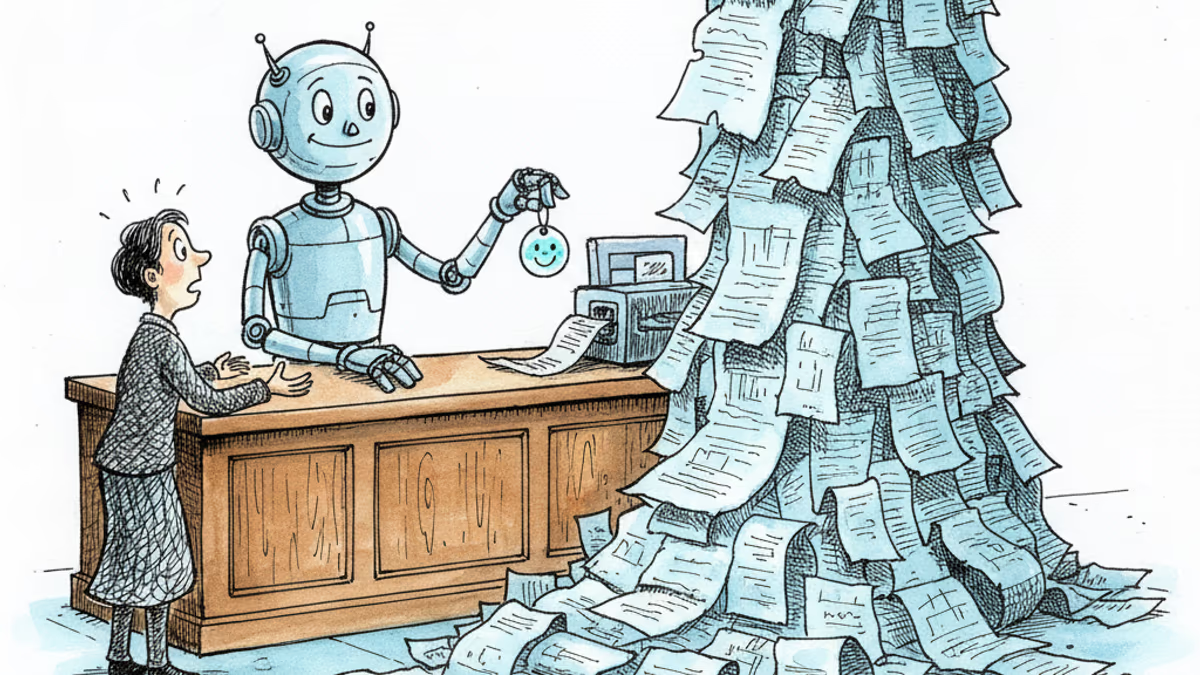
Anthropic CPO Mike Krieger emphasized that doctors often spend more time on documentation than on patients. Claude for Healthcare addresses this by automating the prior authorization process—a tedious administrative hurdle where doctors must prove to insurers that a treatment is necessary. By streamlining this, Anthropic positions Claude as a vital operational tool rather than just a conversational bot.
Authors
Related Articles
Anthropic shipped Claude Sonnet 5, its mid-tier agent model, on June 30. Behind the 'Opus-class power, budget price' headline sits a tokenizer catch and a three-horse race that's only half real. Here's what developers should actually run the numbers on.

A small but growing group of developers has gone all-in on AI coding agents like Claude Code and OpenClaw. History suggests the rest of us won't be far behind.

OpenAI has reorganized for the second time in a month, merging ChatGPT and Codex into a single agentic platform under president Greg Brockman's unified product leadership.

After two weeks of witnesses calling him a liar, OpenAI CEO Sam Altman testified in his own defense, claiming Elon Musk tried to kill the company twice.
Anthropic shipped Claude Sonnet 5, its mid-tier agent model, on June 30. Behind the 'Opus-class power, budget price' headline sits a tokenizer catch and a three-horse race that's only half real. Here's what developers should actually run the numbers on.
A small but growing group of developers has gone all-in on AI coding agents like Claude Code and OpenClaw. History suggests the rest of us won't be far behind.
OpenAI has reorganized for the second time in a month, merging ChatGPT and Codex into a single agentic platform under president Greg Brockman's unified product leadership.
After two weeks of witnesses calling him a liar, OpenAI CEO Sam Altman testified in his own defense, claiming Elon Musk tried to kill the company twice.
Thoughts
Share your thoughts on this article
Sign in to join the conversation