
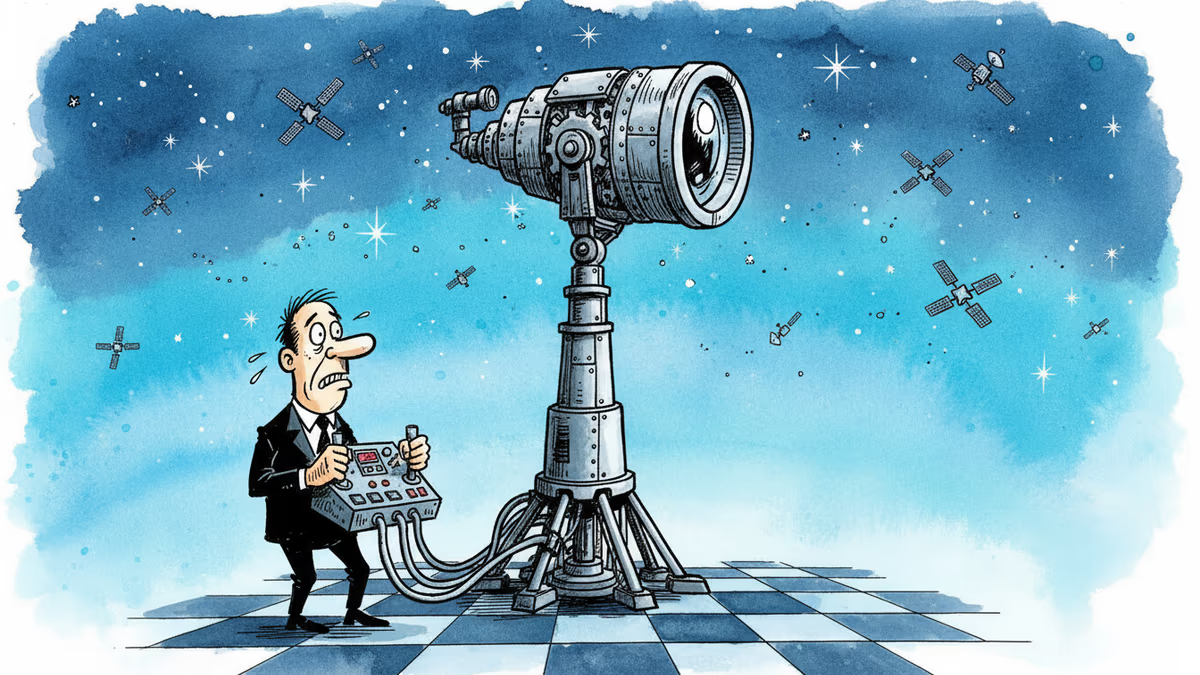
Who Owns the Eyes Watching Every Satellite?
Anduril's acquisition of ExoAnalytic Solutions — the world's largest commercial telescope network — signals a fundamental shift in who controls space domain awareness. What are the stakes?
Right now, hundreds of satellites are maneuvering in orbits you can't see. Until Wednesday, the most comprehensive commercial network watching them belonged to an independent intelligence firm. Now it belongs to a defense startup.
Anduril Industries announced its acquisition of ExoAnalytic Solutions, a space intelligence company that operates the world's largest commercial telescope network — more than 400 systems deployed across the globe. For nearly two decades, ExoAnalytic has quietly supplied software, modeling, simulation, and expertise to classified U.S. national security space programs, including missile warning and missile defense. The acquisition price was not disclosed.
What 400 Telescopes Actually Do
This isn't about stargazing. ExoAnalytic's network delivers what defense planners call Space Domain Awareness (SDA) — the persistent, high-fidelity ability to track what's happening in deep space. Which satellites are maneuvering unexpectedly. Which are approaching others. Which might be weapons.
In an era where China and Russia have both demonstrated satellite-disabling capabilities, SDA has become as strategically critical as radar was in the 20th century. The difference is that this radar is now owned by a private company.
Anduril, founded in 2017 and backed by Peter Thiel and other Silicon Valley heavyweights, has built its identity around bringing tech-industry speed to defense contracting. Its autonomous drone defense systems and AI battlefield platforms have already made it a central Pentagon partner. This acquisition is a clear pivot: from the battlefield floor to the orbital layer thousands of miles above it.
The Privatization of National Security Infrastructure

Here's the tension worth sitting with. The U.S. government has increasingly outsourced space capability to private firms — SpaceX for launch, Planet Labs for imagery, and now Anduril/ExoAnalytic for surveillance. The efficiency argument is compelling: private companies move faster, innovate cheaper, and don't require congressional budget cycles.
But a telescope network that tracks every significant object in deep space is not a typical commercial asset. It's infrastructure. And infrastructure has a way of becoming leverage.
Consider the stakeholders. For the U.S. military, this consolidation is probably welcome — a trusted defense partner now controls a critical sensor layer. For allied nations like Japan, South Korea, Australia, and European NATO members who may rely on ExoAnalytic data, the question becomes: what are the terms of access now that a defense contractor holds the keys? For adversaries, the merger signals that the line between commercial and military space intelligence is effectively gone.
And for regulators — both in Washington and internationally — there's a harder question: what oversight framework applies to a private company that can track every nation's satellites in real time?
The Anduril Pattern
Anduril has been deliberate about vertical integration. It doesn't just want to build weapons; it wants to own the full kill chain — sensing, processing, deciding, acting. ExoAnalytic fits that architecture precisely. Persistent space surveillance feeds targeting data, which feeds autonomous systems, which feeds the next generation of defense platforms Anduril is already building.
This is the Silicon Valley playbook applied to national security: acquire the data layer first, then build everything on top of it. The difference from consumer tech is that the "users" here are governments, and the "product" is strategic advantage.
Authors
Related Articles
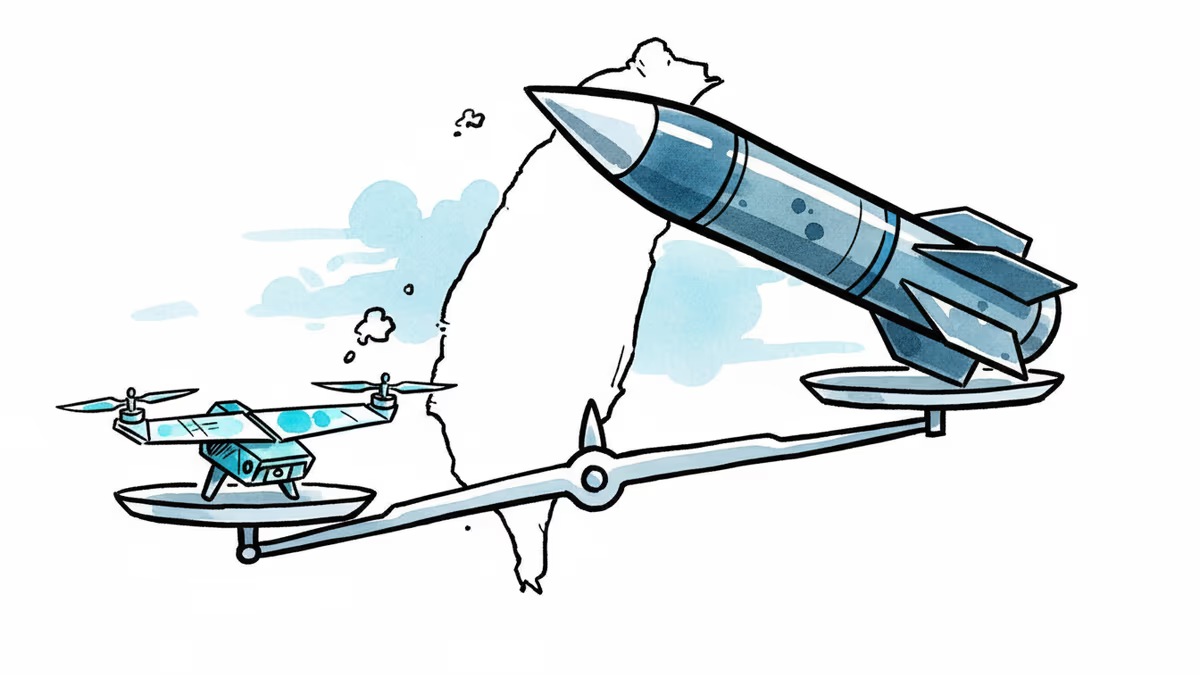
Taiwan's Thunder Tiger became the first Asian firm to win US military drone clearance with a China-free supply chain. As Trump meets Xi, the drone arithmetic reshapes defense strategy.
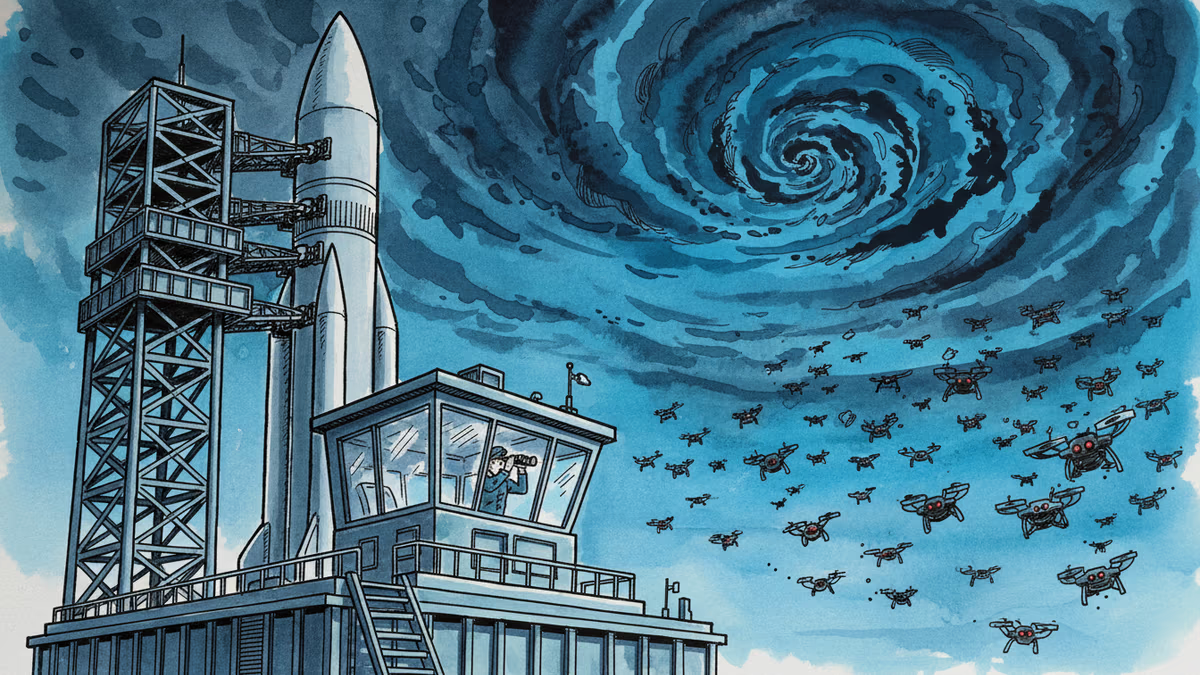
Russia's Plesetsk Cosmodrome has faced multiple drone attacks as Moscow races to build its own Starlink-like satellite network. What does this mean for the future of space warfare?

US Space Command confirms Russia has deployed operational anti-satellite weapons tracking American spy satellites in low-Earth orbit. What does this mean for space security?

Ukraine claims ground robots and drones forced Russian soldiers to surrender without a human soldier present. If verified, it marks a turning point in autonomous warfare with global implications.
Taiwan's Thunder Tiger became the first Asian firm to win US military drone clearance with a China-free supply chain. As Trump meets Xi, the drone arithmetic reshapes defense strategy.
Russia's Plesetsk Cosmodrome has faced multiple drone attacks as Moscow races to build its own Starlink-like satellite network. What does this mean for the future of space warfare?
US Space Command confirms Russia has deployed operational anti-satellite weapons tracking American spy satellites in low-Earth orbit. What does this mean for space security?
Ukraine claims ground robots and drones forced Russian soldiers to surrender without a human soldier present. If verified, it marks a turning point in autonomous warfare with global implications.
Thoughts
Share your thoughts on this article
Sign in to join the conversation