
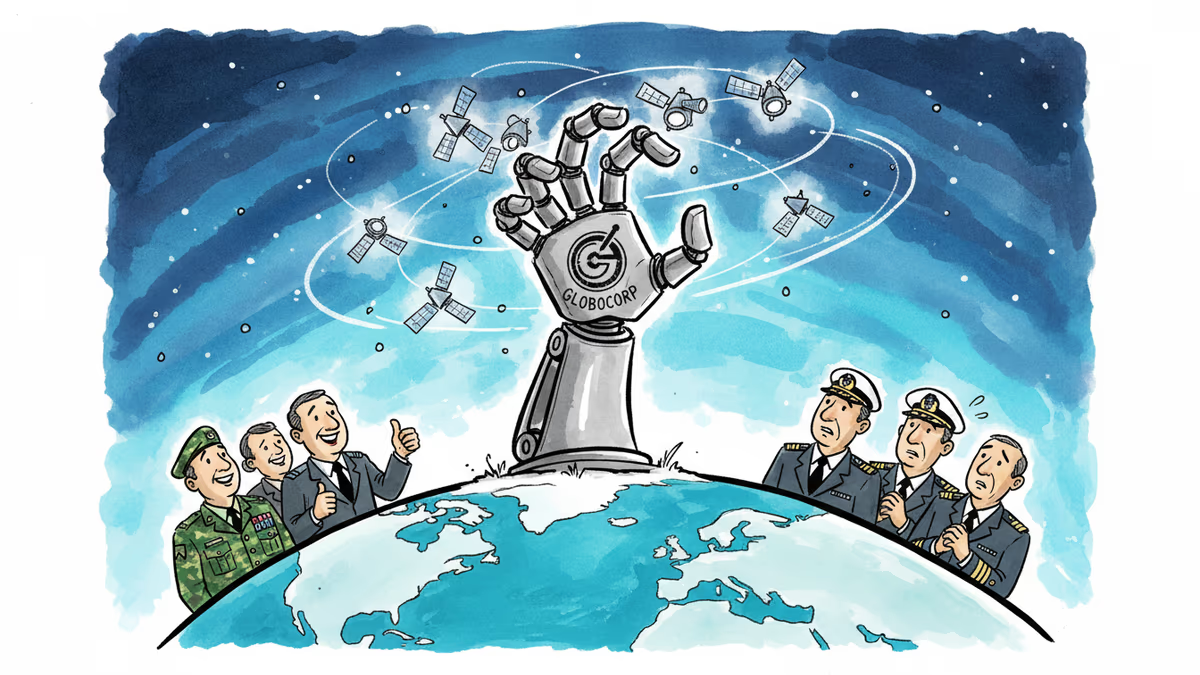
Anduril Just Bought the World's Largest Commercial Space Telescope Network
Anduril Industries acquires ExoAnalytic Solutions and its 400-telescope global network. As private firms take over space domain awareness, who really controls the eyes watching the skies?
Somewhere above 20,000 kilometers, a satellite changes its orbit. Quietly. No announcement. Most governments don't notice. ExoAnalytic Solutions does.
For nearly two decades, ExoAnalytic has operated what it calls the world's largest commercial telescope network — more than 400 optical systems deployed globally — tracking the silent maneuvers of satellites in deep space with persistent, high-fidelity precision. It has fed that intelligence into classified U.S. national security programs, missile warning systems, and missile defense architectures.
This week, Anduril Industries announced it's buying the whole thing.
What Anduril Is Actually Acquiring
On the surface, this looks like a straightforward defense acquisition. But the strategic logic runs deeper than the press release suggests.
Anduril — the venture-backed defense tech firm founded by Palmer Luckey and staffed heavily by Palantir and SpaceX alumni — already operates autonomous drone systems, the AI-driven battlefield management platform Lattice, and undersea autonomous vehicles. What it didn't have was eyes in space.
ExoAnalytic fills that gap entirely. The company doesn't just watch satellites — it models their behavior, simulates threat scenarios, and provides the software backbone for some of the U.S. military's most sensitive space programs. In Anduril's own words: ExoAnalytic has delivered "important advantages for the nation's most critical missions."
Add that to Anduril's existing portfolio and you get something that didn't exist before: a single private company with integrated domain awareness across land, sea, air, and now space.
Why This Deal Matters Right Now
The timing isn't incidental. Space has become a contested warfighting domain at a speed that traditional defense procurement simply can't match.

China has been rapidly expanding its low-Earth orbit satellite constellation. Russia demonstrated in early 2022 — just before invading Ukraine — that it could jam and disrupt Western satellite communications. Both nations have tested anti-satellite weapons (ASAT). The U.S. Space Force, created in 2019, remains the smallest and least-resourced branch of the American military.
The gap between what the Pentagon needs and what it can build internally is exactly where companies like Anduril operate. SpaceX's Starlink became a de facto military communications network in Ukraine without ever being formally contracted for that role. Now, space domain awareness — the ability to know what every satellite is doing, at all times — is following the same privatization trajectory.
For defense investors, this signals a clear direction: the next frontier of defense spending isn't just drones or AI — it's space situational intelligence.
The Case For — and Against — Private Space Eyes
The Pentagon has explicitly embraced commercial space capabilities in its recent strategic planning. The argument is straightforward: private firms innovate faster, procure faster, and can scale globally without the bureaucratic friction of government programs. ExoAnalytic's 400-telescope network took years to build commercially — a government program of equivalent scope might have taken decades.
But the critics aren't wrong to raise flags. Anduril is not publicly traded. Its governance is not subject to congressional oversight in the way a government agency would be. When the infrastructure for missile warning and satellite tracking sits inside a private balance sheet, questions of accountability become genuinely complicated.
Who decides how that intelligence is shared with allies? What happens if Anduril is acquired, goes bankrupt, or faces conflicting commercial incentives? And perhaps most urgently for AI ethicists: Anduril's core competency is autonomous AI decision-making. Fusing real-time space domain awareness with AI-driven response systems creates the technical conditions for missile warning assessments that could, in principle, outpace human judgment.
These aren't hypothetical concerns. They're the logical endpoint of a trajectory that this acquisition accelerates.
What Investors and Allies Should Watch
For defense tech investors, Anduril's move signals that the company is positioning for a comprehensive, multi-domain intelligence and response platform — not just a collection of hardware products. That's a different and potentially far more valuable business model. The question is whether the U.S. government becomes more dependent on Anduril over time, or whether it retains enough internal capability to negotiate from a position of strength.
For U.S. allies — particularly in Europe and the Indo-Pacific — this acquisition raises a subtler concern. Space domain awareness has historically been shared through formal intelligence-sharing frameworks like Five Eyes. If the underlying data infrastructure is now privately owned, those frameworks may need to be renegotiated. Allies may find themselves paying commercial rates for intelligence that was previously shared as a matter of alliance obligation.
For geopolitical analysts, the broader pattern is clear: the United States is increasingly outsourcing its strategic sensing capabilities to private firms. That's a bet on innovation speed over institutional control — and it's a bet with consequences that will play out over decades, not quarters.
Authors
Related Articles
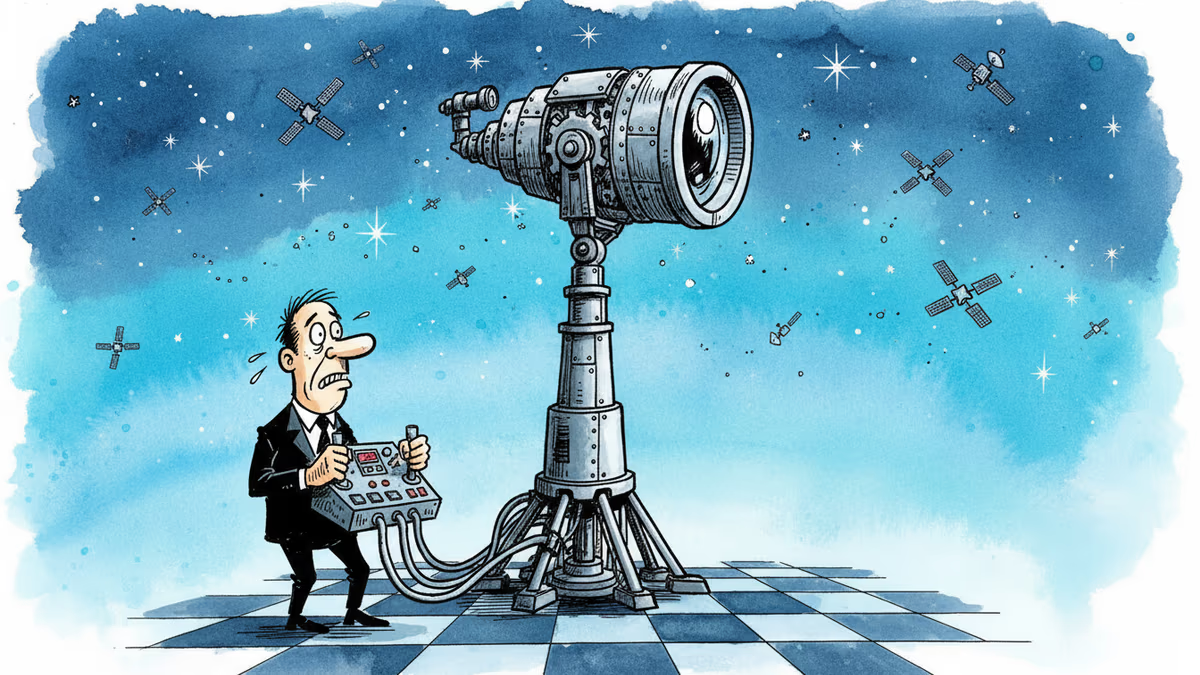
Anduril's acquisition of ExoAnalytic Solutions — the world's largest commercial telescope network — signals a fundamental shift in who controls space domain awareness. What are the stakes?
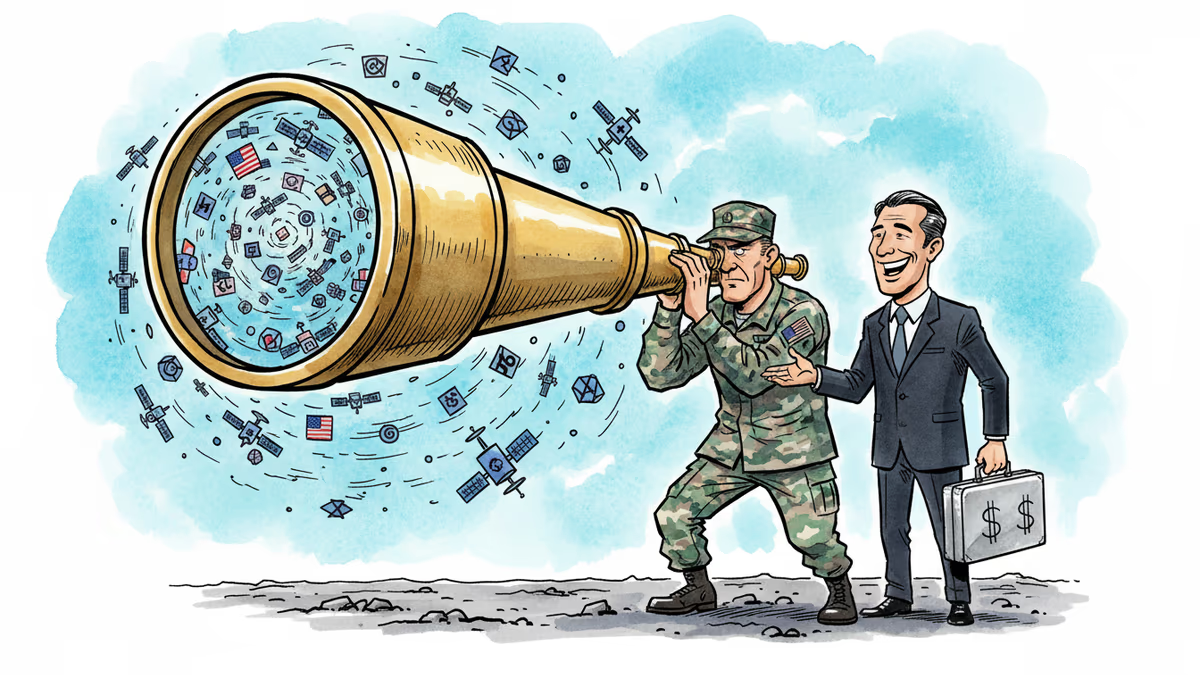
Defense tech firm Anduril is acquiring ExoAnalytic Solutions and its 400-telescope network to build real-time space domain awareness. Here's why it matters for Golden Dome, deterrence, and who controls the high ground.

Anduril's AI Grand Prix isn't just a recruitment event. It's a preview of how autonomous weapons will reshape both warfare and the talent wars.

Explore how the Helsing AI drone defense system is reshaping European security. From Project ASGARD to the $12B startup's autonomous drones, witness the future of digital warfare.
Anduril's acquisition of ExoAnalytic Solutions — the world's largest commercial telescope network — signals a fundamental shift in who controls space domain awareness. What are the stakes?
Defense tech firm Anduril is acquiring ExoAnalytic Solutions and its 400-telescope network to build real-time space domain awareness. Here's why it matters for Golden Dome, deterrence, and who controls the high ground.
Anduril's AI Grand Prix isn't just a recruitment event. It's a preview of how autonomous weapons will reshape both warfare and the talent wars.
Explore how the Helsing AI drone defense system is reshaping European security. From Project ASGARD to the $12B startup's autonomous drones, witness the future of digital warfare.
Thoughts
Share your thoughts on this article
Sign in to join the conversation