
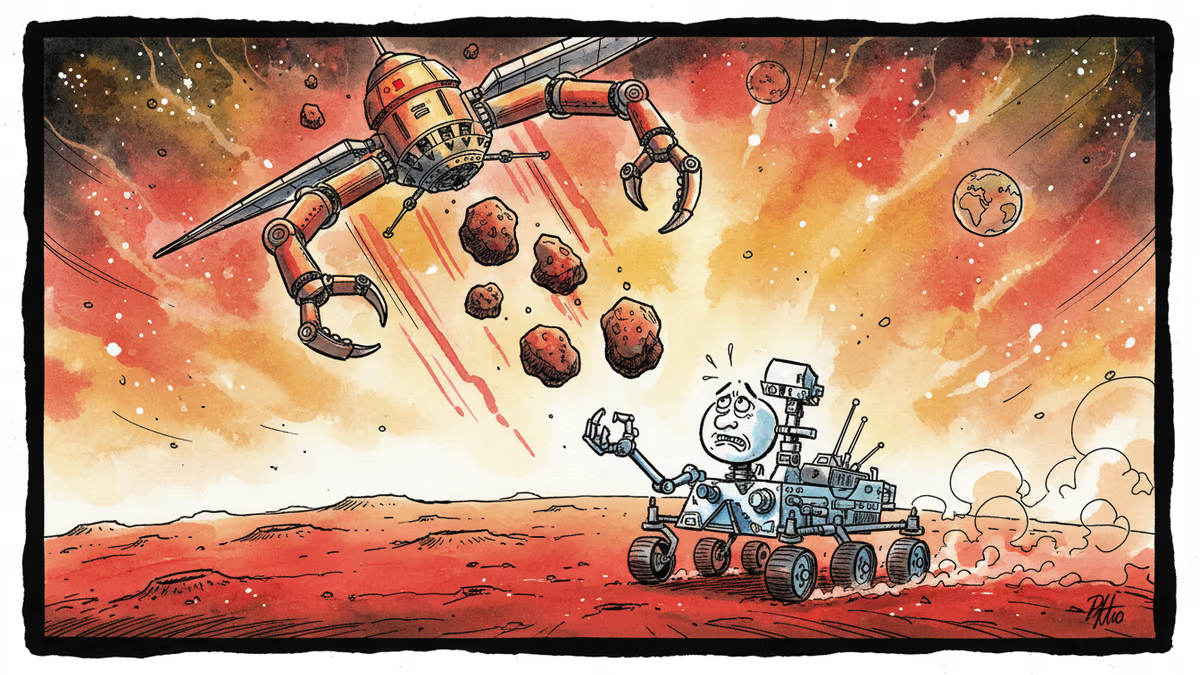
The Space Race America Just Lost
While the US abandons its Mars Sample Return mission after 50 years of preparation, China races toward bringing Martian rocks home by 2031. What went wrong with America's $11 billion bet?
What if 500 grams could rewrite human history?
That's the weight of Martian rock samples that might contain traces of alien life. But in the race to bring those 500 grams home, America just forfeited a 50-year head start to China.
In July 2024, NASA's Perseverance rover discovered something extraordinary on Mars: rocks with leopard-like spots and speckles. On Earth, such patterns almost always indicate microbial life. "If you do it, then human history is never the same," said Casey Dreier of the Planetary Society.
The problem? Those rocks will likely never see Earth.
The $11 Billion Dream That Died
America's Mars Sample Return (MSR) project became a cautionary tale of space ambition gone wrong. Costs doubled from $5.3 billion to $11 billion. Timeline slipped by a decade, from the 2030s to the 2040s. An independent review panel delivered a brutal verdict: "MSR was established with unrealistic budget and schedule expectations from the beginning."
Congress started asking whether MSR should be canceled outright. By January 2025, the answer was clear: $0 in funding for 2026. The project that was supposed to crown America's Mars exploration legacy was dead.
"We've spent 50 years preparing to get these samples back," says Philip Christensen, a planetary scientist at Arizona State University. "Now we're two feet from the finish line—Oh, sorry, we're not going to complete the job."
China's 2031 Moonshot

While America wrestled with budget overruns, China quietly perfected its game plan. In June 2025, Chinese researchers published their bold vision in Nature Astronomy: bring 500 grams of Martian samples home by 2031.
Their Tianwen-3 mission is elegantly simple. Two rockets launch in 2028—one carrying a lander, another an orbiter. The lander drills 7 feet deep, loads samples into a rocket, and blasts them into space where the orbiter catches them baseball-glove style.
It's the same technique China used to become the first nation to return samples from the moon's far side in 2024. "The technologies here are similar," explains Yuqi Qian, a lunar geologist at the University of Hong Kong.
The Irony of American Innovation
China's success builds directly on decades of American Mars exploration. NASA has been sending robots to Mars since 1976, developing the technologies that make sample return possible. Now China is essentially saying, "Thank you for the groundwork—we'll take it from here."
"The Chinese come along and say, Thank you very much, we'll take all of that information—we'll build one mission and go and do what you guys did the groundwork for," Christensen notes. "As a taxpayer, I'm like: It just seems foolish to me."
The technical hurdles remain immense. No one has ever launched a rocket from Mars's surface. But China's track record suggests they can pull it off. Their lunar missions succeeded on the first try—something no other nation has managed.
Beyond Bragging Rights
This isn't just about national pride. Mars Sample Return serves as a dress rehearsal for sending humans to Mars. If you can't safely launch samples from the Red Planet, how can you bring astronauts home?
China explicitly acknowledges this connection. Their Tianwen-3 study opens by stating that "Mars is the most promising planet for humanity's expansion beyond Earth." Losing the sample return race means ceding leadership in the next phase of space exploration entirely.
The implications extend beyond Mars. If America can't complete a mission it spent 50 years preparing for, what does that say about its ability to tackle other ambitious space projects? "If we don't pull this off, what does that mean?" asks planetary scientist Paul Byrne. "Are we not going to do big, expensive, difficult things?"
Authors
Related Articles

As the Kuiper Belt comes into focus with next-generation telescopes, astronomers prepare to discover 10 times more objects than the 4,000 found over 30 years—and possibly solve the Planet X mystery.

Samsung Electronics' union branch revealed that 84% of survey respondents oppose the government's roughly $290 billion (₩400 trillion) semiconductor megaproject in Gwangju. Government, management, the union and shareholders are all reading the same national project in sharply different ways.
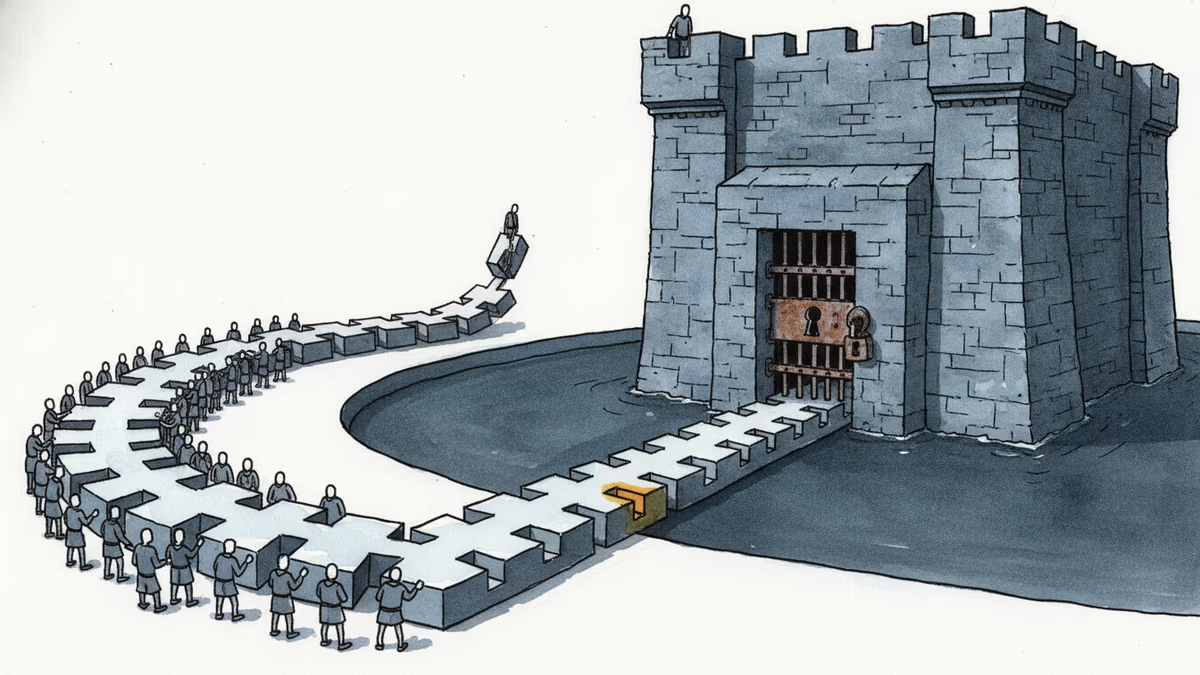
Nvidia shipped roughly a billion RISC-V cores in 2024, then announced it would run CUDA on the open standard. We break down how royalty-free instruction sets and open software stacks are trying to route around CUDA's lock-in. Part 2 of the Semiconductor Sovereignty series.
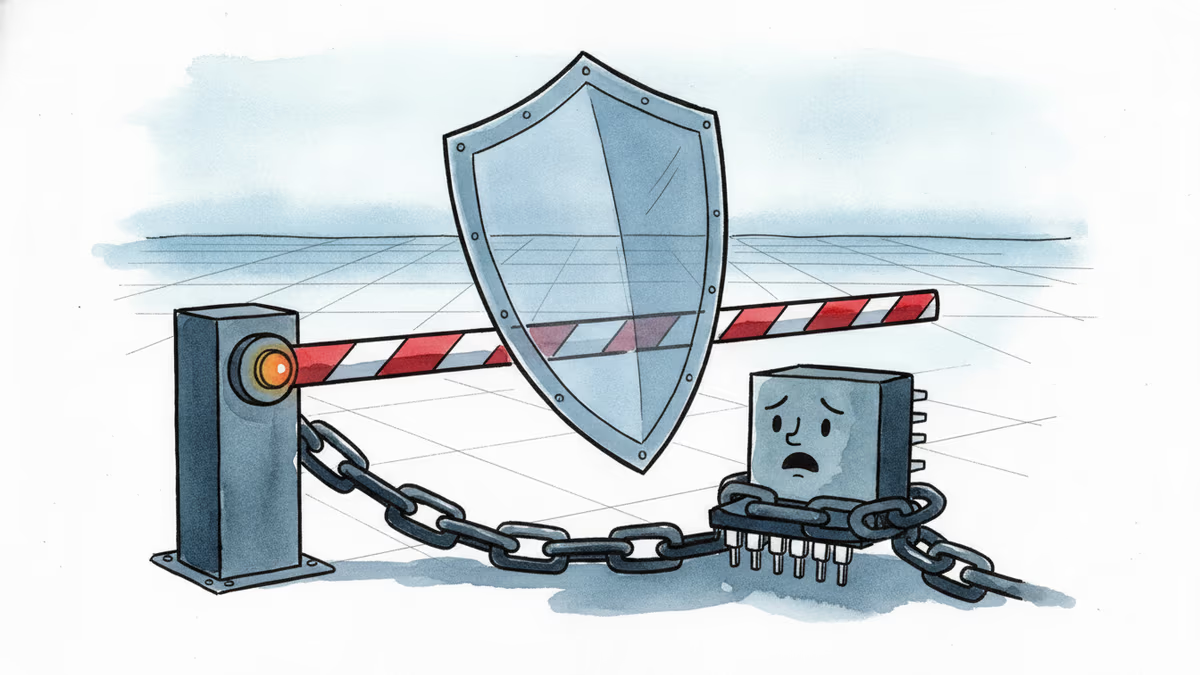
US AI-chip export controls split into three layers in the first half of 2026 — January easing, a May crackdown on circumvention, and a pending bill. Nvidia erased China from its guidance and still posted a record $81.6 billion quarter. A look at the export policy that both shields and cages it.
As the Kuiper Belt comes into focus with next-generation telescopes, astronomers prepare to discover 10 times more objects than the 4,000 found over 30 years—and possibly solve the Planet X mystery.
Samsung Electronics' union branch revealed that 84% of survey respondents oppose the government's roughly $290 billion (₩400 trillion) semiconductor megaproject in Gwangju. Government, management, the union and shareholders are all reading the same national project in sharply different ways.
Nvidia shipped roughly a billion RISC-V cores in 2024, then announced it would run CUDA on the open standard. We break down how royalty-free instruction sets and open software stacks are trying to route around CUDA's lock-in. Part 2 of the Semiconductor Sovereignty series.
US AI-chip export controls split into three layers in the first half of 2026 — January easing, a May crackdown on circumvention, and a pending bill. Nvidia erased China from its guidance and still posted a record $81.6 billion quarter. A look at the export policy that both shields and cages it.
Thoughts
Share your thoughts on this article
Sign in to join the conversation