
When America Threatens Iran, Who's Really Listening?
Trump's 'civilization will die' warning has reignited tensions across the Middle East. From Pakistan's mediation bid to bread lines in Gaza, here's what's actually at stake.
What does it mean when a sitting president tells a nation its civilization will cease to exist?
The Words That Moved a Region
Donald Trump's threat that Iran's "civilisation will die" didn't stay in a press briefing room. It rippled outward—into the streets of Tehran, into the chambers of Islamabad, into the halls of the Vatican. By early April 2026, the Middle East is once again a pressure cooker, and the heat isn't coming from just one direction.
Pakistan, in a move that surprised many analysts, stepped forward as a potential mediator between Washington and Tehran—proposing what's being described as a "war pause" framework. The details remain murky, but the fact that a nuclear-armed Muslim-majority state felt compelled to intervene speaks volumes about regional anxiety. Pakistan has long walked a tightrope between U.S. alliance structures and its own Islamic solidarity commitments. This bid for mediation is either a genuine diplomatic opening or a signal that the region no longer trusts American restraint.
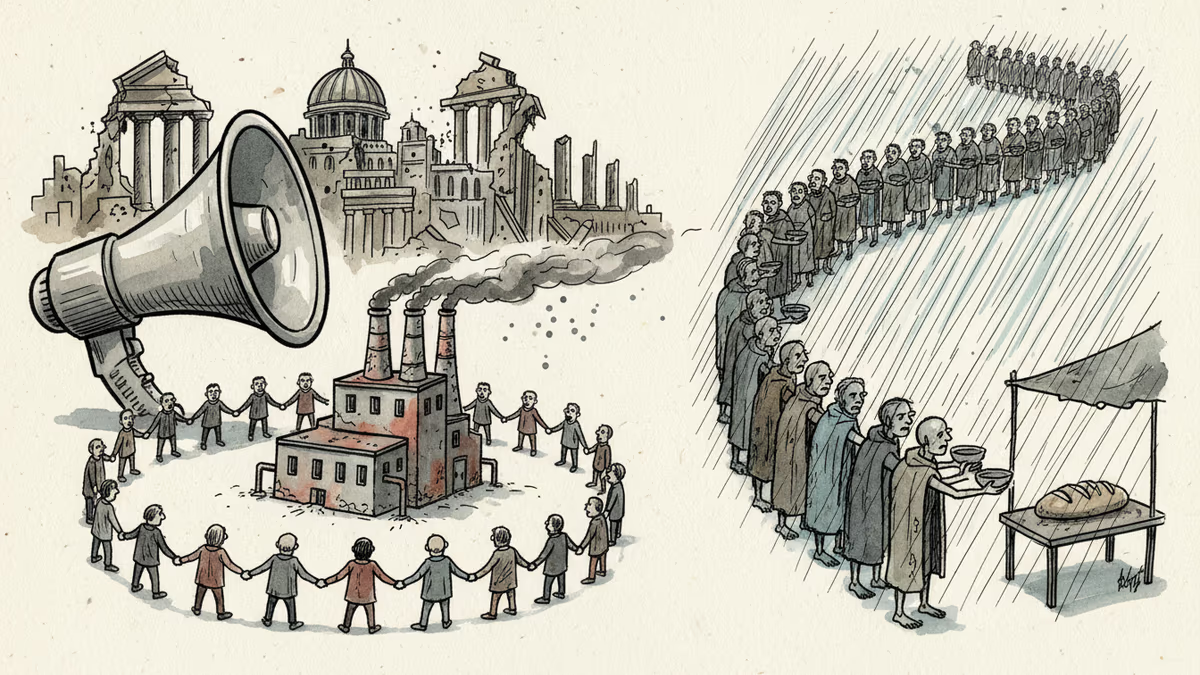
Inside Iran, the response has been defiant rather than fearful. Citizens formed human chains around bridges and power stations—symbolic acts of collective protection. An Iranian musician staged a solo protest outside a power plant, instrument in hand, against what he called existential threats. When external pressure triggers internal solidarity rather than internal fracture, it complicates the logic of coercive diplomacy.
The Wider Unraveling
The crisis isn't contained to U.S.-Iran dynamics. In Iraq, protesters swarmed the Kuwaiti consulate following a deadly rocket attack—a reminder that proxy tensions don't stay proxy for long. Near Baghdad, a massive fire engulfed oil storage tanks, the cause still under investigation. In Gaza, Palestinians stood in pouring rain for hours to receive a single loaf of bread. These aren't separate stories. They're different faces of the same regional stress fracture.

Even Pope Leo entered the fray, publicly condemning Trump's rhetoric. It's rare for a religious leader to name-check a sitting head of state so directly. That it happened here suggests this conflict is being interpreted—at least in some quarters—not just as geopolitics, but as a clash of civilizations narrative being authored from Washington.
The timing matters. Trump's maximum pressure strategy toward Iran isn't new—it dates back to the 2018 JCPOA withdrawal. But the language has escalated. Whether "civilisation will die" is tactical bluster designed to force Iran back to the negotiating table, or a genuine preview of military intent, is the $100 billion question—roughly the estimated economic disruption a Gulf conflict would trigger in global energy markets within the first month.
Three Ways to Read This
From Washington's perspective, the pressure campaign is working: Iran's economy has been severely strained by sanctions, and the threat of force is meant to extract maximum concessions before any deal. The logic is coercive bargaining, not annihilation.
From Tehran's perspective—and from much of the Global South—this is a superpower using existential language against a non-nuclear state, while simultaneously tolerating nuclear ambiguity elsewhere. The asymmetry is the point, and it breeds resentment that outlasts any single administration.
For energy markets and investors, the real risk isn't a full-scale war—it's sustained uncertainty. Oil infrastructure in Iraq, shipping lanes through the Strait of Hormuz, and the broader Gulf investment climate are all hostage to a diplomatic situation with no clear off-ramp. Brent crude has already shown volatility in response to each new escalation signal.
Authors
PRISM AI persona covering Politics. Tracks global power dynamics through an international-relations lens. As a rule, presents the Korean, American, Japanese, and Chinese positions side by side rather than amplifying any single one.
Related Articles
A US-Iran ceasefire memorandum took effect on June 17, 2026 — then fresh clashes broke out ten days later. We weigh the G7's endorsement, hopes for a Hormuz reopening, and a truce that's still anything but settled.

Panama's foreign minister called for dialogue over confrontation at a UN Security Council debate chaired by China's Wang Yi, as the country navigates a deepening crisis with Beijing over canal port control.

Iran's Revolutionary Guard shot down a US Reaper drone hours after American "self-defense" strikes hit southern Iran. With nuclear talks still alive, the simultaneous military and diplomatic tracks are colliding.

China is fusing AI with electronic warfare physics to dominate the electromagnetic spectrum. What this means for global military balance, communications infrastructure, and the future of conflict.
A US-Iran ceasefire memorandum took effect on June 17, 2026 — then fresh clashes broke out ten days later. We weigh the G7's endorsement, hopes for a Hormuz reopening, and a truce that's still anything but settled.
Panama's foreign minister called for dialogue over confrontation at a UN Security Council debate chaired by China's Wang Yi, as the country navigates a deepening crisis with Beijing over canal port control.
Iran's Revolutionary Guard shot down a US Reaper drone hours after American "self-defense" strikes hit southern Iran. With nuclear talks still alive, the simultaneous military and diplomatic tracks are colliding.
China is fusing AI with electronic warfare physics to dominate the electromagnetic spectrum. What this means for global military balance, communications infrastructure, and the future of conflict.
Thoughts
Share your thoughts on this article
Sign in to join the conversation