

AlphaFold at 5: Google DeepMind's 'AI Co-scientist' is Now Debating Hypotheses to Simulate a Human Cell
Five years after its debut, Google DeepMind's AlphaFold is evolving from a protein structure predictor into an 'AI co-scientist.' Built on Gemini 2.0, it's generating hypotheses and tackling the grand challenge of simulating a human cell.
Is the next Nobel Prize winner going to be an AI? Five years after its debut, AlphaFold, the AI system from Google DeepMind, is graduating from predicting protein structures to becoming an 'AI co-scientist' that generates and debates its own hypotheses. It’s a transition that poses a fundamental question about the future of scientific discovery itself.
The 5-Year Journey: Charting the Protein Universe
Since its arrival in November 2020, AlphaFold has been credited with solving one of modern science's grand challenges: protein folding. Its work contributed to a Nobel Prize in Chemistry and culminated in a massive database containing over 200 million predicted structures. This resource is now used by nearly 3.5 million researchers in 190 countries. The latest version, AlphaFold 3, has expanded its capabilities to predict interactions involving DNA, RNA, and drugs.
The Rise of the AI Scientist: Gemini 2.0 Generating Hypotheses
In an interview with WIRED, Pushmeet Kohli, DeepMind's VP of research, said the next step is the 'AI co-scientist.' It's a multi-agent system built on Gemini 2.0 that acts as a virtual collaborator, designed to identify research gaps, generate hypotheses, and suggest experiments. The system works by having multiple Gemini models debate and critique each other's ideas.

Researchers at Imperial College reportedly used the system to study how certain viruses hijack bacteria, opening new paths for tackling antimicrobial resistance. "With AI helping more on the 'how' part, scientists will have more freedom to focus on the 'what'," Kohli explained, emphasizing a new partnership between humans and machines.
The Next 5-Year Goal: Simulating a Human Cell
AlphaFold's long-term goal is even more ambitious: creating the first accurate simulation of a complete human cell. "What genuinely excites me is understanding how cells function as complete systems," Kohli stated, explaining that the first step is to understand the cell's nucleus and how genetic code is read and expressed.
If successful, simulating cells could transform medicine and biology. It would allow scientists to test drug candidates computationally, understand diseases at a fundamental level, and design personalized treatments. This appears to be the bridge DeepMind is building—from computational predictions to real-world therapies that help patients.
Authors
Related Articles
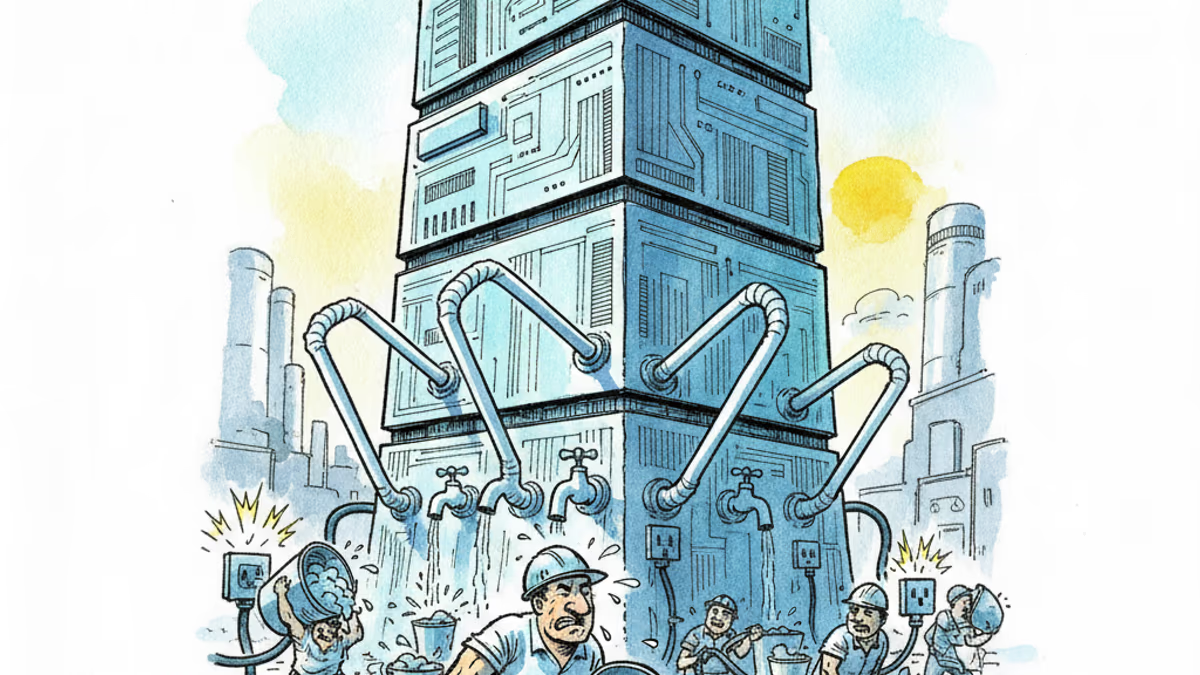
Samsung and SK unveiled a chip and AI investment package worth thousands of trillions of won on June 29. The headline number swings wildly by outlet, but the real contest isn't capital — it's water and power.
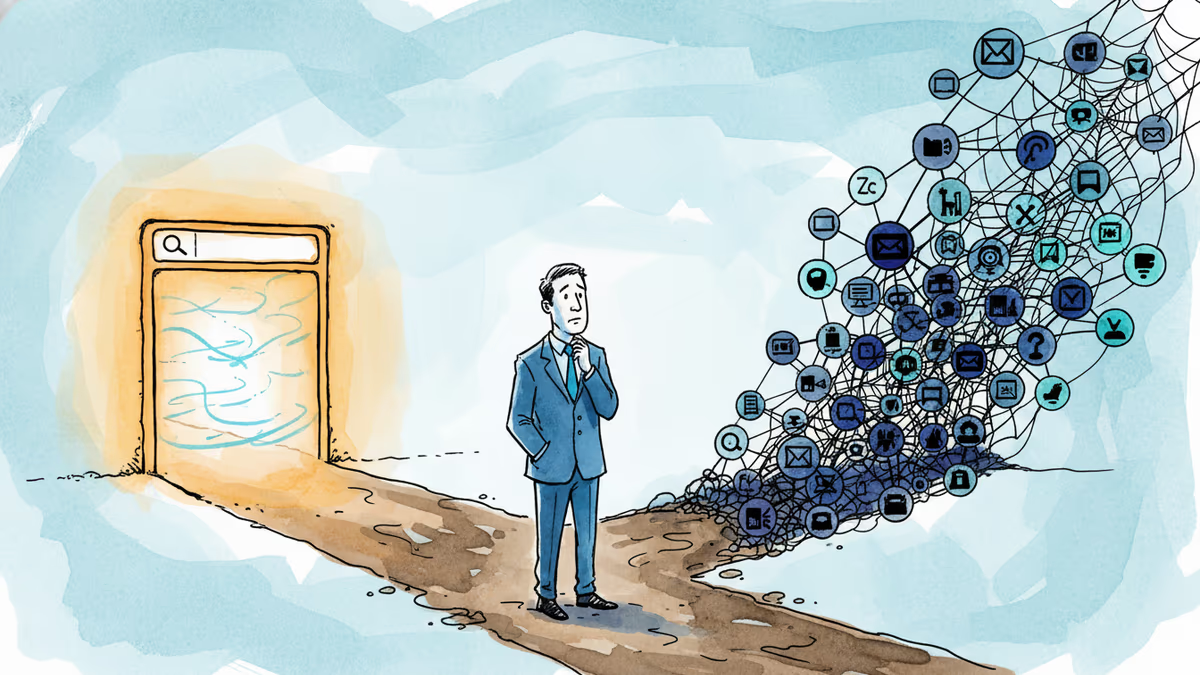
In a post-Google I/O interview, Sundar Pichai acknowledged flawed search results, real AI anxiety, and an AGI timeline that makes the label irrelevant. Here's what he said — and what it means.
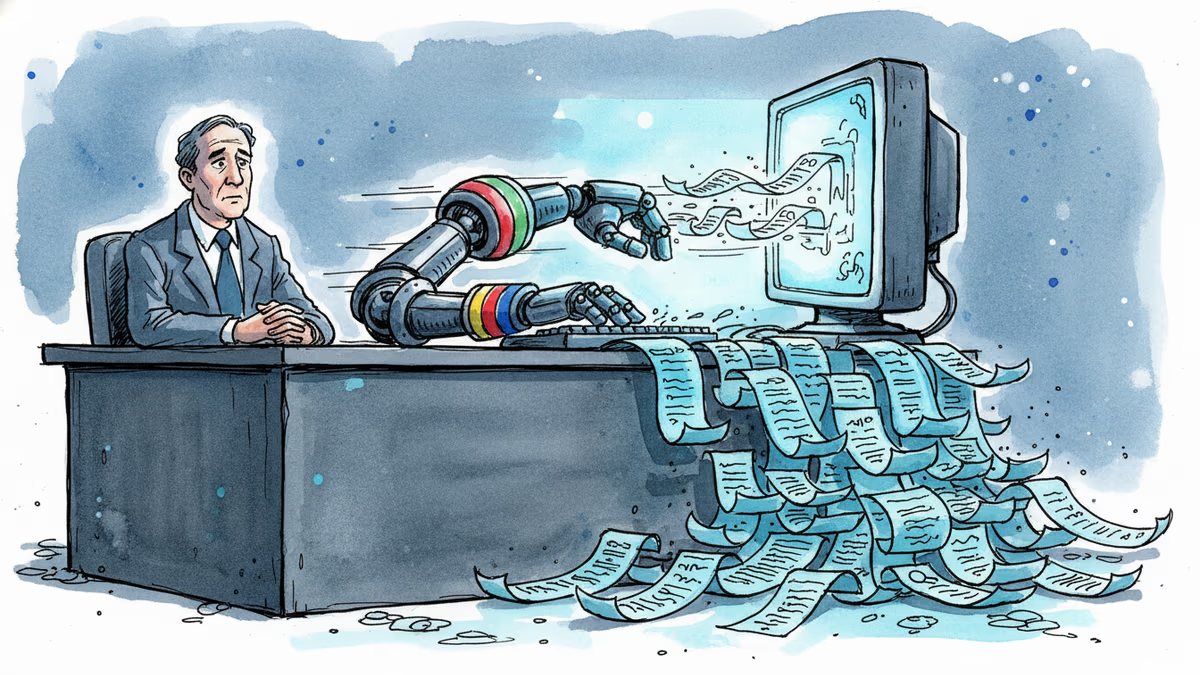
Google is building AI agents that search the web proactively, without user prompting. That's not just a product update — it's a fundamental shift in who controls the information you receive.

Viral videos show 2026 graduates jeering executives who praise AI at commencement ceremonies. It's not just rudeness — it's a signal about who pays for technological optimism.
Samsung and SK unveiled a chip and AI investment package worth thousands of trillions of won on June 29. The headline number swings wildly by outlet, but the real contest isn't capital — it's water and power.
In a post-Google I/O interview, Sundar Pichai acknowledged flawed search results, real AI anxiety, and an AGI timeline that makes the label irrelevant. Here's what he said — and what it means.
Google is building AI agents that search the web proactively, without user prompting. That's not just a product update — it's a fundamental shift in who controls the information you receive.
Viral videos show 2026 graduates jeering executives who praise AI at commencement ceremonies. It's not just rudeness — it's a signal about who pays for technological optimism.
Thoughts
Share your thoughts on this article
Sign in to join the conversation