
Why Google Just Issued a 100-Year Bond
Alphabet's century bond issuance signals Big Tech's massive AI investment race and long-term funding strategies
$20 billion in a single day. That's how much Alphabet raised on Monday, upsizing from its original $15 billion plan because investors couldn't get enough.
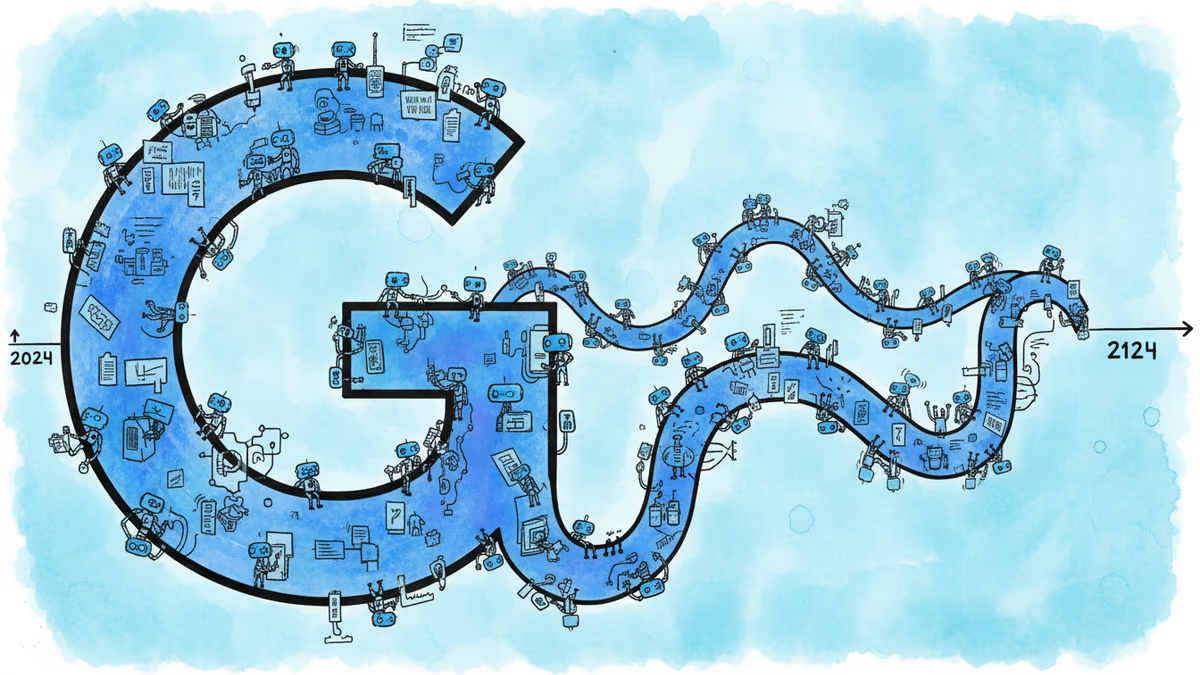
But here's the kicker: Google's parent company isn't just issuing regular bonds. It's planning to sell a 100-year bond as part of its debut sterling issuance, alongside Swiss franc bonds. Yes, you read that right—a bond that won't mature until 2124.
A Century Bond? Really?
Century bonds are rare beasts in corporate finance. Most companies can barely predict next quarter's earnings, let alone promise to pay back investors in 100 years. Yet here's Alphabet, essentially betting that Google will still exist when today's toddlers are celebrating their 100th birthdays.
This isn't about showing off financial creativity. It's about AI—and the staggering amounts of money Big Tech needs to stay competitive in the artificial intelligence arms race.
The AI Money Pit
The numbers are mind-boggling. Microsoft spent over $50 billion on AI-related investments last year. Amazon is pouring billions into AWS AI services. Meta is burning cash on its Reality Labs division, betting on AI-powered virtual worlds.

Why the spending spree? Because AI infrastructure doesn't come cheap. Building data centers capable of training large language models costs billions. A single advanced GPU cluster can run $100 million or more. And that's just the hardware—the electricity bills alone are astronomical.
Google's century bond signals something important: this isn't a short-term investment cycle. The company is essentially telling the market, "We're in this for the long haul—the very, very long haul."
Investors Are All In
The strong demand that forced Alphabet to upsize its bond offering reveals something telling about investor sentiment. In an era of economic uncertainty, pension funds and insurance companies are practically throwing money at Big Tech's AI ambitions.
Why? Because these investors need long-term, stable returns to match their long-term liabilities. A century bond from one of the world's most profitable companies? That's catnip for institutional investors.
But there's a darker interpretation: maybe investors believe traditional investment opportunities are becoming scarce, and Big Tech's AI monopolies represent the only game in town.
The Competition Scrambles
While Google raises billions with ease, smaller players face a harsh reality. Startups burn through venture funding trying to keep pace with OpenAI's latest models. European tech companies struggle to match Silicon Valley's capital firepower. Even established players like IBM and Oracle find themselves outgunned in the AI spending race.
This creates a troubling dynamic: the companies with the most money can afford the best AI talent, the most powerful computing infrastructure, and the longest development timelines. Success breeds more success, while everyone else fights for scraps.
Authors
Related Articles

In a post-Google I/O interview, Sundar Pichai acknowledged flawed search results, real AI anxiety, and an AGI timeline that makes the label irrelevant. Here's what he said — and what it means.
Google is building AI agents that search the web proactively, without user prompting. That's not just a product update — it's a fundamental shift in who controls the information you receive.

Google's Gmail Live lets you ask your inbox questions out loud. Announced at I/O 2026, it's AI's pitch to skeptics — and a reminder of how much Google already knows about you.

OpenAI has reorganized for the second time in a month, merging ChatGPT and Codex into a single agentic platform under president Greg Brockman's unified product leadership.
In a post-Google I/O interview, Sundar Pichai acknowledged flawed search results, real AI anxiety, and an AGI timeline that makes the label irrelevant. Here's what he said — and what it means.
Google is building AI agents that search the web proactively, without user prompting. That's not just a product update — it's a fundamental shift in who controls the information you receive.
Google's Gmail Live lets you ask your inbox questions out loud. Announced at I/O 2026, it's AI's pitch to skeptics — and a reminder of how much Google already knows about you.
OpenAI has reorganized for the second time in a month, merging ChatGPT and Codex into a single agentic platform under president Greg Brockman's unified product leadership.
Thoughts
Share your thoughts on this article
Sign in to join the conversation