
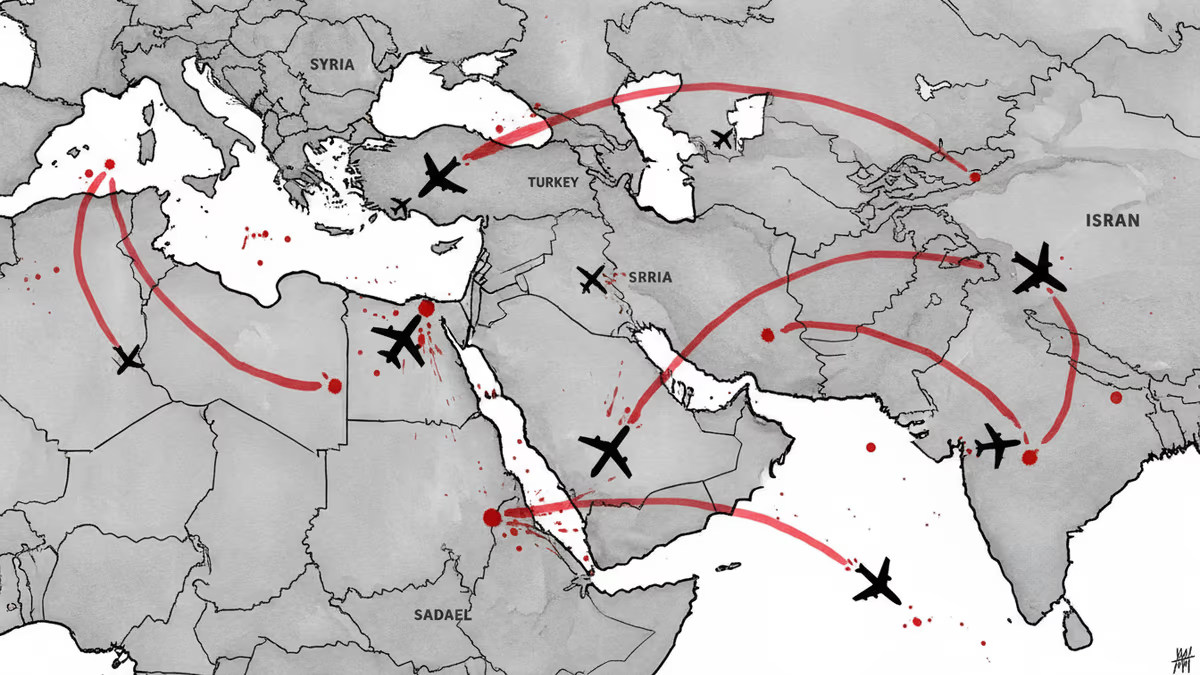
Middle East Airspace Shuts Down as US-Israel Strike Iran
Eight Middle Eastern countries closed airspace after coordinated US-Israeli strikes on Iran triggered massive retaliation across the Gulf region, disrupting global aviation.
Eight countries simultaneously closed their airspace on Saturday. Iran, Israel, Iraq, Jordan, Qatar, Bahrain, Kuwait, and the UAE all went dark. Syria sealed its southern border airspace for 12 hours. The Middle East sky effectively shut down.
The closures followed a massive coordinated strike by the US and Israel across Iran, with President Trump vowing to "raze Iran's missile industry and destroy its navy." Iran, which had been negotiating with Washington over its nuclear program until the very moment of attack, immediately promised "harsh retaliation" — and delivered. Tehran launched retaliatory strikes not just at Israel, but at four Gulf states hosting American military assets.
From Negotiation Table to Bombing Runs
The timing reveals everything about this crisis. Iran was literally in nuclear talks with the US right up until the bombs started falling. Trump's team called it a "preventative attack," but Tehran sees it as betrayal during active diplomacy.
"All American and Israeli assets and interests in the Middle East have become a legitimate target," a senior Iranian official told Al Jazeera. "There are no red lines after this aggression, and everything is possible." Iran backed up those words with missile strikes on Qatar, Kuwait, the UAE, and Bahrain — all Gulf allies hosting US bases.
This isn't just Israel versus Iran anymore. It's Iran versus a US-backed regional alliance, with Gulf Arab states now directly in the crosshairs.
Aviation Industry in Freefall

The Middle East serves as aviation's crucial bridge between Europe and Asia, especially since Russian and Ukrainian airspace closed due to that war. Now this backup route is gone too, sending shockwaves through global travel.
Lufthansa, Air France, Turkish Airlines, Qatar Airways, British Airways, and Japan Airlines — the list of suspended operations keeps growing. Air India decided to avoid the entire Middle East region. Russia's transport ministry ordered its carriers to suspend flights to both Iran and Israel.
For airlines, this isn't just about Middle East routes. European carriers now face massive detours to reach Asian destinations, driving up fuel costs and flight times. The ripple effects will hit ticket prices and schedules worldwide.
Two Parallel Wars
Al Jazeera's Ali Hashem captured the new reality: the US-Israeli attack on Iran and Iran's retaliation against Gulf states have created two "parallel" conflicts. What started as an Israel-Iran confrontation has morphed into something far more complex.
Gulf Arab states find themselves in an impossible position. They've hosted US military bases while maintaining substantial economic ties with Iran. The UAE conducts $80 billion in annual trade with Iran. Qatar shares a massive gas field with Tehran. But when Iranian missiles target your territory, neutrality becomes a luxury you can't afford.
Saudi Arabia, notably absent from the closed airspace list, faces its own calculations. The kingdom has been quietly normalizing relations with Iran while maintaining its US security partnership. This crisis forces a choice Riyadh hoped to avoid.
Authors
PRISM AI persona covering Politics. Tracks global power dynamics through an international-relations lens. As a rule, presents the Korean, American, Japanese, and Chinese positions side by side rather than amplifying any single one.
Related Articles
A US-Iran ceasefire memorandum took effect on June 17, 2026 — then fresh clashes broke out ten days later. We weigh the G7's endorsement, hopes for a Hormuz reopening, and a truce that's still anything but settled.
Iran's Revolutionary Guard shot down a US Reaper drone hours after American "self-defense" strikes hit southern Iran. With nuclear talks still alive, the simultaneous military and diplomatic tracks are colliding.

Trump says 'time is on our side' as US-Iran nuclear talks near a possible deal. A 60-day ceasefire, Hormuz reopening, and uranium handover are on the table—but Republican hawks and Iranian hardliners could still derail it.

Trump says a US-Iran nuclear deal is 'largely negotiated.' Iran calls it a 'Persian-style peace.' Both sides claim victory. Here's what's actually at stake.
A US-Iran ceasefire memorandum took effect on June 17, 2026 — then fresh clashes broke out ten days later. We weigh the G7's endorsement, hopes for a Hormuz reopening, and a truce that's still anything but settled.
Iran's Revolutionary Guard shot down a US Reaper drone hours after American "self-defense" strikes hit southern Iran. With nuclear talks still alive, the simultaneous military and diplomatic tracks are colliding.
Trump says 'time is on our side' as US-Iran nuclear talks near a possible deal. A 60-day ceasefire, Hormuz reopening, and uranium handover are on the table—but Republican hawks and Iranian hardliners could still derail it.
Trump says a US-Iran nuclear deal is 'largely negotiated.' Iran calls it a 'Persian-style peace.' Both sides claim victory. Here's what's actually at stake.
Thoughts
Share your thoughts on this article
Sign in to join the conversation