
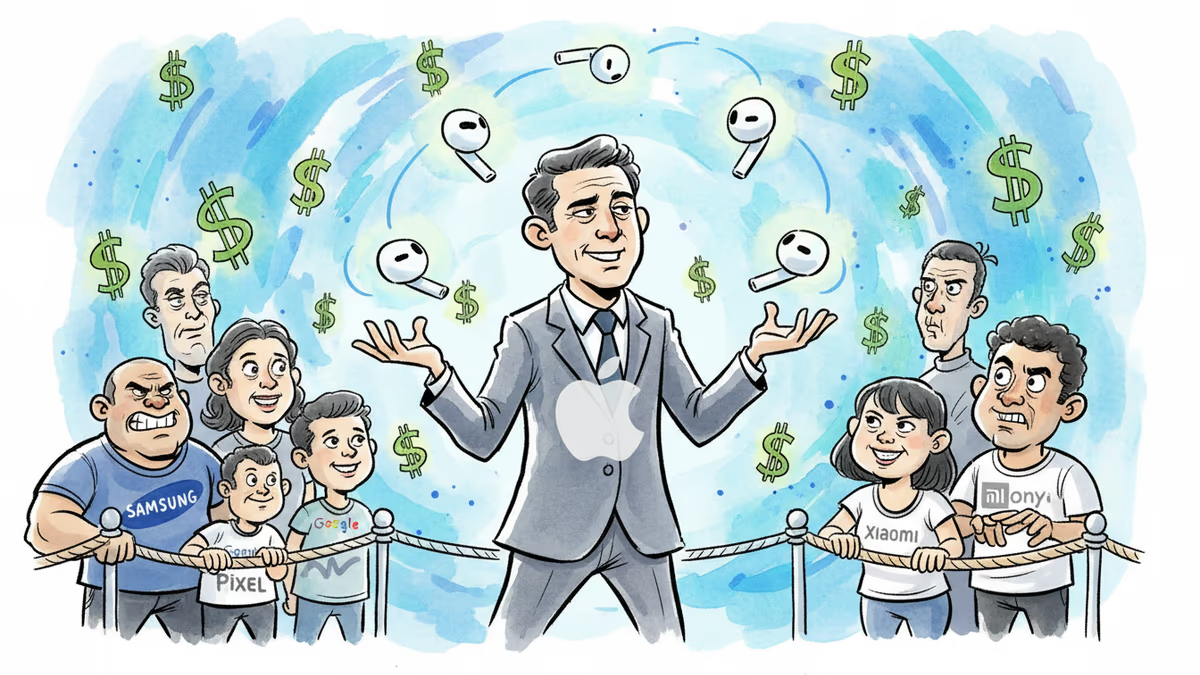
AirPods 4 Sale Reveals Apple's Shifting Strategy
Apple's AirPods 4 are discounted up to $60, but this isn't just about moving inventory. It signals a broader shift in Apple's audio market approach.
Apple doesn't usually slash prices this aggressively, this quickly. Yet here we are: AirPods 4 starting at $89 (down from $129), and the noise-canceling version at $119 (down $60 from $179). For a company that treats discounts like state secrets, this feels significant.
The timing raises questions. These aren't old models gathering dust in warehouses—the AirPods 4 launched just months ago to solid reviews. So what's driving Apple to compete on price?
The Budget Paradox
Call them "entry-level," but the AirPods 4 pack serious punch. They deliver richer bass than previous generations, match the AirPods Pro in call quality, and sport IP54 water resistance. The noise-canceling variant does something remarkable: it makes ANC accessible without the Pro price tag.
For $30 more than the base model, you get noise cancellation that actually works. Not Pro-level, but enough to matter on flights and in open offices. Add transparency mode, Find My tracking, and wireless charging, and you've got a compelling package.
This isn't just product evolution—it's strategic repositioning. Apple is bringing premium features down-market faster than ever before.
Market Pressures Mount

The competition has been heating up. Sony's WF-1000XM5 earbuds offer superior noise cancellation. Samsung's Galaxy Buds integrate seamlessly with Android devices. Chinese brands like Nothing and OnePlus deliver surprising quality at aggressive prices.
Meanwhile, the broader audio market is fragmenting. Spatial audio, lossless streaming, and AI-powered features are becoming table stakes. Apple can't rely solely on ecosystem lock-in anymore—the product has to stand on its own merits.
The $119 ANC model particularly targets the sweet spot where most consumers make decisions. It's expensive enough to feel premium, cheap enough to justify impulse purchases.
The Ecosystem Play
But here's Apple's real game: every AirPods sale is a gateway drug. Users who start with AirPods often upgrade their phones, tablets, and computers to match. The seamless switching between devices, hands-free Siri, and automatic pairing create subtle but powerful incentives to stay within Apple's walled garden.
At $89, the barrier to entry drops significantly. College students, budget-conscious professionals, and Android users curious about Apple's ecosystem can now afford to experiment. Once they're in, switching costs—both financial and psychological—make leaving difficult.
What This Signals
Apple's aggressive pricing suggests three possibilities. First, they're clearing inventory ahead of AirPods 5. Second, they're responding to market share pressure from competitors. Third, they're deliberately expanding their addressable market by making premium features more accessible.
The third option feels most likely. Apple has historically moved upmarket, but that strategy has limits. At some point, you run out of customers willing to pay premium prices for incremental improvements.
Authors
Related Articles
After 15 years of fragmented mobile messaging, Apple and Google are rolling out end-to-end encrypted RCS messaging between iPhones and Android devices. Here's what changed, why it took so long, and what it means for your privacy.
Apple agreed to pay $250 million to settle claims it misled iPhone 16 buyers about Apple Intelligence features. What this means for consumers, Big Tech marketing, and the AI industry.
Apple quietly removed the entry-level $599 Mac Mini, raising the starting price to $799 — just one day after Tim Cook warned of chip supply constraints on the earnings call.
Apple names John Ternus, its hardware engineering chief, as the next CEO. The shift from operator to product person signals where Apple thinks its next decade of growth will come from — and raises real questions about what comes next.
After 15 years of fragmented mobile messaging, Apple and Google are rolling out end-to-end encrypted RCS messaging between iPhones and Android devices. Here's what changed, why it took so long, and what it means for your privacy.
Apple agreed to pay $250 million to settle claims it misled iPhone 16 buyers about Apple Intelligence features. What this means for consumers, Big Tech marketing, and the AI industry.
Apple quietly removed the entry-level $599 Mac Mini, raising the starting price to $799 — just one day after Tim Cook warned of chip supply constraints on the earnings call.
Apple names John Ternus, its hardware engineering chief, as the next CEO. The shift from operator to product person signals where Apple thinks its next decade of growth will come from — and raises real questions about what comes next.
Thoughts
Share your thoughts on this article
Sign in to join the conversation