
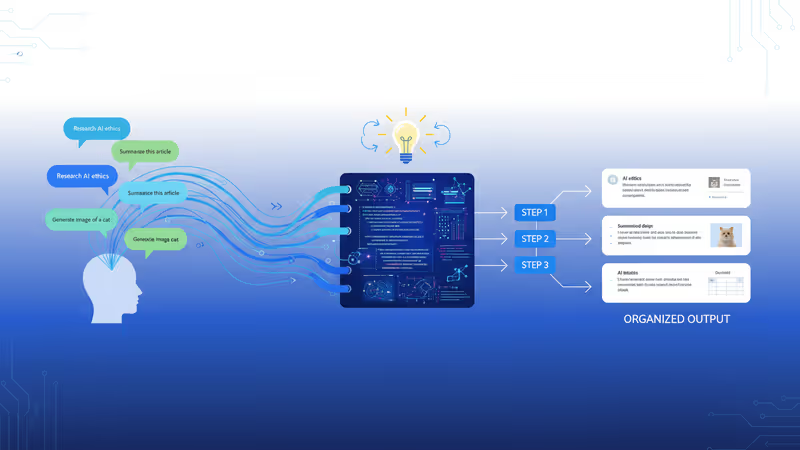
AI Prompt Masterclass: The Art of Getting the Answers You Want
1. What is Prompt Engineering?
Definition
Prompt engineering is the art of designing inputs (prompts) to get desired results from AI models.
It's not simply "asking questions." It's designing effective communication with AI.
Why Does It Matter?
Same AI, same question—but how you ask completely changes the results.
Example: Marketing Strategy Request
❌ Bad Prompt:
"Tell me about marketing strategy"
✅ Good Prompt:
"You are a marketing consultant for small businesses. Create a 7-day social media content calendar for a local coffee shop that wants to increase foot traffic on a $500 monthly budget. Include post ideas, best posting times, and engagement strategies for Instagram and Facebook."
Result Difference: The first gives generic advice; the second provides an immediately actionable specific plan.
2. 5 Principles of Good Prompts
Principle 1: Clarity
Remove ambiguity. The more AI has to guess your intent, the more inaccurate it becomes.
❌ "Write something good"
✅ "Write a 1,500-word blog post for a B2B SaaS startup. Topic: 'Remote work productivity tools'. Tone: professional but friendly."
Principle 2: Context
Give AI background information for more relevant answers.
✅ "I'm a frontend developer with 3 years of experience. I need to choose a state management library for a React project. Team of 5, medium-sized project. Compare Redux, Zustand, and Jotai."Principle 3: Specificity
Specify the format, length, and structure of desired output.
✅ "Compare the 3 options in a table format. Columns: 'Pros', 'Cons', 'Best Use Case'."Principle 4: Positive Instructions
"Do this" is more effective than "don't do that."
❌ "Don't write too long"
✅ "Summarize in 300 words or less"
Principle 5: Iteration
No prompt is perfect on the first try. Review results and modify.
1st: Results too generic → Add specific examples
2nd: Format doesn't match → Specify output format
3rd: Tone too stiff → Add role assignment
3. Core Technique 1: Zero-shot vs Few-shot
Zero-shot Prompting
Direct instruction without examples. Relies entirely on AI's existing knowledge.
Prompt: "Analyze the sentiment of this sentence: 'This product is absolutely terrible'"
Response: "Negative sentiment (dissatisfaction, disappointment)"
Best for: Simple tasks, patterns AI already knows well
Few-shot Prompting
Provide 1-3 examples so AI can learn the pattern.
Prompt:
"Analyze sentiment in this format:

Input: 'Shipping was surprisingly fast!'
Output: Positive (surprise, satisfaction)

Input: 'It's just okay'
Output: Neutral (indifference)

Input: 'Never buying again'
Output: ???"

Response: "Negative (disappointment, rejection)"
Best for:
- When specific format is needed
- Matching tone/style
- Classification tasks
Comparison
| Feature | Zero-shot | Few-shot |
|---|---|---|
| Examples needed | ❌ | ✅ (1-3) |
| Consistency | Lower | Higher |
| Token usage | Less | More |
| Best tasks | Simple Q&A | Format/Classification |
4. Core Technique 2: Chain-of-Thought
The Magic Phrase: "Think Step by Step"
Adding "Think step by step" to complex problems dramatically improves accuracy.
Example: Math Problem
❌ Zero-shot:
Prompt: "What is 8 + 3 × 2 - 4 ÷ 2?"
Response: "12" (might be wrong)
✅ Chain-of-Thought:
Prompt: "What is 8 + 3 × 2 - 4 ÷ 2? Show your work step by step."
Response:
"1. First multiplication: 3 × 2 = 6
2. Division: 4 ÷ 2 = 2
3. Addition: 8 + 6 = 14
4. Subtraction: 14 - 2 = 12
Answer: 12"
When to Use

| Task Type | Chain-of-Thought Effectiveness |
|---|---|
| Math problems | ⭐⭐⭐⭐⭐ |
| Logic puzzles | ⭐⭐⭐⭐⭐ |
| Code debugging | ⭐⭐⭐⭐ |
| Decision making | ⭐⭐⭐⭐ |
| Simple questions | ⭐ (unnecessary) |
5. Core Technique 3: Role Prompting
Give AI a Persona
Assigning a role maintains consistent tone, expertise, and perspective.
Basic Format
"You are a [role]. [Context]. Please perform [task]."Practical Examples
Legal Advice:
"You are a startup-specialized lawyer with 10 years of experience.
List 5 key considerations when drafting an equity distribution agreement with co-founders.
Explain in terms a non-expert can understand."
Technical Writing:
"You are a senior backend developer and tech blogger.
Write a 'Docker vs Kubernetes' comparison article for junior developers.
Include real use cases and when to choose each."
Marketing Copy:
"You are an Apple marketing copywriter.
Write 5 landing page headlines for a new wireless earbuds product.
Use Apple's minimalist, impactful style."
6. Core Technique 4: Output Format Specification
Why Format Matters
Makes AI responses predictable and easier to post-process.
Format Methods
1. Explicit Structure:
"Answer in this format:
## Summary
## Pros
- Item 1
- Item 2
## Cons
- Item 1
- Item 2
## Conclusion"
2. Table Format:
"Organize in a table: | Item | Description | Score |"3. JSON Format (for developers):
"Respond in this JSON format:
{
  "summary": "string",
  "pros": ["string"],
  "cons": ["string"],
  "score": number
}"
Anchoring
Specifying how the response starts improves format compliance.
Prompt: "Analyze this code's issues. Start with 'Analysis Result:'"
Response: "Analysis Result:
1. Potential memory leak..."
7. Core Technique 5: Prompt Chaining
Break Complex Tasks into Steps
Instead of one massive prompt, divide into multiple sequential steps.
Example: Blog Post Writing
Step 1: Create Outline
"Create an outline for a blog post on 'How AI is transforming education'.
5 sections, 2-3 key points each."
Step 2: Expand Section
"Expand 'Section 2: Personalized Learning' to 500 words.
Include specific examples."
Step 3: Write Introduction
"Based on the content above, write an engaging introduction.
Start with a question or statistic."
Step 4: Final Review
"Review the entire article. Check for natural flow and remove redundancies."Benefits of Chaining
| Benefit | Description |
|---|---|
| Quality improvement | Can provide feedback/corrections at each step |
| Control | Guide in desired direction |
| Debugging | Easy to identify where problems occurred |
| Complex tasks possible | Accomplish what single prompts cannot |
8. 10 Practical Prompt Templates
1. Writing (Blog/Article)
You are a [field] content specialist.

Write a [length] article about [topic].

Target audience: [target]
Tone: [professional/friendly/persuasive]
Include:
- [element1]
- [element2]
- [element3]

Format: Introduction-Body(3 sections)-Conclusion
2. Code Review
You are a senior developer.

Review this code:
[code]

Analyze from these perspectives:
1. Bugs or potential issues
2. Performance optimization opportunities
3. Code readability/maintainability
4. Security vulnerabilities

Include corrected code examples for each issue.
3. Email Writing
Write a business email for this situation:

Situation: [description]
Recipient: [relationship/title]
Purpose: [request/thanks/apology/information]
Tone: [formal/friendly]
Length: [brief/detailed]

Key points to include:
- [point1]
- [point2]
4. Data Analysis
Analyze this data:
[data]

Analysis requests:
1. Identify main patterns/trends
2. Find outliers
3. Derive 3 insights
4. Suggest areas requiring further investigation

Explain results so non-experts can understand.
5. Brainstorming
Brainstorm on [topic/problem].

Constraints:
- Budget: [amount]
- Timeline: [time]
- Resources: [available resources]

Generate:
1. 3 traditional approaches
2. 3 creative/unconventional ideas
3. 2 high-risk-high-reward ideas

Include pros and cons for each idea.
9. Common Mistakes and Solutions
Mistake 1: Too Vague
❌ Problem: "Write something good"
✅ Solution: Add specifics—topic, length, tone, audience, format
Mistake 2: Information Overload
❌ Problem: 10 requests in one prompt
✅ Solution: Use prompt chaining to separate
Mistake 3: Negative Instructions
❌ Problem: "Don't be verbose, don't use jargon"
✅ Solution: Convert to positive instructions "Be concise, under 300 words, use layperson-friendly terms"
Mistake 4: Missing Context
❌ Problem: "Review this code" (just throwing code)
✅ Solution: Provide background "This code is for a real-time chat app's message sending feature. Python 3.11, Flask. Goal is performance optimization."
Mistake 5: No Iteration
❌ Problem: Give up if first result isn't satisfactory
✅ Solution: Provide feedback and iterate "Add more specific examples" "Make the tone friendlier" "Explain point 3 in more detail"
Glossary
| Term | Definition |
|---|---|
| Zero-shot | Prompting method with direct instructions, no examples |
| Few-shot | Method providing 1-3 examples for AI to learn patterns |
| Chain-of-Thought | Technique guiding AI to reason step by step |
| Role Prompting | Technique assigning a specific role/persona to AI |
| Prompt Chaining | Dividing complex tasks into sequential prompts |
| Anchoring | Technique controlling format by specifying response start |
| Self-Consistency | Generating multiple reasoning paths and selecting consistent answer |
Update Log
| Date | Changes |
|---|---|
| 2026-01-06 | Initial publication |
© 2026 PRISM by Liabooks. All rights reserved.
Authors

"17 years in the field, now telling the story of technology"
Related Articles

Five stories from late September, traced to where the paper trail stops: Korea's export record, Nvidia's Hugging Face 8-K, a US-China AI channel, the UN on AI, and rising births.

Huawei's CANN is open source under a license barring software for non-Ascend chips. Inside China's second CUDA, and the two links still outside it: pre-training compute and 5nm capacity.
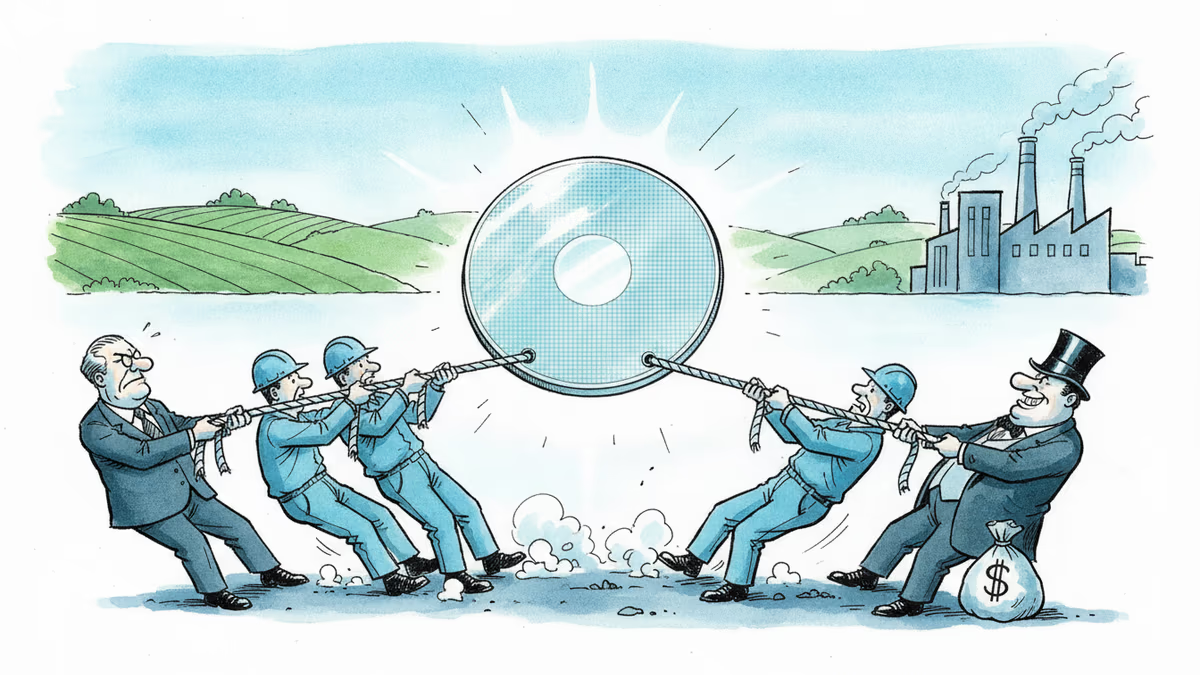
Samsung Electronics' union branch revealed that 84% of survey respondents oppose the government's roughly $290 billion (₩400 trillion) semiconductor megaproject in Gwangju. Government, management, the union and shareholders are all reading the same national project in sharply different ways.
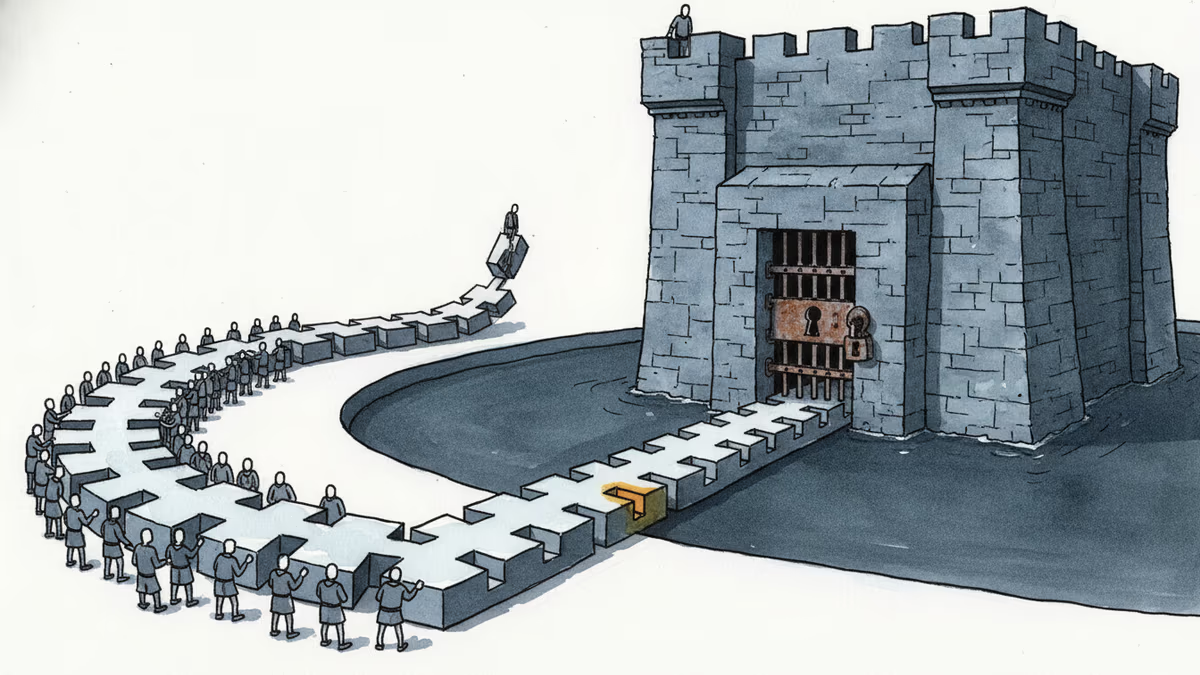
Nvidia shipped roughly a billion RISC-V cores in 2024, then announced it would run CUDA on the open standard. We break down how royalty-free instruction sets and open software stacks are trying to route around CUDA's lock-in. Part 2 of the Semiconductor Sovereignty series.
Five stories from late September, traced to where the paper trail stops: Korea's export record, Nvidia's Hugging Face 8-K, a US-China AI channel, the UN on AI, and rising births.
Huawei's CANN is open source under a license barring software for non-Ascend chips. Inside China's second CUDA, and the two links still outside it: pre-training compute and 5nm capacity.
Samsung Electronics' union branch revealed that 84% of survey respondents oppose the government's roughly $290 billion (₩400 trillion) semiconductor megaproject in Gwangju. Government, management, the union and shareholders are all reading the same national project in sharply different ways.
Nvidia shipped roughly a billion RISC-V cores in 2024, then announced it would run CUDA on the open standard. We break down how royalty-free instruction sets and open software stacks are trying to route around CUDA's lock-in. Part 2 of the Semiconductor Sovereignty series.
Thoughts
Share your thoughts on this article
Sign in to join the conversation