

Why China's Tech Giants Are Racing to Package Moltbot
Silicon Valley's viral AI agent Moltbot is sparking a cloud computing rush in China, with Alibaba, Tencent, and ByteDance offering special packages to early adopters seeking autonomous AI assistants.
100,000 GitHub stars for an open-source AI agent that most people can't even install properly. Yet China's biggest cloud providers are rushing to make Moltbot accessible to anyone willing to pay between $10 and $76 annually for the privilege.
The Austrian-developed AI agent—now renamed OpenClaw after legal pressure from Anthropic—has captured imaginations with its ability to learn user habits, control devices, and complete tasks proactively. But the real story isn't the technology itself; it's how Chinese tech giants are positioning themselves for the next phase of AI adoption.
The Cloud Computing Land Grab
Alibaba Cloud, Tencent Cloud, and ByteDance's Volcano Engine have all launched Moltbot-specific packages, essentially commoditizing what was once a complex technical setup. The move signals something bigger: these companies see AI agents as the next battleground for cloud dominance.
The packages aren't just about convenience—they're about ecosystem lock-in. Users can power Moltbot with Chinese LLMs like DeepSeek and integrate it with domestic messaging platforms like DingTalk, QQ, and Lark. It's a textbook example of how Chinese tech companies adapt global innovations to fit their controlled digital environment.
Meanwhile, on secondhand marketplace Xianyu, dozens of sellers offer installation services for $1 to $22. The emergence of this gray market suggests both the complexity of the technology and the hunger for accessible AI agents.
Mixed Reviews from Early Adopters
On Chinese social network Xiaohongshu, users share wildly different experiences. One cross-border e-commerce worker successfully delegated email management to Moltbot. Another discovered their AI assistant was taking personality notes—"curious, passionate about AI, and willing to trust others"—prompting the joke: "How is this different from being in a relationship?"

But the honeymoon phase is revealing cracks. Users complain about installation difficulties, high computing costs, frequent bugs, and dangerous mistakes like deleting wrong files. One frustrated user described it as "a wild bison rampaging around in my computer."
These mixed reviews highlight a crucial gap between AI agent hype and reality. The technology promises autonomous assistance but delivers inconsistent performance that requires constant human oversight.
The Global AI Agent Arms Race
Moltbot's viral spread reflects broader industry momentum toward AI agents that go beyond chatbots. Anthropic recently launched Claude Cowork for file organization and spreadsheet creation. Meta acquired Manus, a China-origin AI agent for social media automation and resume screening—though neither tool works in China.
Chinese companies are building their own alternatives. Alibaba's Qwen now handles food delivery orders, travel bookings, and online shopping through conversational interfaces. ByteDance unveiled AI smartphone prototypes that let users control apps through voice commands.
This parallel development suggests the AI agent market may fragment along geopolitical lines, with Western and Chinese ecosystems evolving separately due to regulatory and competitive pressures.
Security Risks in the Rush to Automate
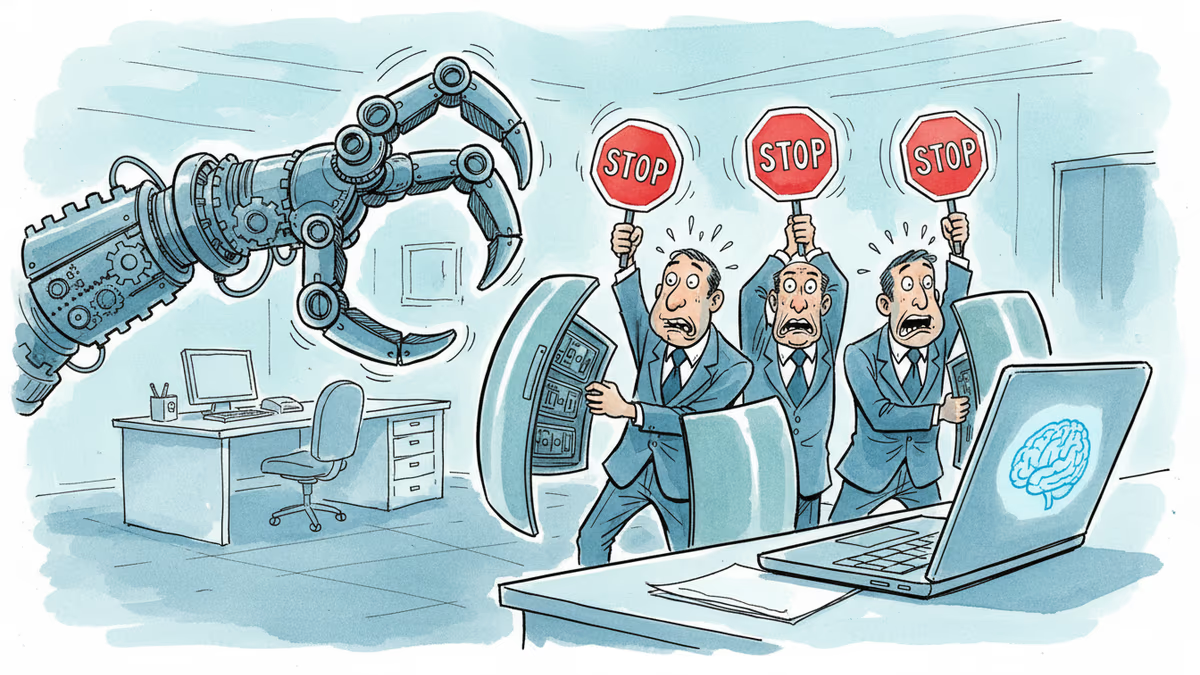
Cybersecurity experts warn about the privacy and security implications of giving "rudimentary agents" too much autonomy. Moltbot can send wrong emails, leak sensitive information, or accidentally share user credentials—risks that multiply when deployed at scale.
The enthusiasm for AI agents may be outpacing our ability to secure them properly. As these tools become more accessible through cloud packages, the potential for widespread security incidents grows.
Authors
Related Articles

Salesforce deployed every weapon in its arsenal to convince investors that AI agents won't kill SaaS. But are they fighting the right battle?
Companies split on OpenClaw AI tool - revolutionary productivity booster or security nightmare? From Silicon Valley startups to Meta, executives are drawing battle lines.

Google launches Auto Browse in Chrome, letting AI handle online tasks from booking flights to shopping. But as browsers get smarter, what happens to human agency?

Austrian developer's Moltbot becomes one of 2026's fastest-growing AI projects, offering proactive personal assistance across messaging platforms—with serious security trade-offs.
Salesforce deployed every weapon in its arsenal to convince investors that AI agents won't kill SaaS. But are they fighting the right battle?
Companies split on OpenClaw AI tool - revolutionary productivity booster or security nightmare? From Silicon Valley startups to Meta, executives are drawing battle lines.
Google launches Auto Browse in Chrome, letting AI handle online tasks from booking flights to shopping. But as browsers get smarter, what happens to human agency?
Austrian developer's Moltbot becomes one of 2026's fastest-growing AI projects, offering proactive personal assistance across messaging platforms—with serious security trade-offs.
Thoughts
Share your thoughts on this article
Sign in to join the conversation