
Republican AGs Just Erased Climate Science from Federal Judges' Handbook
Federal Judicial Center deletes entire climate change chapter after GOP attorneys general complained it treated human influence on climate as fact. Science meets politics in America's courtrooms.
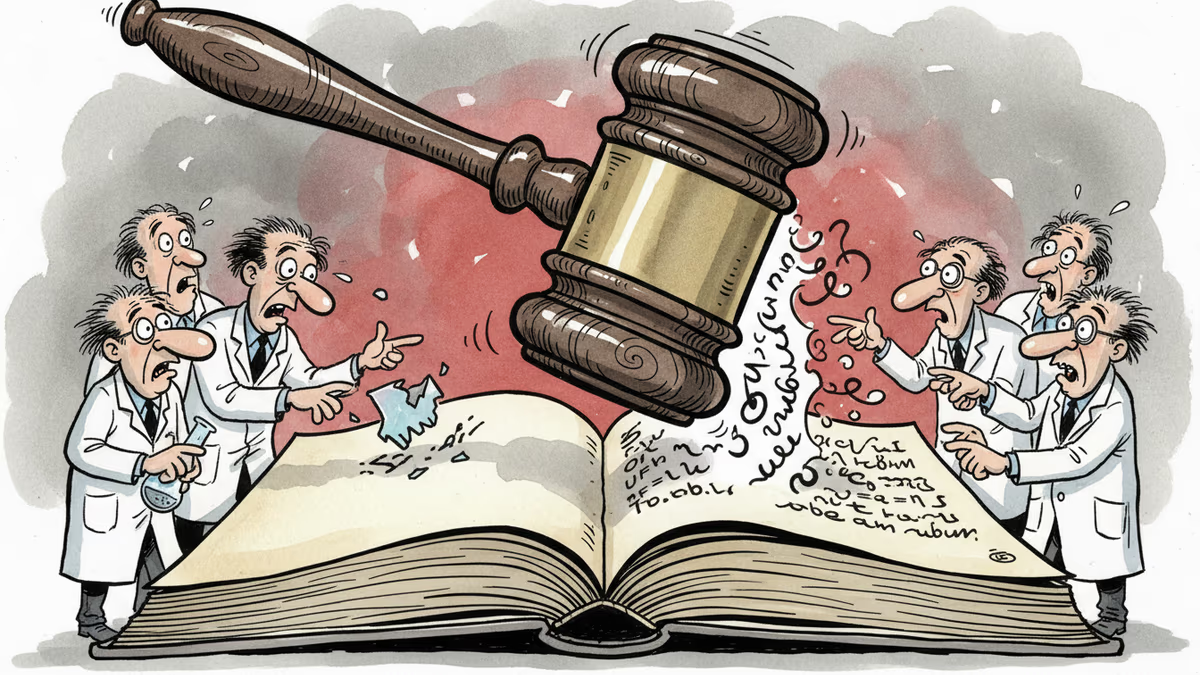
One letter from 15 Republican state attorneys general just rewrote how America's federal judges learn about climate science. The Federal Judicial Center caved to political pressure Friday, deleting an entire chapter on climate change from its scientific reference manual—because it dared to treat human influence on climate as established fact.
The Handbook That Shapes How Judges Think
When complex scientific issues land in courtrooms, federal judges turn to the Reference Manual on Scientific Evidence. This isn't light reading—it's the authoritative guide that helps judges navigate everything from DNA evidence to statistical analysis. The fourth edition, released in December, broke new ground by including a climate change chapter for the first time.
Columbia University researchers wrote the chapter, presenting the 97% scientific consensus that human activities drive climate change as settled science. But that factual treatment triggered a political firestorm. Republican attorneys general fired off a complaint letter in January, arguing the manual was biased because it didn't treat climate science as "controversial."
The Federal Judicial Center's response? Complete capitulation. The entire chapter vanished.
When Science Becomes a Political Football
This deletion reveals how deeply America's political polarization has infected even scientific education. Three perspectives are clashing:

Scientists' View: Climate change represents one of the strongest scientific consensuses in modern history. Treating it as "debatable" is like questioning whether smoking causes cancer—scientifically irresponsible and potentially harmful.
Republican AGs' Strategy: They're playing the long game. With climate lawsuits against fossil fuel companies multiplying, they want judges to view climate science as unsettled. If judges see human causation as "controversial," it's harder to hold companies liable for damages.
Judicial Center's Dilemma: Caught between scientific integrity and political pressure, they chose the path of least resistance. But by removing the chapter entirely, they've essentially declared climate science too "political" for judges to learn about objectively.
The Bigger Stakes: America's Climate Court Battles
This isn't academic. Climate litigation is exploding across America. Cities and states are suing ExxonMobil, Chevron, and other fossil fuel giants for billions in climate damages. Young activists are challenging government climate policies in court. Indigenous communities are fighting pipeline projects.
Every case hinges on one question: Is human-caused climate change scientifically established? The deleted chapter would have helped judges understand that yes, it absolutely is. Now they're flying blind—or worse, getting their information from partisan sources.
Meanwhile, the insurance industry is already acting on climate science reality. State Farm stopped writing new homeowner policies in California due to wildfire risks. Allstate pulled back from Louisiana after repeated hurricane damage. The business world has moved past climate denial—but America's legal system is moving backward.
Authors
Related Articles

While 2020 brought the cleanest air in decades, methane levels hit record highs. New research reveals the complex atmospheric chemistry behind this counterintuitive phenomenon

Narwhals have survived for millennia using sound to navigate Arctic waters. Now climate change is making their world too noisy to survive. What does this mean for ocean ecosystems?
Samsung Electronics' union branch revealed that 84% of survey respondents oppose the government's roughly $290 billion (₩400 trillion) semiconductor megaproject in Gwangju. Government, management, the union and shareholders are all reading the same national project in sharply different ways.
Nvidia shipped roughly a billion RISC-V cores in 2024, then announced it would run CUDA on the open standard. We break down how royalty-free instruction sets and open software stacks are trying to route around CUDA's lock-in. Part 2 of the Semiconductor Sovereignty series.
While 2020 brought the cleanest air in decades, methane levels hit record highs. New research reveals the complex atmospheric chemistry behind this counterintuitive phenomenon
Narwhals have survived for millennia using sound to navigate Arctic waters. Now climate change is making their world too noisy to survive. What does this mean for ocean ecosystems?
Samsung Electronics' union branch revealed that 84% of survey respondents oppose the government's roughly $290 billion (₩400 trillion) semiconductor megaproject in Gwangju. Government, management, the union and shareholders are all reading the same national project in sharply different ways.
Nvidia shipped roughly a billion RISC-V cores in 2024, then announced it would run CUDA on the open standard. We break down how royalty-free instruction sets and open software stacks are trying to route around CUDA's lock-in. Part 2 of the Semiconductor Sovereignty series.
Thoughts
Share your thoughts on this article
Sign in to join the conversation