
How COVID's Clean Air Paradoxically Fueled a Methane Surge
While 2020 brought the cleanest air in decades, methane levels hit record highs. New research reveals the complex atmospheric chemistry behind this counterintuitive phenomenon
16.2 parts per billion—that's how much atmospheric methane surged in 2020, the highest growth rate since systematic records began in the early 1980s. The twist? This happened during the year when COVID-19 gave us the cleanest air in decades.
When Clean Air Backfires
In spring 2020, as the pandemic brought global industry and travel to a near-standstill, satellite sensors captured something remarkable. Nitrogen dioxide—a byproduct of car engines and heavy industry—plummeted dramatically. For the first time in decades, the world's air was genuinely clean.
But while we celebrated cleaner skies, something unexpected was brewing in the atmosphere. Methane, the second most important greenhouse gas after carbon dioxide, began surging at unprecedented rates. A new study published in Science has unraveled this apparent paradox, revealing how the two phenomena are intricately connected through atmospheric chemistry.
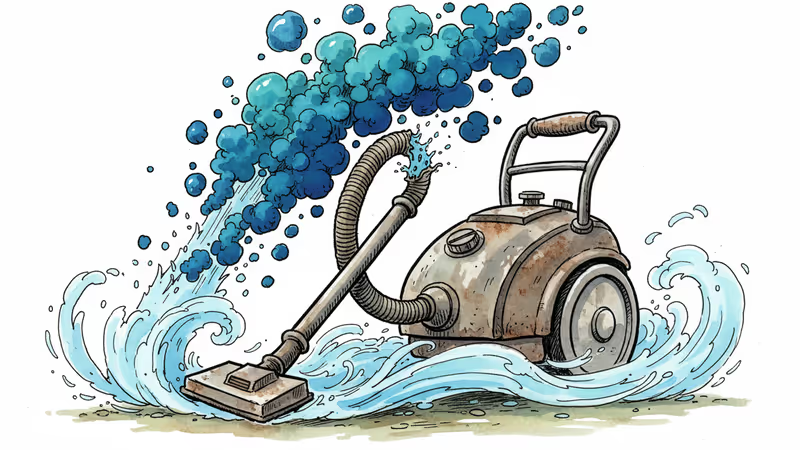
The key player is a molecule called the hydroxyl radical—nature's atmospheric janitor that actively scrubs methane from the sky, breaking it down into water vapor and carbon dioxide.
The One-Second Cleaner
"The problem is that the lifetime of the hydroxyl radical is very short—its lifespan is less than a second," explains Shushi Peng, a professor at Peking University and co-author of the study. For this molecular cleaner to do its job, it must be constantly replenished through a series of chemical reactions triggered by sunlight.

Here's where the plot thickens: the key ingredient for creating hydroxyl radicals is nitrogen oxides—precisely the pollutants that vanished when cars stayed parked and factories went dark in 2020. Less nitrogen oxide meant fewer hydroxyl radicals, which meant less methane removal from the atmosphere.
The Unintended Consequence
This discovery highlights a crucial blind spot in environmental policy. Our well-intentioned efforts to reduce air pollution can sometimes have unexpected climate consequences. It's not an argument against clean air initiatives—far from it. Rather, it's a reminder that Earth's climate system operates as an interconnected web where pulling one thread can cause ripples elsewhere.
The implications extend beyond academic curiosity. Methane is 28 times more potent than carbon dioxide as a greenhouse gas, though it stays in the atmosphere for a much shorter time. This means that controlling methane emissions could offer a faster path to slowing climate change than focusing solely on CO2.
The Policy Puzzle
For policymakers and environmental scientists, this research poses fascinating questions. As we transition to cleaner energy and transportation, how do we account for these atmospheric chemistry effects? Should air quality regulations consider their impact on other greenhouse gases?
The 2020 experience also offers a unique natural experiment. It showed us what happens when human industrial activity suddenly drops—and the results weren't entirely what we expected. As economies recovered and emissions resumed, methane growth rates began to stabilize, suggesting the effect was indeed linked to the temporary pollution reduction.
Authors
Related Articles

Federal Judicial Center deletes entire climate change chapter after GOP attorneys general complained it treated human influence on climate as fact. Science meets politics in America's courtrooms.

Narwhals have survived for millennia using sound to navigate Arctic waters. Now climate change is making their world too noisy to survive. What does this mean for ocean ecosystems?
Samsung Electronics' union branch revealed that 84% of survey respondents oppose the government's roughly $290 billion (₩400 trillion) semiconductor megaproject in Gwangju. Government, management, the union and shareholders are all reading the same national project in sharply different ways.

Nvidia shipped roughly a billion RISC-V cores in 2024, then announced it would run CUDA on the open standard. We break down how royalty-free instruction sets and open software stacks are trying to route around CUDA's lock-in. Part 2 of the Semiconductor Sovereignty series.
Federal Judicial Center deletes entire climate change chapter after GOP attorneys general complained it treated human influence on climate as fact. Science meets politics in America's courtrooms.
Narwhals have survived for millennia using sound to navigate Arctic waters. Now climate change is making their world too noisy to survive. What does this mean for ocean ecosystems?
Samsung Electronics' union branch revealed that 84% of survey respondents oppose the government's roughly $290 billion (₩400 trillion) semiconductor megaproject in Gwangju. Government, management, the union and shareholders are all reading the same national project in sharply different ways.
Nvidia shipped roughly a billion RISC-V cores in 2024, then announced it would run CUDA on the open standard. We break down how royalty-free instruction sets and open software stacks are trying to route around CUDA's lock-in. Part 2 of the Semiconductor Sovereignty series.
Thoughts
Share your thoughts on this article
Sign in to join the conversation