
The Arctic's Acoustic Crisis: When Unicorns Can't Hear
Narwhals have survived for millennia using sound to navigate Arctic waters. Now climate change is making their world too noisy to survive. What does this mean for ocean ecosystems?
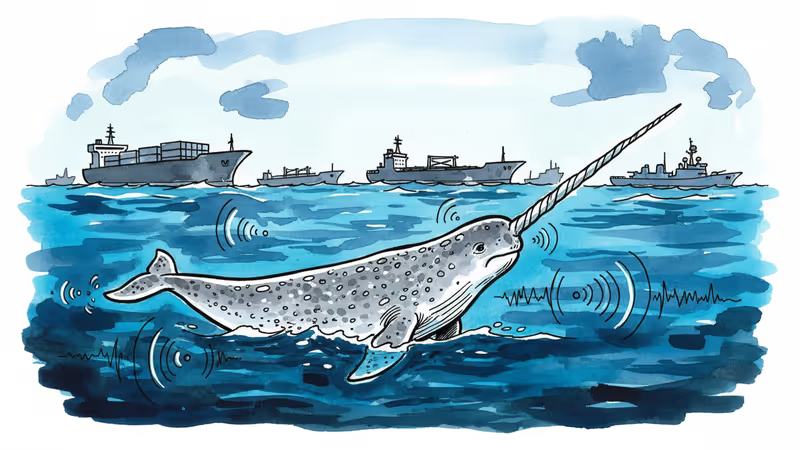
A thousand clicks per second. That's how often narwhals emit acoustic signals as they navigate the Arctic's dark depths. For hundreds of thousands of years, these "unicorns of the sea" have relied more on sound than sight to survive. But now, the acoustic world they depend on is rapidly becoming too noisy for survival.
Masters of Sound in a Silent World
Narwhals earned their mythical nickname from the males' distinctive spiral tusks, but their real superpower lies in echolocation. From northeastern Canada and Greenland to Norway's Svalbard archipelago and Russia's Arctic waters, these speckled whales have perfected the art of acoustic survival.
Through a sophisticated system of calls, whistles, and high-frequency clicks, narwhals can locate prey hundreds to thousands of feet below the surface and detect narrow breathing holes in sea ice with remarkable precision. It's a finely tuned system that has worked flawlessly in the Arctic's traditionally quiet underwater environment.
The Noise Revolution
Climate change is fundamentally altering this acoustic landscape. As global temperatures rise, the Arctic Ocean is becoming increasingly noisy, disrupting millions of years of evolutionary adaptation.
The culprits are multiple and interconnected. Melting sea ice opens new shipping routes, bringing cargo vessels and cruise ships into previously pristine waters. Reduced ice cover means more wave action and wind-generated noise. Changing ecosystems bring new species and altered migration patterns, each contributing to the acoustic chaos.
The opening of Arctic shipping routes represents a particularly dramatic shift. Waters that were once sealed by thick ice now echo with the drone of massive engines, creating an entirely new soundscape that narwhals have never encountered.

Beyond the Arctic: Global Implications
This isn't just an Arctic problem. The narwhal crisis reflects broader challenges facing marine ecosystems worldwide as human activity increasingly dominates ocean soundscapes. From shipping lanes to offshore drilling, industrial noise pollution is becoming a global threat to marine life that depends on acoustic communication.
The economic drivers are powerful. Arctic shipping routes can cut thousands of miles off traditional routes between Asia and Europe, representing billions in potential savings. The pressure to exploit these new pathways will only intensify as ice continues to retreat.
The Canary in the Coal Mine
Narwhals serve as indicator species for Arctic marine ecosystem health. Their acoustic sensitivity makes them early warning systems for environmental change. When narwhals can't hunt effectively or communicate properly, it signals broader ecosystem disruption that will eventually affect the entire Arctic food web.
Scientists are already documenting behavioral changes. Narwhals are diving deeper, staying submerged longer, and abandoning traditional feeding areas. While these adaptations show remarkable resilience, they also indicate stress that may not be sustainable long-term.
The Sound of Silence
The irony is striking: as we gain access to the Arctic through climate change, we're destroying the very qualities that made it unique. The vast, quiet wilderness that has existed for millennia is being replaced by an industrialized seascape in just decades.
This transformation raises fundamental questions about how we value natural systems. Can we quantify the worth of narwhals' acoustic world against shipping efficiency? How do we balance economic opportunity with ecological preservation?
Authors
Related Articles

Federal Judicial Center deletes entire climate change chapter after GOP attorneys general complained it treated human influence on climate as fact. Science meets politics in America's courtrooms.

While 2020 brought the cleanest air in decades, methane levels hit record highs. New research reveals the complex atmospheric chemistry behind this counterintuitive phenomenon

Five stories from late September, traced to where the paper trail stops: Korea's export record, Nvidia's Hugging Face 8-K, a US-China AI channel, the UN on AI, and rising births.

Huawei's CANN is open source under a license barring software for non-Ascend chips. Inside China's second CUDA, and the two links still outside it: pre-training compute and 5nm capacity.
Federal Judicial Center deletes entire climate change chapter after GOP attorneys general complained it treated human influence on climate as fact. Science meets politics in America's courtrooms.
While 2020 brought the cleanest air in decades, methane levels hit record highs. New research reveals the complex atmospheric chemistry behind this counterintuitive phenomenon
Five stories from late September, traced to where the paper trail stops: Korea's export record, Nvidia's Hugging Face 8-K, a US-China AI channel, the UN on AI, and rising births.
Huawei's CANN is open source under a license barring software for non-Ascend chips. Inside China's second CUDA, and the two links still outside it: pre-training compute and 5nm capacity.
Thoughts
Share your thoughts on this article
Sign in to join the conversation