
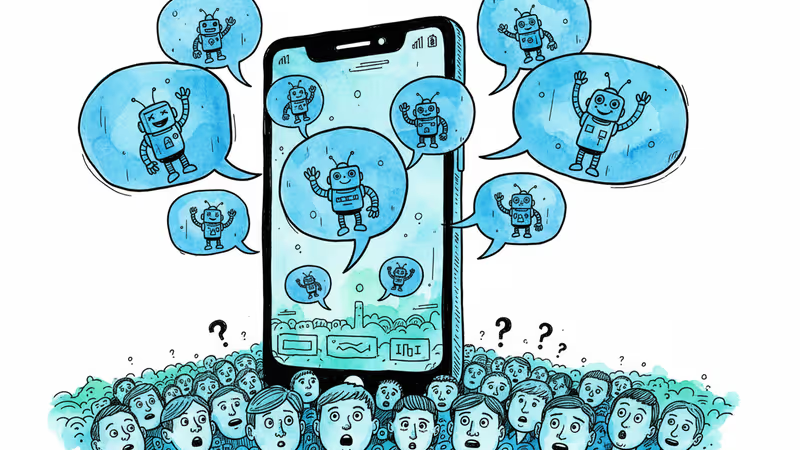
The Blue Bubble Revolution: How AI Agents Are Taking Over Messaging
Linq doubled its revenue in 8 months by letting AI agents communicate natively through iMessage. The messaging app is becoming the new AI platform.
If you're an iPhone user, you know the difference. Blue bubbles mean iMessage. Green bubbles mean regular SMS. But what if businesses could send you messages that appeared in those coveted blue bubbles too?
That's exactly what Birmingham, Alabama-based startup Linq figured out, and it doubled their annual revenue in just eight months. The company, which started as a digital business card service, pivoted last year to help businesses communicate with customers through iMessage and RCS instead of traditional SMS.
From Gray Bubbles to Blue Authenticity
Apple already offers Messages for Business, and Twilio has built an $18.26 billion empire helping companies text their customers. But these services are obviously corporate—messages appear in gray bubbles with clear branding that screams "business communication."
Linq's customers wanted something different: authentic-looking blue bubble messages that felt like personal conversations. They wanted access to all of iMessage's native features—group chats, emojis, threaded replies, images, and voice notes.
CEO Elliott Potter and his co-founders, former Shipt executives, heard this feedback and launched their API in February 2025. The results were immediate: they doubled the annual recurring revenue they'd built over four years in just eight months.
When AI Agents Changed Everything
But Linq's real breakthrough came when AI agents entered the picture. Last spring, a California company approached them with an AI assistant called Poke that could handle tasks, answer questions, and manage calendars directly within iMessage.
"They didn't have a CRM, but they really wanted to use our API," Potter told TechCrunch. When Poke went viral after launching in September, Linq was suddenly flooded with requests from AI companies wanting to offer their chatbots and assistants directly through iMessage, RCS, and SMS.
Linq faced a crucial decision: stick with their steady B2B revenue stream, or pivot again to become the infrastructure layer for a new segment of the AI market.

The End of App Fatigue
Potter believes consumers are suffering from app fatigue—they're tired of downloading and learning new applications. With Linq's technology, there's no need for another app to interact with AI assistants. Everything happens within the messaging app you already use.
"Poke and others have proved that AI has gotten good enough," Potter explained. "You don't need a traditional app anymore. You just need an interface that lets you talk to intelligent AI, connect it to your systems, and tell it what to do."
Linq chose to pivot. The results speak for themselves: their customer base expanded by 132% from the previous quarter, existing customer accounts grew by an average of 34%, and their AI agents now reach 134,000 monthly active users. The platform facilitates over 30 million messages per month with a net revenue retention rate of 295% and zero churn.
$20 Million Bet on Conversational Infrastructure
On Monday, Linq announced it raised $20 million in Series A funding led by TQ Ventures, with participation from Mucker Capital and angel investors. The company plans to use the fresh capital to expand its team, develop new go-to-market strategies, and continue building its technology.
"By making AI-to-human communication as frictionless as texting a friend, Linq is enabling an entirely new category of companies," said Andrew Marks, co-founding partner of TQ Ventures.
The Platform Risk Reality
But there's a catch. Linq is still building on top of Apple's platform, and there's no guarantee Apple won't pull a Meta and restrict third-party AI chatbots. Plus, while iMessage dominates in the US, the rest of the world relies on WhatsApp, WeChat, Telegram, and Signal.
Potter acknowledges this but has bigger ambitions: "Our vision is everything you need to build conversational tech. Wherever your customers are—Slack, email, Telegram, WhatsApp, Discord, Signal—you should be able to talk to them."
The Messaging Platform Wars
Linq's success raises fascinating questions about the future of digital interaction. If messaging apps become the new operating system for AI services, who controls the infrastructure? Apple and Google currently gatekeep iMessage and RCS, while Meta dominates WhatsApp globally.
For developers, this shift could be liberating—no more App Store approvals or complex mobile development. Just build for a messaging-native interface. But for platform owners, it represents both an opportunity and a threat to their app ecosystem revenues.
Authors
Related Articles

Samsung and SK unveiled a chip and AI investment package worth thousands of trillions of won on June 29. The headline number swings wildly by outlet, but the real contest isn't capital — it's water and power.

Viral videos show 2026 graduates jeering executives who praise AI at commencement ceremonies. It's not just rudeness — it's a signal about who pays for technological optimism.

Filipino virtual assistants using AI to ghost-manage LinkedIn profiles for executives is now a structured industry. 30 comments a day, fake engagement rings, and a platform struggling to tell real from fabricated.
Two commencement speakers learned the hard way that AI enthusiasm doesn't land well with today's graduates. The backlash reveals a widening gap between tech optimism and Gen Z's economic reality.
Samsung and SK unveiled a chip and AI investment package worth thousands of trillions of won on June 29. The headline number swings wildly by outlet, but the real contest isn't capital — it's water and power.
Viral videos show 2026 graduates jeering executives who praise AI at commencement ceremonies. It's not just rudeness — it's a signal about who pays for technological optimism.
Filipino virtual assistants using AI to ghost-manage LinkedIn profiles for executives is now a structured industry. 30 comments a day, fake engagement rings, and a platform struggling to tell real from fabricated.
Two commencement speakers learned the hard way that AI enthusiasm doesn't land well with today's graduates. The backlash reveals a widening gap between tech optimism and Gen Z's economic reality.
Thoughts
Share your thoughts on this article
Sign in to join the conversation