
India's $100 Billion Bet on AI Infrastructure
Adani Group announces massive AI data center investment as India positions itself as a global computing hub. What this means for the AI landscape and why timing matters.
$100 Billion Just Changed the AI Game
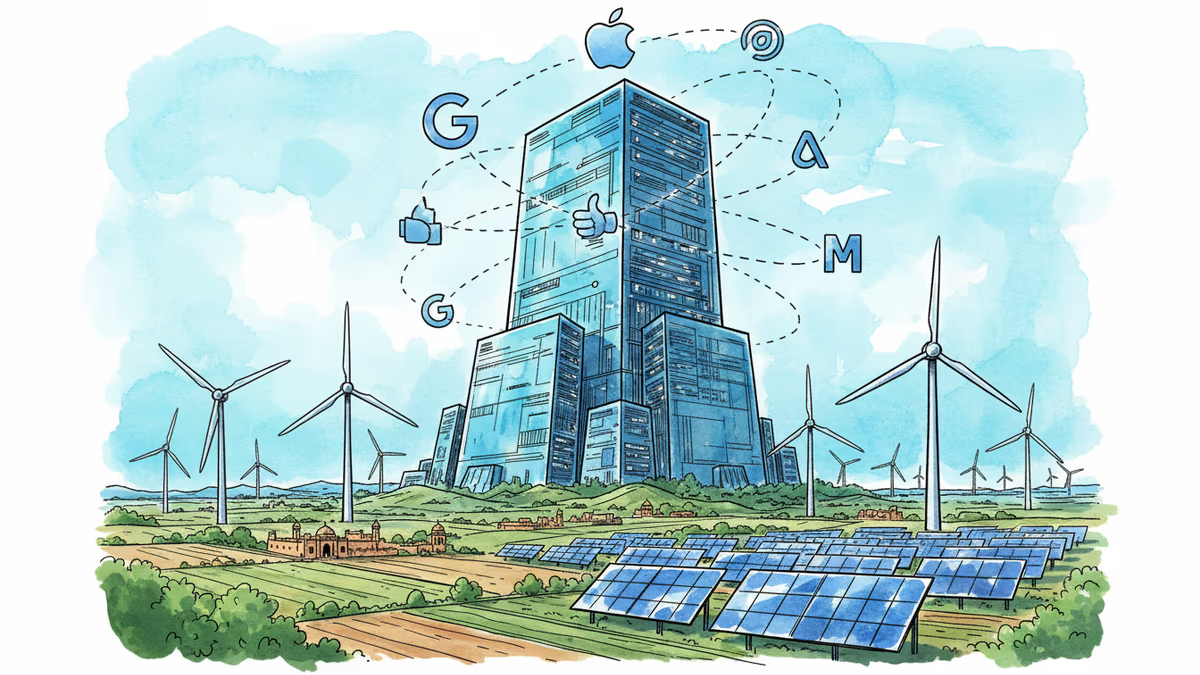
India's Adani Group dropped a bombshell this week: $100 billion over the next decade for AI-specialized data centers across the country. But here's what makes this announcement different from typical corporate investment pledges—it happened during India's AI Impact Summit in New Delhi, with leaders from OpenAI, Nvidia, Microsoft, and Google sitting in the same room as Indian policymakers.
The timing isn't coincidental. It's strategic.
Why Companies Are Looking Beyond Silicon Valley
The global AI infrastructure race has hit a bottleneck. U.S. data centers are reaching capacity constraints, energy costs are soaring, and regulatory scrutiny is intensifying. Meanwhile, companies need massive computing power to train increasingly sophisticated AI models.
Enter India. The country offers three compelling advantages: a rapidly expanding digital economy, growing renewable energy capacity, and AI-friendly policies. Adani isn't just building data centers—they're creating an integrated ecosystem powered by their 30-gigawatt Khavda renewable energy project in western India, with over 10 gigawatts already operational.
"India will not be a mere consumer in the AI age," declared Adani Chairman Gautam Adani, framing this as a long-term bet on the convergence of energy and computing.
The Ripple Effects Are Already Starting

This investment could trigger a domino effect worth $150 billion in related investments, potentially creating a $250 billion AI infrastructure ecosystem in India by 2035. That's not just corporate optimism—it's based on real partnerships already in motion.
Adani is building on existing relationships with Google and Microsoft, developing large-scale AI data center campuses in Visakhapatnam and Noida, with additional facilities planned for Hyderabad and Pune. An expanded partnership with Walmart-owned Flipkart will focus on another AI data center.
The plan calls for deploying up to 5 gigawatts of data center capacity—roughly equivalent to powering 3.75 million homes.
What This Means for Global Tech Giants
For AI companies, India's infrastructure buildout solves several problems at once. Lower operational costs, abundant renewable energy, and a massive domestic market of 1.4 billion people. But it also creates new dependencies and geopolitical considerations.
OpenAI, Anthropic, and other AI model developers could significantly reduce their computing costs by leveraging Indian infrastructure. However, they'll need to navigate data sovereignty laws and ensure their models can operate effectively across different regulatory environments.
For cloud providers like Microsoft and Google, India's AI infrastructure boom represents both opportunity and competition. They can partner with local players like Adani while simultaneously competing with them for enterprise customers.
The Supply Chain Gambit
Perhaps the most intriguing aspect of Adani's strategy is their plan to co-invest in domestic manufacturing of critical components—transformers, power electronics, and thermal management systems. This isn't just about reducing costs; it's about insulating India's AI infrastructure from global supply chain disruptions.
This move could reshape global tech supply chains. If India successfully builds domestic capacity for data center components, it could reduce dependence on traditional manufacturing hubs and create new competitive dynamics.
Authors
Related Articles

SolarSquare is raising $55-60M at a $450-500M valuation, more than doubling its worth in 18 months. Here's what's driving investor conviction in India's residential solar market.

Indian venture capital has quietly displaced Silicon Valley in its own backyard. Only one American VC made India's top 10 investor list last year. Here's why that matters beyond India.
Google is committing up to $40 billion to Anthropic, a direct AI competitor. The deal reveals how the real AI arms race isn't about models — it's about who controls the infrastructure beneath them.
SpaceX wants to launch a million orbital data centers to power AI without draining Earth. The vision is compelling. The physics, economics, and debris math are not.
SolarSquare is raising $55-60M at a $450-500M valuation, more than doubling its worth in 18 months. Here's what's driving investor conviction in India's residential solar market.
Indian venture capital has quietly displaced Silicon Valley in its own backyard. Only one American VC made India's top 10 investor list last year. Here's why that matters beyond India.
Google is committing up to $40 billion to Anthropic, a direct AI competitor. The deal reveals how the real AI arms race isn't about models — it's about who controls the infrastructure beneath them.
SpaceX wants to launch a million orbital data centers to power AI without draining Earth. The vision is compelling. The physics, economics, and debris math are not.
Thoughts
Share your thoughts on this article
Sign in to join the conversation