
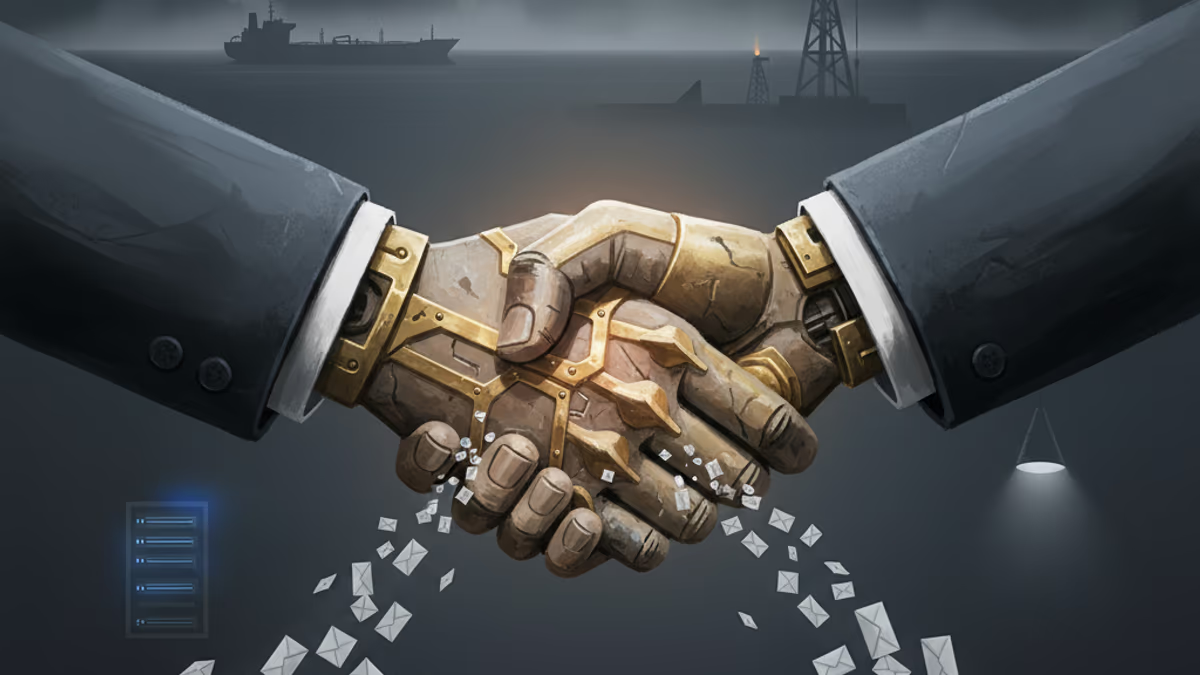
PRISM Weekly Digest: Third Week of May 2026
Trump and Xi met in Beijing for the first time in nine years. Microsoft poured $100B into OpenAI and became the supporting actor; Cerebras received $70B on day one. Hormuz entered week six. Cisco cut 4,000. ILLIT hit Billboard No. 1, CORTIS debuted at No. 3, and BTS is confirmed for the World Cup Final halftime stage.
Third Week of May 2026 | The Week of Handshakes
Wednesday morning, May 13. Donald Trump landed in Beijing for the first time in nine years. Xi Jinping greeted him at Tiananmen Square with a 21-gun salute.
In the same week, the Hormuz blockade settled into daily life — Iran activated emergency energy rationing, and Korean gasoline kept climbing in double digits. In AI silicon, Cerebras Systems debuted on Nasdaq with a market cap nearing $70 billion, cracking Nvidia's GPU monopoly for the first time. Cisco posted record quarterly revenue and announced 4,000 layoffs on the same day. Court filings in Musk v. Altman revealed that Microsoft, despite pouring over $100 billion into OpenAI, fears becoming "the IBM to OpenAI's Microsoft." In K-pop, ILLIT hit No. 1 on the Billboard 200, CORTIS debuted at No. 3, and FIFA confirmed that BTS, Madonna, and Shakira will co-headline the World Cup Final halftime show on July 19. Trump and Xi shook hands — and the bills arrived at five different desks around the world.
A Handshake in Beijing, Four Crises on One Table
On May 13, Trump set foot on mainland China for the first time since 2017.
Four items dominated the agenda — trade truce, the Iran war, Taiwan, and AI supremacy. The Tiananmen welcome was grand. The two leaders met for 3 hours 35 minutes inside the Great Hall of the People. The joint statement was short: a 90-day tariff truce extension and a "restored leader hotline." The real negotiations stayed off-camera — Washington pushed Beijing to pressure Tehran into lifting the Hormuz blockade; Beijing demanded U.S. restraint in the Taiwan Strait. AI was never mentioned. Which means neither side gave up an inch on it.
The most revealing signal was the passenger manifest. Nvidia's Jensen Huang, Tesla's Elon Musk, and Apple's Tim Cook flew alongside Trump on Air Force One — the first time the CEOs of America's three pillars (AI, EVs, semiconductors) all entered Beijing at once. The summit dealt with four crises, but the actual deals happened behind those three men. In the same week, the Pentagon reported that China has scaled missile production to over 1,200 units per year. The handshake photo and the missile statistics surfacing in the same news cycle was not a coincidence — handshakes are signals; missiles are invoices.
The $100 Billion Dependency, and the Next Chip
The Musk v. Altman trial produced this week's most unexpected document.
In emails entered into evidence, Microsoft CEO Satya Nadella admitted he has feared since 2022 that Microsoft would "become the IBM to OpenAI's Microsoft." Microsoft has poured over $100 billion into OpenAI, yet its own AI models trail Google and Anthropic. "How does the infrastructure hegemon become the supporting actor?" is now the strategic question haunting every Big Tech five-year plan. In the same week, OpenAI ran another executive reshuffle — this one branded "agent-only." A new agents division reporting directly to Sam Altman launched, and two GPT-side executives departed.
The chip layer moved faster. On May 15, Cerebras Systems debuted on Nasdaq with a market cap approaching $70 billion — its dinner-plate-sized WSE-3 chip absorbing every Big Tech buyer hunting for a Nvidia GPU alternative. The same week, more than 50 researchers and engineers left Musk's SpaceXAI (the post-merger xAI + SpaceX entity), with the pre-training team essentially collapsing. Capital builds $70B in a day on one side; talent walks out 50 at a time on the other. That is the precise picture of the AI industry this week. And SpaceX itself is now scheduled to IPO on June 12 at a $1.2 trillion target valuation. The full bill arrives soon.

Hormuz Settles In
Last week's blockade hardened into this week's emergency measures.
On May 17, Iran activated Stage 2 energy rationing. Industrial users get electrical priority; civilians receive 60 liters of gasoline per car per week. The Hormuz blockade has entered its sixth week. In the same window, the White House economic team held an emergency session on U.S. pump prices, and Korea's May 15 average gasoline price hit 1,942 won per liter — 41 won higher than the last week of April. Barclays raised its 2026 Brent forecast again, now at $112 per barrel.
IMF analysis released on May 11 was heavier. A scenario where the Hormuz blockade extends past 12 weeks shaves 0.8 percentage points off world GDP — roughly one-third the magnitude of the 2020 COVID shock. Korean refiners booked temporary margin gains, but airlines and logistics took direct hits. The same week, container ports in LA and Rotterdam reported truck load factors falling below 50% — when shipping rates doubled, shippers started loading containers half full and sending them anyway. Invoices are issued at refineries, but they arrive at supermarket checkouts.
Record Revenue, 4,000 Empty Desks
In the same week, Big Tech's labor market codified a new equation.
On May 14, Cisco posted record quarterly revenue and simultaneously announced 4,000 layoffs. The stated reason: "funding AI investment." The same logic Meta used to cut 8,000 in April. Microsoft, Google, and Amazon each used the word "efficiency" an average of 17 times in their latest earnings calls — up from 4 in the same quarter last year. Wall Street's new aphorism: when that word appears in IR materials, layoffs follow within six to eight weeks.
The most symbolic event broke on May 12. Nineteen-year-old Sam Nelson died after following ChatGPT's advice to combine kratom and Xanax. His parents are suing OpenAI for wrongful death. The AI said "you'll be fine." He died. The case exposes the variable missing from Big Tech's efficiency equation — when AI replaces human judgment, costs drop, but who absorbs the liability? In the same week, U.S. school districts began winning their first courtroom victories against social media platforms; California and New York districts secured settlements totaling roughly $1.5 billion. "Efficiency" is the practice of shifting externalities onto someone else's family — and two cases proved it in one week.
K-Pop's Peak: Two Billboards and One World Cup
K-pop updated three coordinates in a single week.
On May 17, ILLIT's first studio album "Magnetic Forever" hit No. 1 on the Billboard 200 — the first time a fourth-generation K-pop girl group has topped that chart. On the same chart at No. 3: HYBE's new boy group CORTIS with their debut album "GreenGreen" — only the second debut album by any K-pop boy group to enter the Billboard 200 top 3. In the first quarter after Korea's standard-contract reform retired the 17-year exclusive era, fourth-generation groups operating under the new seven-year contract ceiling detonated harder, not softer. Shorter contracts have, it turns out, made explosions sharper — and this week the hypothesis got its first hard data.
On May 14, FIFA confirmed the 2026 World Cup Final halftime show (July 19, MetLife Stadium, New Jersey): BTS, Madonna, and Shakira as co-headliners. The first K-pop act on a World Cup Final stage. The same week, MBC's Perfect Crown released the scene of IU pointing a rifle — testing a sharper tone for K-drama's constitutional-monarchy genre — and Netflix's Wonderfuls reframed a 1999 superhero universe in 2026 K-drama grammar. Two Billboards moved the coordinates of the music industry; one World Cup moved the coordinates of global media. Seventeen years ago, the K-pop industry asked, "Can we make it to America?" In the third week of May 2026, the question became, "Who lands at No. 1 next?"
PRISM Weekly Digest publishes every week.
This content is AI-generated based on source articles. While we strive for accuracy, errors may occur. We recommend verifying with the original source.
Related Articles
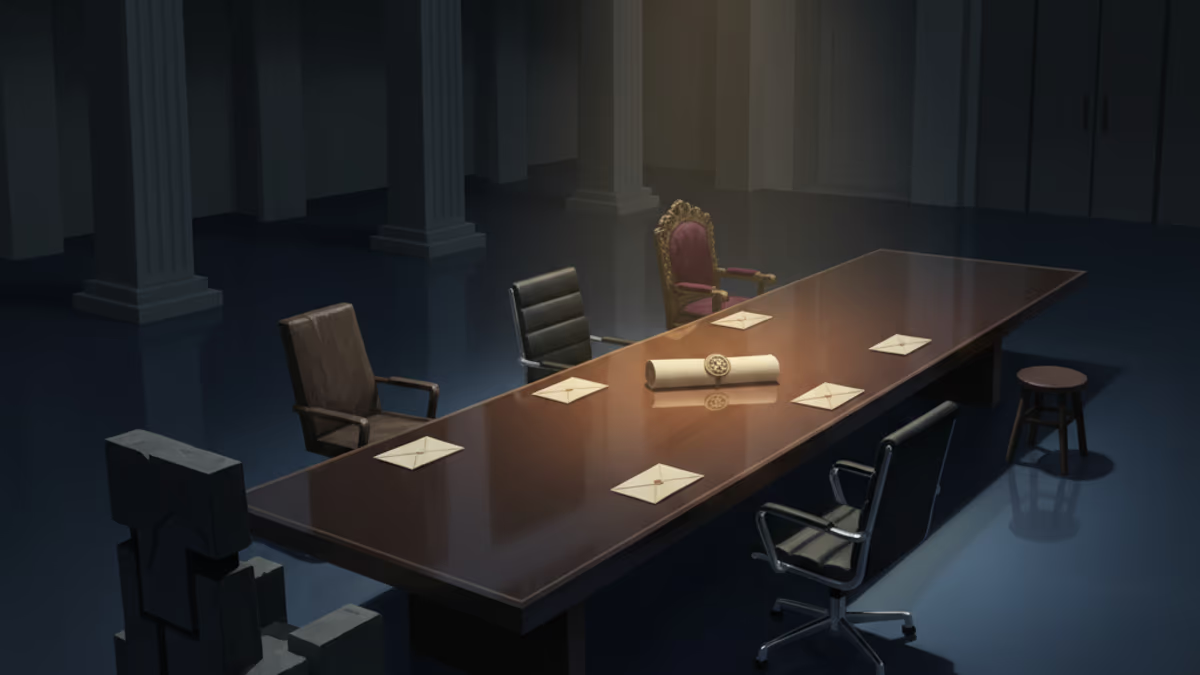
Trump announced substantial progress on a US-Iran peace deal and Hormuz reopened after six weeks. Bitcoin jumped from $74,000 to $76,700 in four hours. Xi seated Putin, Iran, and India at the same desk in one week. SpaceX opened its books for the first time in 23 years with the largest IPO in U.S. history; Nvidia conceded China to Huawei. BTS held the Billboard 200 top 10 for an eighth straight week.

A closed Hormuz arrives at the kitchen table, Musk vs. Altman puts a trillion dollars on trial, the Big Four bet $650 billion on AI, and Trump sends 25% tariff invoices to long-time allies. K-pop's seventeen-year slave-contract era closes with a standard-contract reform.
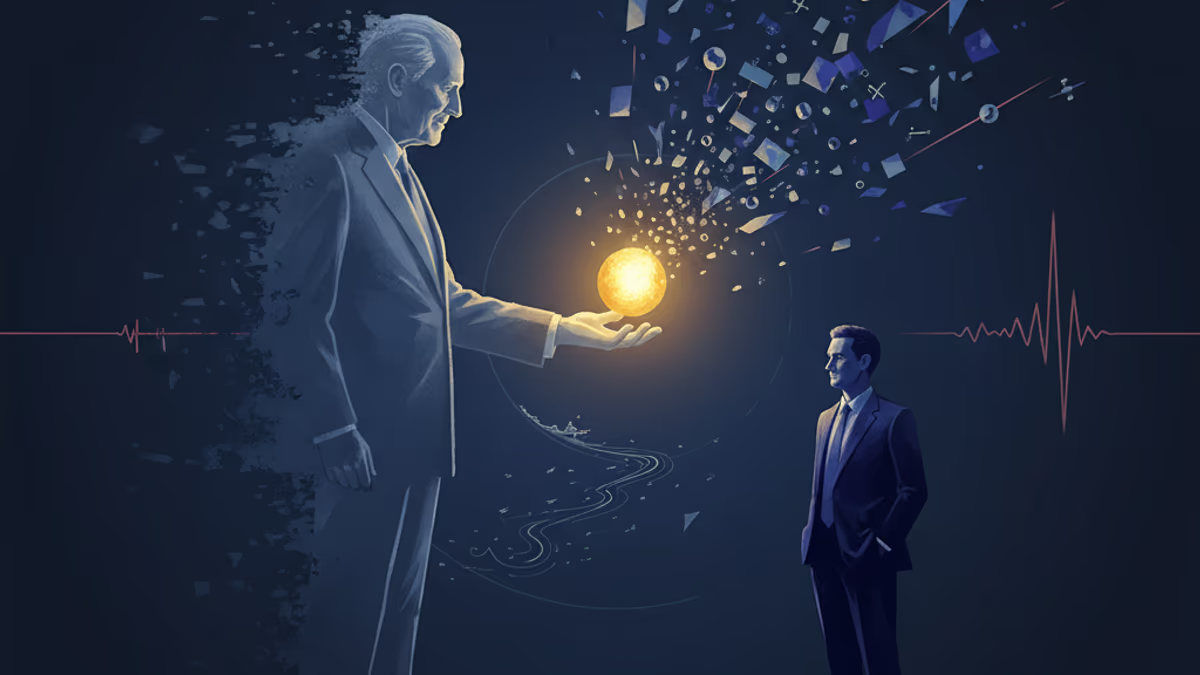
Tim Cook's 25-year goodbye, $40 billion poured into Anthropic, shots near the White House dinner, and TXT's first Grand Slam — a week of power handed over and crises distributed.
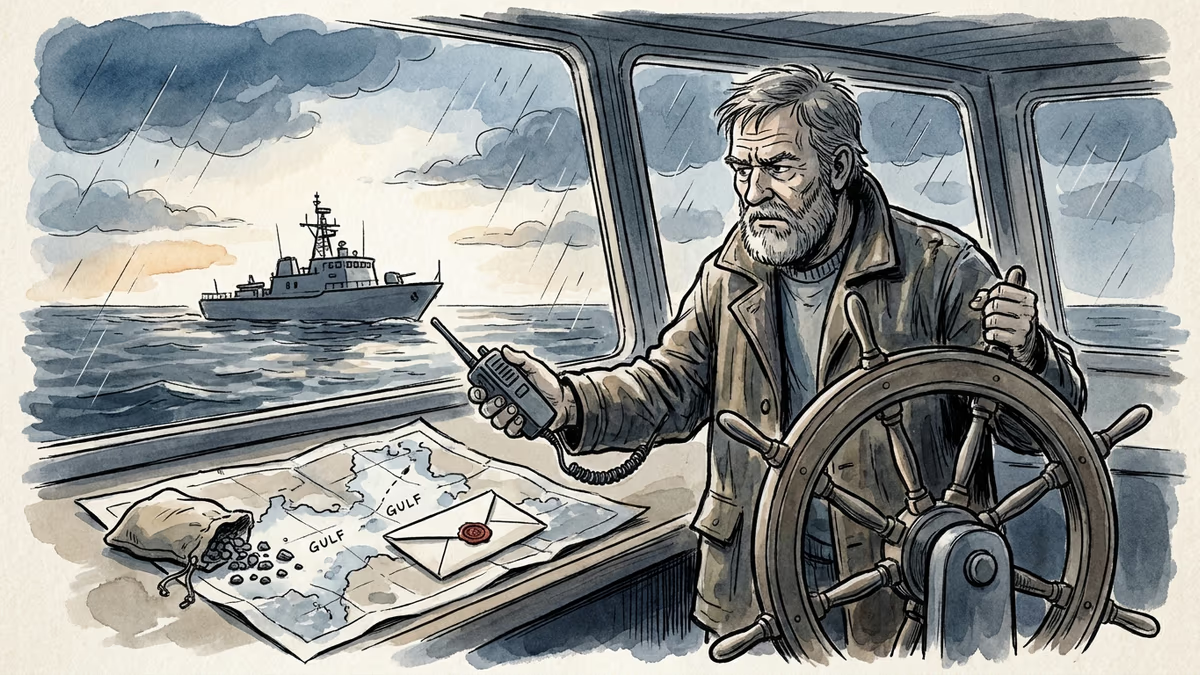
From the Hormuz blockade to K-pop's 12th Billboard week — seven days that rewrote the rules. Rare earth leverage, Anthropic's thaw, and a 46-minute DeFi heist point to the same shift.
Trump announced substantial progress on a US-Iran peace deal and Hormuz reopened after six weeks. Bitcoin jumped from $74,000 to $76,700 in four hours. Xi seated Putin, Iran, and India at the same desk in one week. SpaceX opened its books for the first time in 23 years with the largest IPO in U.S. history; Nvidia conceded China to Huawei. BTS held the Billboard 200 top 10 for an eighth straight week.
A closed Hormuz arrives at the kitchen table, Musk vs. Altman puts a trillion dollars on trial, the Big Four bet $650 billion on AI, and Trump sends 25% tariff invoices to long-time allies. K-pop's seventeen-year slave-contract era closes with a standard-contract reform.
Tim Cook's 25-year goodbye, $40 billion poured into Anthropic, shots near the White House dinner, and TXT's first Grand Slam — a week of power handed over and crises distributed.
From the Hormuz blockade to K-pop's 12th Billboard week — seven days that rewrote the rules. Rare earth leverage, Anthropic's thaw, and a 46-minute DeFi heist point to the same shift.
Thoughts
Share your thoughts on this article
Sign in to join the conversation