
Prettier Than AI: The K-Pop Idol ID Photo Redefining Digital Beauty
A K-pop star's ID photo went viral for being 'prettier than AI.' Discover why this moment is a major signal about beauty, authenticity, and our future with technology.
The Uncanny Valley in Reverse
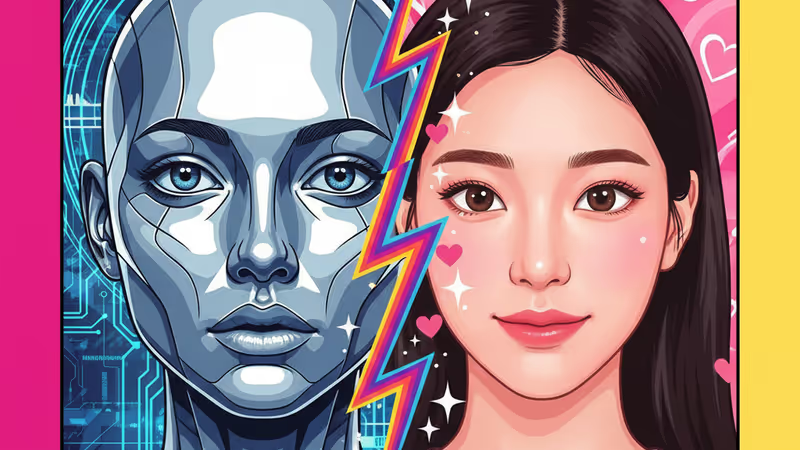
In an internet saturated with flawless AI influencers and deepfaked perfection, a simple, real-life ID photo just broke through the noise. When a picture of Jiwoo, from the K-pop group Hearts2Hearts, surfaced online, the reaction wasn't just 'she's pretty.' The overwhelming consensus was something far more telling about our current moment: she looks 'prettier than AI.'
This isn't just fandom enthusiasm. It's a cultural flashpoint that reveals our complicated, evolving relationship with authenticity, perfection, and the digital faces we see every day. Here’s the story of why one photo became a global conversation.
How One ID Photo Broke the Internet
The story began simply. A screenshot from a video revealed Jiwoo's official ID photo—a format typically associated with unflattering lighting and stark realism. But this photo looked like a high-fashion magazine shoot. The image quality was so pristine and her features so symmetrical that it immediately sparked disbelief and admiration on the Korean forum Theqoo before exploding across global social media.
The virality hinged on two key factors:
- The 'Long Hair' Reveal: For many fans, who were used to her signature short haircut, seeing Jiwoo with long, flowing hair was a dramatic and stunning transformation.
- The AI Comparison: The phrase that echoed across every platform was a variation of "She's prettier than AI." In 2025, where AI-generated models set an impossible standard, a human being surpassing that standard felt both shocking and refreshing.
The Best Reactions: A Masterclass in Internet Hype
The internet did what it does best: react with a mix of awe, humor, and hyperbole. We've curated the most insightful and entertaining takes.
The 'System Error' Crowd
This group couldn't process how a supposedly raw, official document could look so perfect. Their commentary focused on the surreal, almost algorithmic quality of her beauty.
- "My brain is short-circuiting. An ID photo is supposed to be your government-mandated ugly pic. What is this sorcery?"
- "Did she submit a rendering instead of a photo? The AI art generators are taking notes."
- "This is proof we're living in a simulation and she's the main character."
The 'Humanity Strikes Back' Brigade
For these users, Jiwoo's photo was a victory for humanity in the silent war against synthetic beauty. It was a celebration of authentic, yet aspirational, human aesthetics.
- "After years of seeing AI models, you forget what 'breathtaking' actually looks like on a real person. This is it."
- "I love this. It's like nature's algorithm just dropped a patch that beats the tech bros' code."
- "Seriously beautiful. The short hair is iconic, but the long hair is just... ethereal."
Cultural Context: The Pressure of Perfection
To understand why this resonated so deeply, you have to look at the culture it comes from. The K-pop industry is a global leader in crafting and maintaining a 'perfect visual.' Idols are known for their meticulous styling and almost supernatural beauty. An ID photo, which in most cultures is a moment of vulnerability, becomes another canvas to project this ideal.
However, the global reaction transcends K-pop. We are all living in the 'Age of AI Aesthetics.' Our feeds are filled with images filtered, tweaked, and sometimes wholly generated by algorithms. This has created a new 'uncanny valley'—not where AI looks almost human, but where humans look so perfect they appear artificial. Jiwoo’s photo landed squarely in this territory, and the confirmation that it was real is what made it so powerful.
PRISM Insight: Welcome to the Post-AI Beauty Standard
This viral moment is more than just a fleeting trend; it's a significant cultural marker. It signals a shift from aspirational beauty to what we're calling 'Post-AI Beauty.'
For the past decade, the pinnacle of digital beauty was achieving a photoshopped, filtered perfection that mimicked the flawlessness of a digital rendering. Now, the goalposts have moved. AI can create 'perfect' faces on demand, making that old standard feel cheap and synthetic. The new, ultimate status symbol isn't looking like a filter; it's looking so naturally perfect in a real-world context that people think you *must* be AI—and then being proven human.
Jiwoo's ID photo is the perfect example of this phenomenon. It represents a new frontier in the creator and influencer economy: outperforming the algorithm. It's a testament to the enduring power of human charisma and genetics, a biological trump card in a world increasingly dominated by code. The highest compliment you can receive in 2025 is no longer "you look like a model," but "Are you even real?"
관련 기사
엑소 레이의 갑작스러운 팬미팅 불참 공지가 단순한 해프닝이 아닌 이유. 10년간 이어진 팬들의 희망과 좌절, 그리고 그 이면에 숨겨진 문화적, 지정학적 맥락을 분석합니다.
BTS 정국의 인스타그램 셀카 한 장이 전 세계 K팝 팬덤을 뒤흔들었습니다. 단순한 사진이 아닌, '에스파화' 밈과 4세대 아이돌 문화의 상징이 된 이유를 분석합니다.
댄서 타잔의 '뉴진스 손절' 발언이 K팝 씬을 뒤흔들었습니다. 단순한 취향 변화가 아닌, 팬덤 정치와 업계 역학을 드러낸 이 사건에 대한 해외 팬들의 날카로운 반응과 문화적 분석.
10년 만에 돌아온 '응답하라 1988' 배우들의 OST 프로젝트. 이것이 단순한 팬서비스를 넘어 K-드라마 역사에 남을 문화 현상이 된 이유와 해외 반응을 심층 분석합니다.