
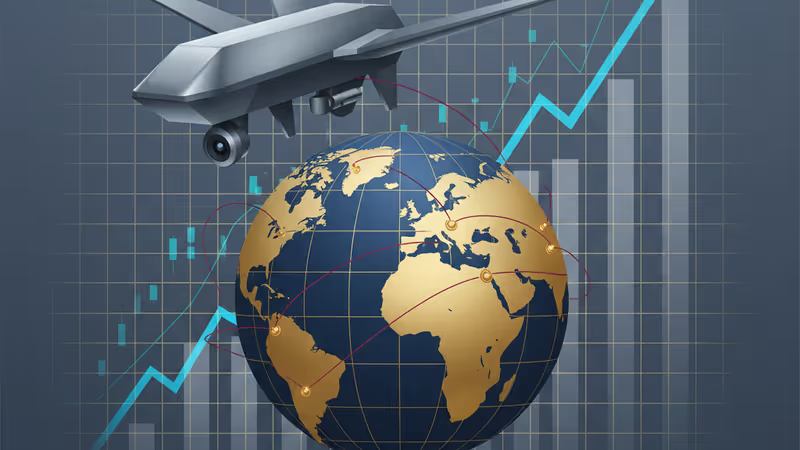
Israel's Defense Exports Hit Record $15 Billion, Fueled by 'Battle-Tested' Gaza Weaponry
Israel's defense exports reached a record $15 billion in 2024, driven by demand for 'battle-tested' weapons used in the Gaza war. An analysis of the market shift, ethical controversy, and human impact.
The Lead: A Controversial Boom
Israel’s defense exports soared to a record high of nearly $15 billion in 2024, a 13% increase from the previous year, as the country’s arms manufacturers marketed their products as "battle-tested" in the ongoing war in Gaza. The surge, announced by the Israeli government in June, was driven primarily by sales of missiles, rockets, and air-defense systems, with European nations emerging as the top buyers amid escalating global tensions.
Shifting Markets, Rising Demand
According to Israel's Ministry of Defence, the composition of its export market underwent a significant transformation in 2024. Deliveries to European militaries accounted for 54% of the total, a sharp rise from 36% in 2023. The Asia-Pacific region followed at 23%, with India as a key client, while the United States made up 9% of sales. This pivot to Europe reflects a continent rapidly re-arming in the face of regional instability.
Context: A Backdrop of Legal Scrutiny
This export boom occurred as Israel faced mounting international legal pressure. The country is defending itself against allegations of genocide brought by South Africa at the International Court of Justice (ICJ), and the International Criminal Court (ICC) has issued arrest warrants for Prime Minister Benjamin Netanyahu and his former Defence Minister Yoav Gallant for alleged war crimes.
The 'Battle-Tested' Premium
Analysts suggest that a key driver of Israel's export success is the perception that its technology has been proven effective in active combat scenarios. For some nations, this provides a compelling seal of approval.
"Israel sells the idea of getting away with it. There is a very great appeal of that to many other nations."
However, critics argue this commercial success is morally and legally fraught. Shir Hever, an Israeli arms trade specialist, told Al Jazeera that purchasing countries are aware of the legal implications. "[Buyers] know that a genocide is taking place, and third countries are under a legal obligation not to trade with countries that are committing war crimes and crimes against humanity," Hever stated.
The Human Cost of Technology
While Israeli arms companies report record revenues, Palestinians in Gaza recount the devastating impact of these technologies. Kareem al-Birawi told Al Jazeera how a quadcopter attack killed his mother and three siblings at a school in Jabalia last year.
"I saw the drone enter the room. There was a red flash, then smoke came out. After that, there was an explosion and fire. My mum and aunt were screaming. Then they all went silent."
Israel's exports extend beyond conventional arms to include sophisticated AI and surveillance tools. Facial recognition technology is deployed at hundreds of locations in the occupied West Bank and used extensively in Gaza. Ahmad Lubbad, a released Palestinian detainee, described the scope of this surveillance after his detention in late 2023, saying Israeli soldiers knew his wife's phone number, his addresses, and the names of his neighbors. "After what I went through in the interrogation, I am convinced we are watched all the time. Totally exposed," he said.
Despite the overall increase in demand, the international response is not uniform. Some nations, such as Spain, have moved to impose restrictions on arms imports from Israel, signaling a growing divide in how countries approach the issue.
관련 기사

미 법무부가 제프리 엡스타인 관련 파일을 공개한 직후, 도널드 트럼프 전 대통령의 사진이 포함된 문서 16건을 예고 없이 삭제했다. 정부의 정보 처리 방식과 투명성을 둘러싼 의문이 제기되고 있다.

미국 해안경비대가 베네수엘라 인근 해역에서 제재 대상 유조선 '벨라 1'을 추격 중이다. 트럼프 행정부의 대(對)베네수엘라 압박 강화가 국제 유가 및 지정학적 긴장에 미칠 영향을 분석한다.

미국 공화당 토마스 매시와 민주당 로 칸나 의원이 팸 본디 법무장관에게 엡스타인 파일 미제출을 이유로 '내재적 모독'을 적용해 벌금을 부과하겠다고 경고했다. 이는 이례적인 초당적 압박이다.

전문가 분석에 따르면, 페르디난드 마르코스 필리핀 대통령이 국내 스캔들과 두테르테의 위협 속에서 2026년을 '운명의 해'로 맞이한다. 아세안 의장국 역할이 그의 정치적 구원의 기회가 될 수 있을까?