
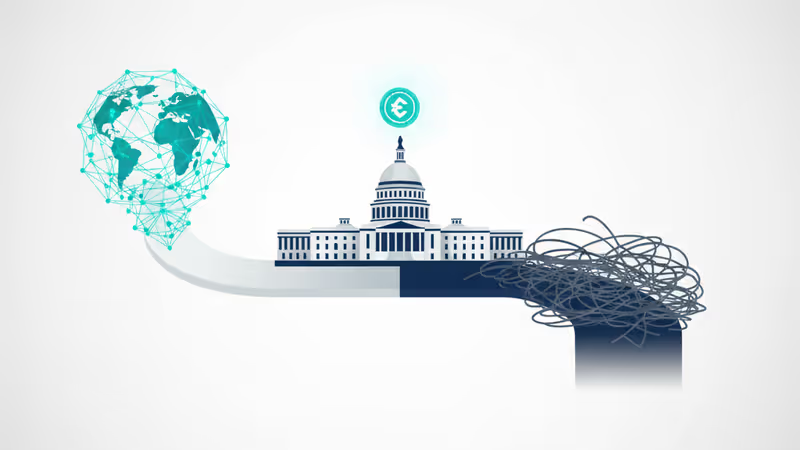
America's Crypto Crossroads: Legislative Limbo Threatens Global Leadership
US crypto regulation is stalled in the Senate, creating a high-stakes limbo. This analysis breaks down the strategic cost of inaction and the threat to US tech leadership.
The Lede: DC's Stalemate is a Multi-Trillion Dollar Unforced Error
While the US Senate engages in hopeful but sluggish bipartisan talks over crypto market structure, the real story isn't the negotiation—it's the mounting cost of delay. For global executives and investors, Washington's legislative inertia is no longer a procedural footnote; it is actively creating a vacuum that threatens to cede America's dominance in the next generation of financial technology. The central question is not *if* a bill will pass, but how much irreversible damage is being done to US competitiveness in the interim.
Why It Matters: The High Cost of Regulatory Ambiguity
A failure to pass comprehensive crypto legislation in the near term has severe second-order effects beyond the industry itself:
- Capital Flight and Innovation Drain: Without clear rules of the road, institutional capital remains sidelined and innovative startups are increasingly incorporating in jurisdictions with established frameworks, such as the EU (MiCA), Singapore, and Hong Kong. This isn't just a loss of potential tax revenue; it's a brain drain of top-tier engineering and financial talent.
- The Entrenchment of 'Regulation by Enforcement': The current status quo empowers federal agencies like the SEC to govern through litigation. This is an inefficient, expensive, and unpredictable method of policymaking that creates a hostile environment for legitimate businesses and benefits only the legal profession.
- Weakening the US Dollar's Digital Future: A robust domestic digital asset ecosystem, including well-regulated stablecoins, is critical for the long-term relevance of the US dollar in a tokenized global economy. Legislative paralysis is a strategic blunder that undermines this future.
The Analysis: A Familiar Story of Political Gridlock
The current impasse is a classic case of Washington's process overwhelming its purpose. While the House has passed its version of a market structure bill, the Senate's insistence on starting from scratch—a common symptom of inter-chamber rivalry—has reset the clock. This legislative quagmire is now colliding with predictable political headwinds: looming budget fights and the increasing polarization of a midterm election cycle.
This isn't a debate over novel concepts; it's a turf war. The core of the proposed legislation seeks to draw clear lines between assets that are securities (under the SEC) and those that are commodities (under the CFTC). By failing to resolve this, Congress perpetuates a costly power struggle between its own regulators, leaving the private sector to foot the bill for the uncertainty. The optimistic bipartisan sentiment expressed by negotiators is a positive signal, but it is fragile and likely to be overridden by broader political imperatives as the election calendar advances.
PRISM Insight: The Rise of the 'Regulatory Arbitrage' Thesis
Sophisticated investors are not simply waiting for US clarity; they are actively pursuing a strategy of global regulatory arbitrage. The investment thesis is shifting from betting on specific US-based projects to backing platforms and protocols that are either globally compliant or sufficiently decentralized to be jurisdiction-agnostic. The delay in US legislation is paradoxically accelerating the very trend regulators fear: the growth of a truly borderless, decentralized financial system that operates outside the purview of any single nation-state. Capital is flowing to exchanges and funds that have secured licenses in multiple proactive jurisdictions, treating the US as one market among many, rather than the default center of the financial universe.
PRISM's Take: America is Choosing to Lose the Race
The narrative of 'waiting for crypto regulation' is misleading. A decision is already being made. By failing to act decisively, the United States is effectively choosing a policy of managed decline in the digital asset sector. While other economic blocs are laying down clear regulatory pavement to attract the next wave of financial innovation, the US is leaving up roadblocks and 'danger' signs.
This legislative paralysis is a profound, self-inflicted wound. It sends a clear message to global innovators: build elsewhere. The cost of this inaction won't be measured in a single failed bill, but in the lost opportunity to architect the future of finance. The storm isn't coming; for American leadership in digital assets, it's already here.
関連記事
米国の暗号資産規制法案が議会で停滞。この遅延が業界、投資家、そして米国の国際競争力に与える深刻な影響を専門家が徹底分析します。
2026年、SECの規制緩和で暗号資産ETPが急増する見通し。市場の成熟化を意味する一方、淘汰の波も。投資家が知るべき勝者の条件を専門家が分析。
米上院で審議中の暗号資産市場構造法案が2026年に延期。この「規制の空白」が投資家心理と市場に与える影響、そして今後の投資戦略を専門家が徹底分析します。

中国製薬業界がジェネリックから革新ハブへ。新指標が示す圧倒的なコスト効率と開発力。投資家と業界リーダー必見の分析です。