
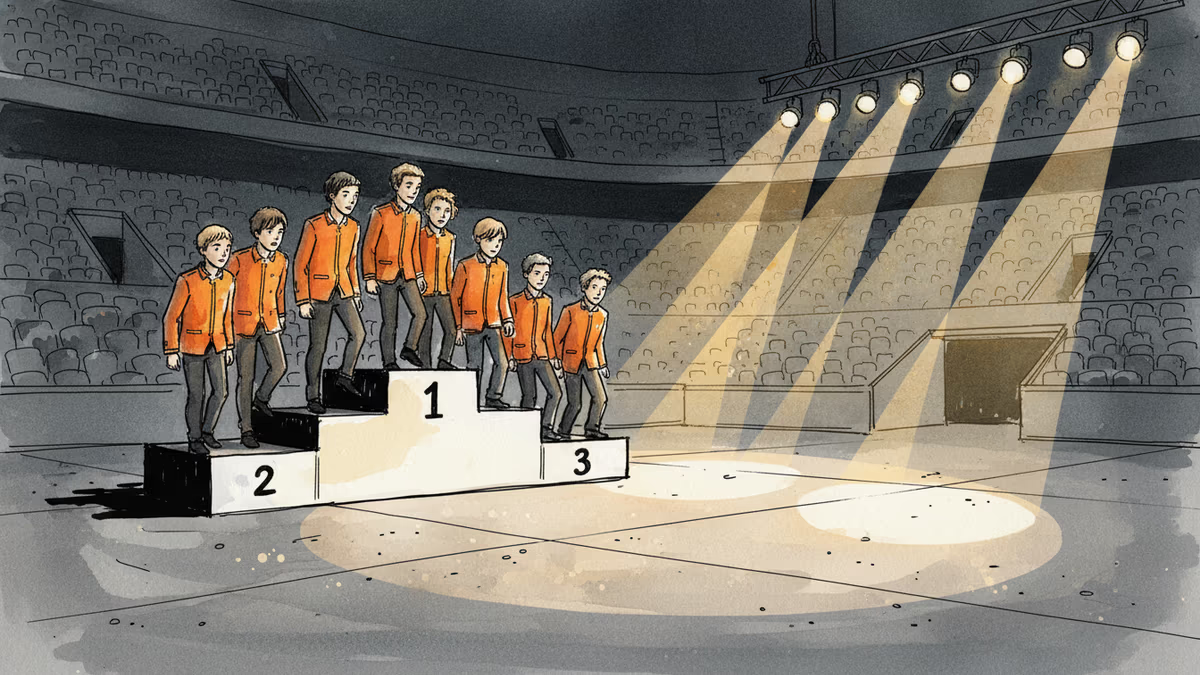
YUHZ Debuts—But the Real Competition Starts Now
Survival show YUHZ makes their debut with 'Rush Rush.' A look at what survival-program fandom economics mean for new K-pop groups in a saturated market.
Every K-pop survival show ends the same way: confetti, tears, and a debut announcement. What happens in the 12 months after that is where most groups quietly disappear.
On May 7, 2026, at 6 p.m. KST, eight-member group YUHZ dropped their debut single album 《Orange Record》 and the music video for title track 'Rush Rush'—a bubbly, high-energy pop song built around the theme of charging forward without hesitation. The group was formed through 《B:MY BOYZ》, a Mnet survival program that gave viewers a vote in determining the final lineup. The MV leans into the same bright, kinetic energy as the song: the visual language of optimism, not menace.
For fans who watched every elimination episode, this is the payoff. For everyone else, YUHZ is still an introduction.
The Survival Show Playbook—and Its Hidden Costs
The format that produced YUHZ traces directly back to 《Produce 101》 (2016), which industrialized a simple insight: if fans vote to build a group, they arrive at the debut already emotionally invested. Ten years later, that model has become one of the most reliable fan-acquisition pipelines in K-pop. ZEROBASEONE, ENHYPEN, and Kep1er all came from the same assembly line.
But the pipeline has a structural tension baked in. Survival-show fandoms are built around competition narratives—weekly rankings, elimination drama, underdog stories. The moment the show ends, that narrative engine switches off. What replaces it is the group's own identity: their music, their chemistry, their ability to generate new stories. Groups that fail to make that transition quickly tend to see their fandom plateau or fragment, especially when the next survival show starts airing and pulls attention back to the format rather than the graduate.
YUHZ enters a male idol market that is, by most measures, already crowded. RIIZE, ZEROBASEONE, and multiple other groups launched within the past three years have staked out distinct audience segments. A debut single in the energetic pop lane—accessible, cheerful, broadly appealing—is a low-risk opening move, but it also delays the moment when YUHZ has to answer the harder question: what makes them specifically worth following?

What 'Orange Record' Signals
The album title is a quiet act of positioning. Orange is an unusual color choice in male idol visual grammar, which tends to cluster around either soft pastels or high-contrast darks. Choosing orange—energy, warmth, youth without edge—places YUHZ deliberately in the 'non-threatening brightness' lane.
That positioning isn't arbitrary. Between 2024 and 2025, hyper-maximalist and dark-concept aesthetics cycled through their peak and began generating fatigue signals in streaming and physical sales data. Meanwhile, the global success of NewJeans' Y2K nostalgia and the cultural moment around lighter, emotionally warmer content suggested a market opening for groups willing to bet on sincerity over intensity. 'Rush Rush' reads as a calculated entry into that opening.
The risk is that several other groups read the same data. When multiple acts occupy the same aesthetic lane in the same quarter, the differentiator stops being the music and becomes parasocial infrastructure: variety show appearances, social media clip virality, fan-meet accessibility. YUHZ has a head start on the parasocial side from 《B:MY BOYZ》, but that advantage has a shelf life measured in months, not years.
The Fan Economy After the Finale
Survival-show fandoms are high-frequency consumers. The weekly content cadence of a live competition—performance clips, behind-the-scenes footage, vote countdowns—conditions fans to expect a constant content stream. Labels that fail to replicate that density post-debut often see engagement drop sharply in the first 60 to 90 days.
At the same time, the audience YUHZ needs to grow beyond its current base—people who never watched 《B:MY BOYZ》—requires a different kind of content entirely. Casual listeners don't respond to in-group references or competition callbacks; they respond to a song catching them off guard on a playlist, or a clip going wide on a platform they already use. The chart performance of 'Rush Rush' on Melon, Spotify, and YouTube in its first two weeks will be an early signal of how successfully YUHZ is crossing that gap.
The broader platform context matters here too. K-pop labels have increasingly structured debut rollouts around short-form video virality—a single choreography point, a 15-second hook, a member moment that clips well. Whether YUHZ's agency built that infrastructure into the 'Rush Rush' launch will be visible in the MV's comment section geography: domestic fans celebrating versus international casual viewers discovering the group for the first time.
This content is AI-generated based on source articles. While we strive for accuracy, errors may occur. We recommend verifying with the original source.
Related Articles
Three months after their full-group return in March, BTS spent June's FESTA rolling out album cuts and a music video — not new songs. Come Over cracked a global top 5 with zero new music behind it. Did the play work?
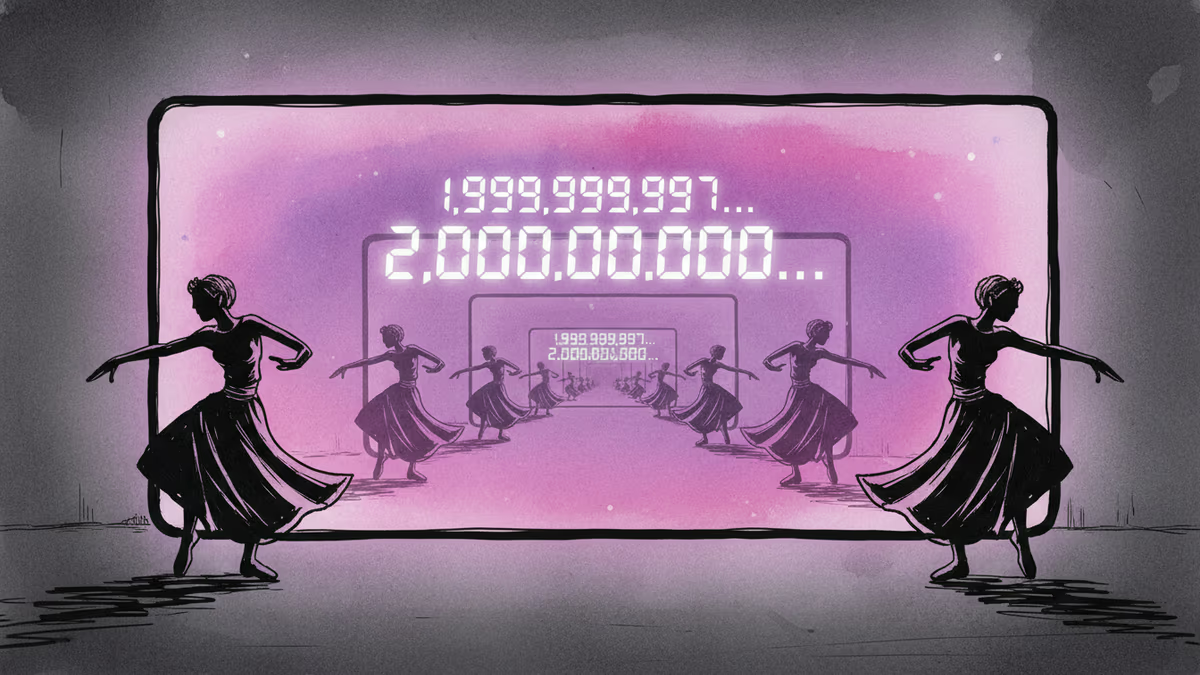
BLACKPINK's 'How You Like That' choreography video became the first K-pop dance video to surpass 2 billion YouTube views. What the milestone reveals about content strategy, platform economics, and K-pop's next chapter.
&TEAM's 'We on Fire' debuted on the Billboard 200 for the first time. Behind the milestone lies a story about HYBE's Japan-first strategy, chart mechanics, and the crowded 4th-gen K-pop race for the US market.

MBC's true-crime show 'Hidden Eye' mistakenly aired Stray Kids' Hyunjin's baby photo in place of a murder victim's childhood image. Five months later, an apology. What does that timeline reveal?
Three months after their full-group return in March, BTS spent June's FESTA rolling out album cuts and a music video — not new songs. Come Over cracked a global top 5 with zero new music behind it. Did the play work?
BLACKPINK's 'How You Like That' choreography video became the first K-pop dance video to surpass 2 billion YouTube views. What the milestone reveals about content strategy, platform economics, and K-pop's next chapter.
&TEAM's 'We on Fire' debuted on the Billboard 200 for the first time. Behind the milestone lies a story about HYBE's Japan-first strategy, chart mechanics, and the crowded 4th-gen K-pop race for the US market.
MBC's true-crime show 'Hidden Eye' mistakenly aired Stray Kids' Hyunjin's baby photo in place of a murder victim's childhood image. Five months later, an apology. What does that timeline reveal?
Thoughts
Share your thoughts on this article
Sign in to join the conversation