
The Morning Star of Lingao Industrial Party: How Sci-Fi Mirrors China's Tech Ambition
Explore how the web novel 'The Morning Star of Lingao' fueled China's Industrial Party ideology, prioritizing engineering and speed over traditional political reforms.
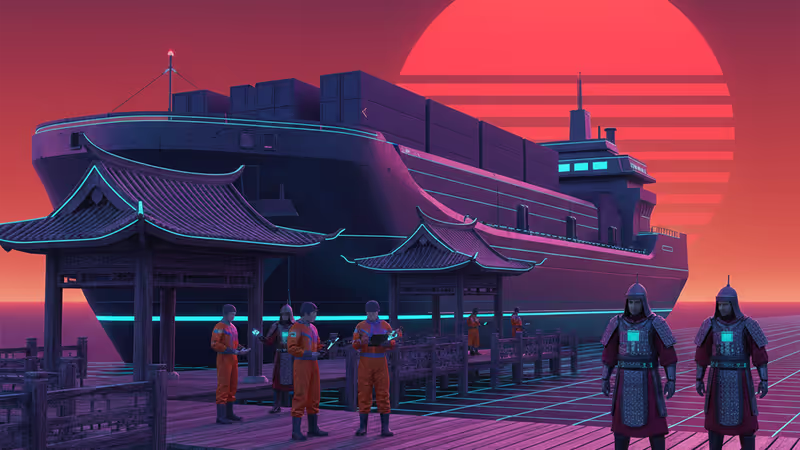
What if 500 engineers traveled 400 years back in time to trigger an industrial revolution? This isn't just a plot point in The Morning Star of Lingao—it's a cultural phenomenon that has defined the Chinese internet for nearly two decades. The novel serves as a prophetic blueprint for understanding the rise of China's techno-nationalist ideology.
How The Morning Star of Lingao Industrial Party Rewrote Chinese Ambition
Since its inception on a military forum in 2006, this collectively written web novel has evolved into the sacred text of the Industrial Party (工业党). These aren't political members in the traditional sense; they are a circle of thinkers who believe that engineering is destiny. In their view, progress isn't found in democratic reforms but in the cold, hard logic of industrial capacity and infrastructure.

Ma Qianzu and the Aesthetic of Building
Real-life engineer Ma Qianzu (Ren Chonghao), the inspiration for the book's protagonist, became a pivotal voice in 2011. Following a tragic high-speed train crash, he argued that China shouldn't slow down but should instead double down on its technological mastery. This 'Darwinian' approach views industrialization as the highest form of beauty—a sentiment shared by figures like Elon Musk, whose engineering-first mindset resonates deeply with the Industrial Party aesthetic.
Authors
Related Articles

X's attempts to stop Grok from creating nonconsensual deepfakes were bypassed in under a minute. Explore the details of the X Grok deepfake controversy and its impact.

Five stories from late September, traced to where the paper trail stops: Korea's export record, Nvidia's Hugging Face 8-K, a US-China AI channel, the UN on AI, and rising births.

Huawei's CANN is open source under a license barring software for non-Ascend chips. Inside China's second CUDA, and the two links still outside it: pre-training compute and 5nm capacity.
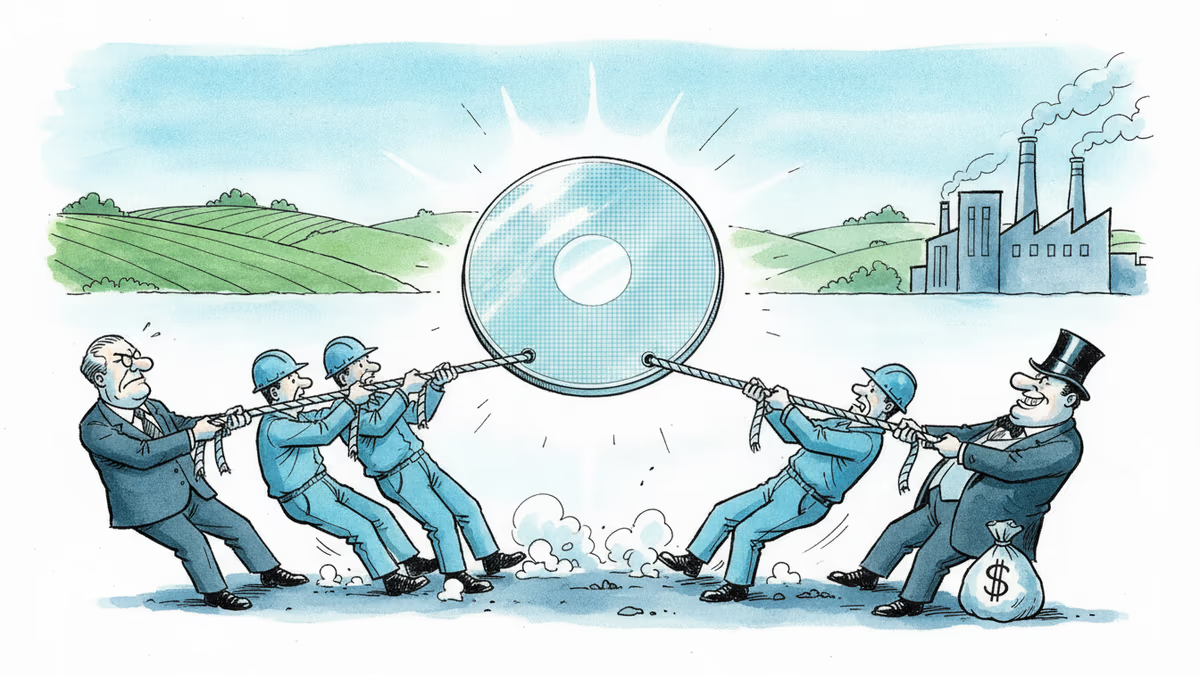
Samsung Electronics' union branch revealed that 84% of survey respondents oppose the government's roughly $290 billion (₩400 trillion) semiconductor megaproject in Gwangju. Government, management, the union and shareholders are all reading the same national project in sharply different ways.
X's attempts to stop Grok from creating nonconsensual deepfakes were bypassed in under a minute. Explore the details of the X Grok deepfake controversy and its impact.
Five stories from late September, traced to where the paper trail stops: Korea's export record, Nvidia's Hugging Face 8-K, a US-China AI channel, the UN on AI, and rising births.
Huawei's CANN is open source under a license barring software for non-Ascend chips. Inside China's second CUDA, and the two links still outside it: pre-training compute and 5nm capacity.
Samsung Electronics' union branch revealed that 84% of survey respondents oppose the government's roughly $290 billion (₩400 trillion) semiconductor megaproject in Gwangju. Government, management, the union and shareholders are all reading the same national project in sharply different ways.
Thoughts
Share your thoughts on this article
Sign in to join the conversation