
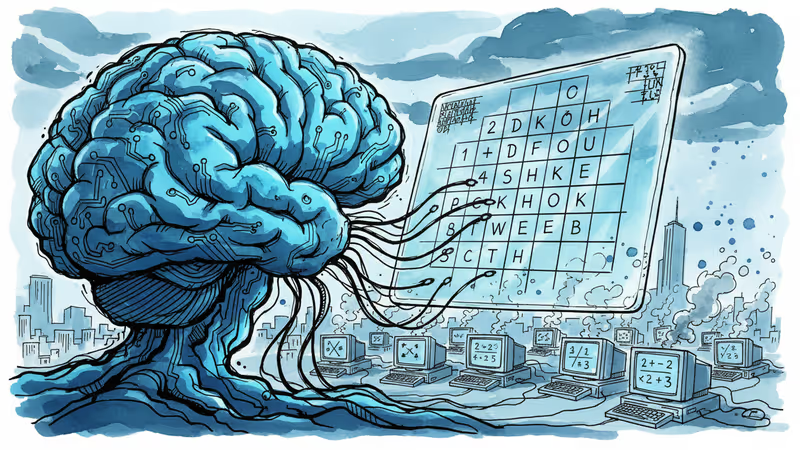
This AI Solves Sudoku 1000x Faster Than ChatGPT
Meta's former AI chief Yann LeCun joins startup developing energy-based reasoning models that claim to eliminate AI hallucinations and require far less compute power
While ChatGPT might take minutes to solve a single sudoku puzzle, a new AI model claims to crack it in seconds—using just one GPU.
San Francisco startup Logical Intelligence has developed what it calls a fundamentally different approach to artificial intelligence. On January 21, AI luminary Yann LeCun joined the company's board, lending credibility to their bold claims about moving beyond large language models.
LeCun's Rebellion Against Silicon Valley Groupthink
Since leaving Meta in November, LeCun has been vocal about what he sees as Silicon Valley's tunnel vision. Everyone, he argues, has been "LLM-pilled"—convinced that large language models are the only path to artificial general intelligence (AGI).
Logical Intelligence CEO Eve Bodnia echoes this skepticism. "LLMs are a big guessing game," she tells WIRED. "You take a neural network, feed it pretty much all the garbage from the internet, and try to teach it how people communicate with each other."
The problem, Bodnia argues, is that language is merely a manifestation of intelligence, not intelligence itself. "When you speak, your reasoning happens in some sort of abstract space that you decode into language. People are trying to reverse engineer intelligence by mimicking intelligence."
How Energy-Based Models Work Differently
Logical Intelligence has built what's known as an energy-based reasoning model (EBM). While LLMs predict the most likely next word in a sequence, EBMs absorb a set of parameters—like sudoku rules—and complete tasks within those constraints.
Bodnia uses mountain climbing as an analogy. "If you're an LLM climber, you don't see the whole map. You fix in one direction at a time and keep going. If there's a hole, you're going to jump and die."
EBMs, by contrast, can see multiple directions, choose one path, and if they encounter a dead end, try another route. "The task is always in the back of your mind," she explains.

This self-correction ability is supposed to eliminate the hallucinations that plague current AI systems while requiring far less computational power. Kona 1.0 runs on fewer than 200 million parameters—a fraction of the 1.8 trillion parameters estimated for GPT-4.
Real-World Applications Beyond Language
Bodnia isn't interested in chatbots. She's targeting problems where mistakes aren't acceptable: energy grid optimization, pharmaceutical research, advanced manufacturing.
"In real time, you have to process a lot of variables and distribute energy accordingly," she says about the power sector. "Right now, it just dumps a chunk of energy, some of which is used and some of which is not."
The company is also talking to major chip manufacturers and data centers—industries where precision and efficiency directly impact bottom lines.
The AGI Ecosystem Vision
Bodnia sees AGI not as a single super-intelligent system, but as an ecosystem of specialized AI models working together. LLMs would handle human communication, EBMs would tackle reasoning tasks, and world models (like those being developed at LeCun's new Paris-based startup AMI Labs) would help robots navigate physical space.
"There are different stages to the AGI evolution," she says. "We are somewhere in the very baby steps."
This modular approach contrasts sharply with the "one model to rule them all" philosophy driving much of current AI development. Instead of building increasingly massive models, Logical Intelligence creates smaller, specialized systems for individual businesses.
Investment and Industry Implications
The company is currently seeking funding to scale up operations and explore different use cases. For investors, this represents a bet against the prevailing wisdom that bigger is always better in AI.
For businesses, EBMs could offer a more cost-effective alternative to running massive language models for tasks that don't actually require natural language processing. Manufacturing companies, energy providers, and pharmaceutical firms might find specialized reasoning models more suitable for their needs than general-purpose chatbots.
Authors
Related Articles

Samsung and SK unveiled a chip and AI investment package worth thousands of trillions of won on June 29. The headline number swings wildly by outlet, but the real contest isn't capital — it's water and power.

Viral videos show 2026 graduates jeering executives who praise AI at commencement ceremonies. It's not just rudeness — it's a signal about who pays for technological optimism.

Filipino virtual assistants using AI to ghost-manage LinkedIn profiles for executives is now a structured industry. 30 comments a day, fake engagement rings, and a platform struggling to tell real from fabricated.
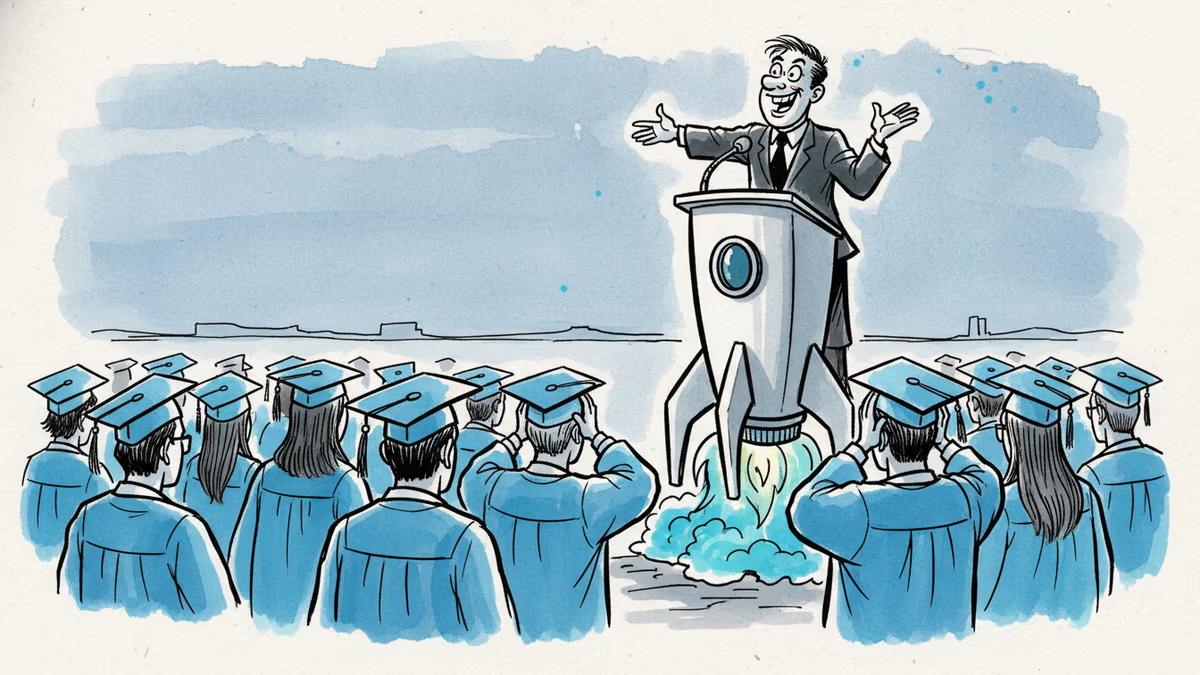
Two commencement speakers learned the hard way that AI enthusiasm doesn't land well with today's graduates. The backlash reveals a widening gap between tech optimism and Gen Z's economic reality.
Samsung and SK unveiled a chip and AI investment package worth thousands of trillions of won on June 29. The headline number swings wildly by outlet, but the real contest isn't capital — it's water and power.
Viral videos show 2026 graduates jeering executives who praise AI at commencement ceremonies. It's not just rudeness — it's a signal about who pays for technological optimism.
Filipino virtual assistants using AI to ghost-manage LinkedIn profiles for executives is now a structured industry. 30 comments a day, fake engagement rings, and a platform struggling to tell real from fabricated.
Two commencement speakers learned the hard way that AI enthusiasm doesn't land well with today's graduates. The backlash reveals a widening gap between tech optimism and Gen Z's economic reality.
Thoughts
Share your thoughts on this article
Sign in to join the conversation