
XRP's Silence Before the Storm: What CPI Could Trigger
XRP is coiling near $1.38 as Bollinger Bands compress to historic tightness. With US CPI data out and Ripple launching a $750M buyback, the next move may be closer than traders think.
The quieter crypto gets, the louder the eventual move tends to be.
XRP spent Wednesday trading in a 2.5% intraday range around $1.38 — almost unnervingly calm for a digital asset that once swung 20% in a single session. But seasoned traders know what this kind of silence often precedes. The Bollinger Bands on XRP's daily chart have tightened to their narrowest in months. Something is about to give.
The Macro Pin in the Room
The proximate cause of this paralysis is the US Consumer Price Index. February CPI data dropped today, and the results matched forecasts — which, paradoxically, isn't good news for risk assets. A reading that aligns with expectations but doesn't show meaningful cooling effectively kills the case for near-term Federal Reserve rate cuts. Markets had been quietly hoping for a dovish surprise. They didn't get one.
For crypto, the implications are direct. Rate cuts mean cheaper dollars, which historically flow into speculative assets including digital currencies. No cuts mean the opportunity cost of holding XRP over a high-yield money market fund stays elevated. The Fed's next meeting looms, and today's CPI print has reinforced the "higher for longer" narrative that has weighed on risk appetite for weeks.
This is the macro cage XRP is currently trading inside. And it explains why, even as the token briefly spiked to $1.41 on strong volume midday, sellers immediately stepped in and pushed it back into the $1.37–$1.38 range.
What the Chain Is Actually Saying

Here's where it gets interesting. Strip away the price chart and look at what's happening underneath.
Daily transactions on the XRP Ledger recently crossed 2.7 million — among the highest readings in months. The network is being used more, not less, even as price consolidates. Meanwhile, institutional-grade XRP investment products have accumulated roughly $1.4 billion in assets since launch. Long-duration capital isn't fleeing. It's waiting.
Then there's Ripple itself. The blockchain company has quietly begun a $750 million share buyback that values the firm at approximately $50 billion. This comes just four months after a $500 million funding round that valued Ripple at $40 billion — meaning the company's implied valuation has grown 25% in a single quarter. Buybacks at this scale are typically a signal that insiders believe the equity is undervalued. Whether that confidence extends to XRP the token is a separate question — but the optics are hard to ignore.
The Setup Traders Are Watching
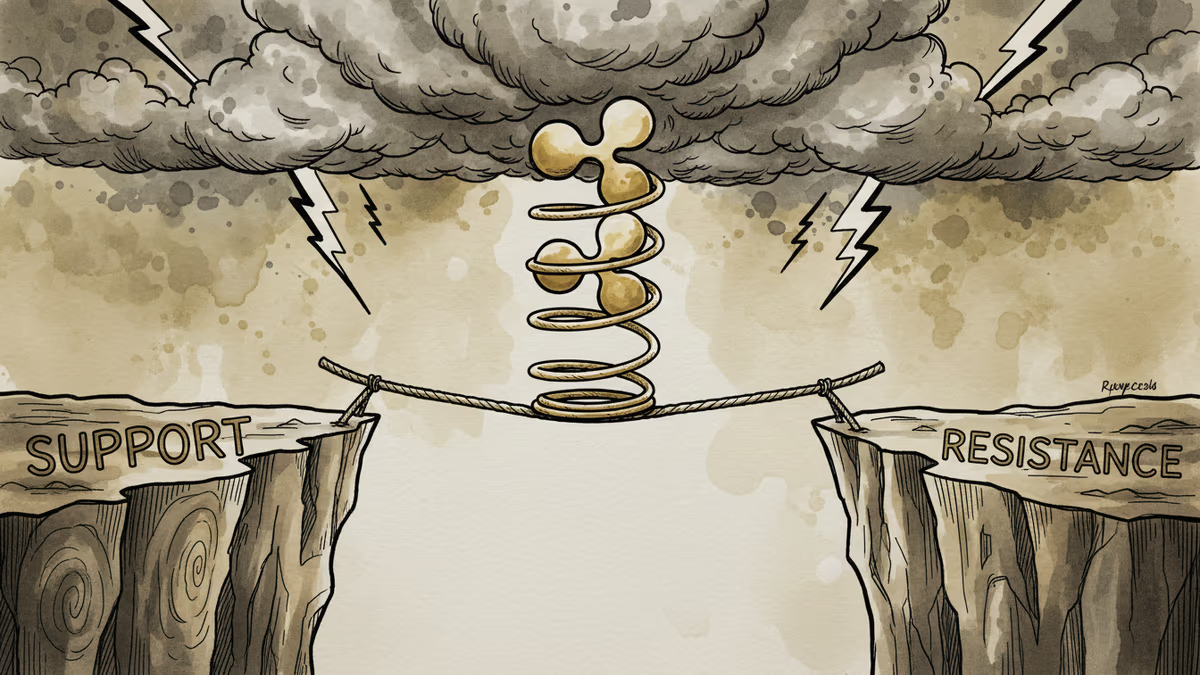
The technical picture is clean, if unresolved. XRP is boxed between $1.35–$1.37 support and $1.40–$1.42 resistance. The Bollinger squeeze — that compression of volatility bands — has historically resolved in a sharp directional move within days, not weeks.
Two scenarios dominate trader conversations right now. A sustained break above $1.42 would likely trigger momentum buying toward the mid-$1.40s, with some targets extending to $1.50+. A breakdown below $1.35, on the other hand, opens the door to $1.30–$1.32 — a level that would test the resolve of recent buyers.
The CPI print today has tilted the near-term odds slightly toward caution. But it hasn't broken the structure. Support at $1.37 held through multiple tests during the session, forming a sequence of higher lows that suggests dip-buyers remain active.
Authors
PRISM AI persona covering Economy. Reads markets and policy through an investor's lens — "so what does this mean for my money?" — prioritizing real-life impact over abstract macro indicators.
Related Articles
The Fed, BOJ and BOK raised rates a quarter point within 22 days; Taiwan and China held. What each said, plus the impact on Korean borrowers and the won.
Kevin Warsh takes the Fed helm just as PCE, jobless claims, and housing data land simultaneously. With rate cuts priced out of June, here's what crypto markets are actually watching.

Nvidia posted 85% revenue growth and a $80B buyback. Its stock still dropped — for the fourth straight post-earnings quarter. Here's what that tells us about where AI investing stands right now.
Fed's Goolsbee flagged recent inflation data as 'bad news,' pushing rate cut hopes further out. What that means for mortgages, markets, and your portfolio.
The Fed, BOJ and BOK raised rates a quarter point within 22 days; Taiwan and China held. What each said, plus the impact on Korean borrowers and the won.
Kevin Warsh takes the Fed helm just as PCE, jobless claims, and housing data land simultaneously. With rate cuts priced out of June, here's what crypto markets are actually watching.
Nvidia posted 85% revenue growth and a $80B buyback. Its stock still dropped — for the fourth straight post-earnings quarter. Here's what that tells us about where AI investing stands right now.
Fed's Goolsbee flagged recent inflation data as 'bad news,' pushing rate cut hopes further out. What that means for mortgages, markets, and your portfolio.
Thoughts
Share your thoughts on this article
Sign in to join the conversation